Poging GOUD - Vrij
Pets, Health and People
Scientific American
|October 2025
Only when human-pet relationships are strong, it seems, do owners get physical and mental benefits from their animals
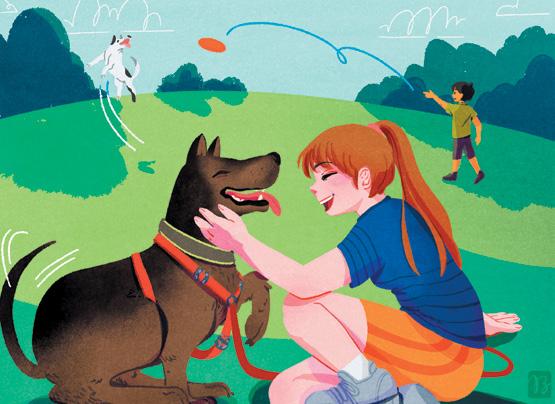
WE GOT OUR FIRST DOG when my oldest son was 10. A friend who was a teacher told me that was a perfect age for a kid to have a pet. “Jake can throw his arms around the dog when he doesn’t feel comfortable hugging you anymore,” he said.
It took a bit for me to get over his reminder that my child was growing up, but I immediately recognized my friend’s insight. A beloved animal can make everything seem better. And most of us believe strongly that our pets make us healthier.
Yet the science of human-animal interaction has found mixed results when it comes to physical and psychological health benefits from pets. Depending on the study, for example, people with pets are either less or more likely to be depressed. Experts say this seesawing probably happens because, for some owners, pets serve as a calming influence and emotional support. But in other cases, the study may include more people who are already struggling mentally and get pets to try to feel better; then such participants are counted as depressed.
Owning a dog has consistently been associated with higher levels of physical activity, no doubt because of all that walking, which has social benefits, too. One of the very first studies in the field, published in 1980, found that people who had been hospitalized for a heart attack or coronary artery disease were more likely to survive the following year if they had a pet, and the researchers suspected that physical activity from walking dogs was partly responsible, although the results held for other kinds of pets, too. A 2019 analysis of several studies, published in

Dit verhaal komt uit de October 2025-editie van Scientific American.
Abonneer u op Magzter GOLD voor toegang tot duizenden zorgvuldig samengestelde premiumverhalen en meer dan 9000 tijdschriften en kranten.
Bent u al abonnee? Aanmelden
MEER VERHALEN VAN Scientific American

Scientific American
Let There Be Weapons
The Department of Energy’s new Genesis Mission promises AI-accelerated discovery. Seven of its first 26 challenges focus on nuclear weapons and national security

4 mins
July/August 2026

Scientific American
How to Fix Science
The federal funding system for scientific research in the U.S. needs reform
9 mins
July/August 2026

Scientific American
Robots Can Now Fold Your Laundry
Home-helper tasks are becoming easier for robotic assistants
4 mins
July/August 2026

Scientific American
50, 100 & 150 Years
NATURAL FISSION REACTOR
3 mins
July/August 2026

Scientific American
Anna Ho
Describing the characteristics of short-lived astrophysical events
1 mins
July/August 2026
Scientific American
THE SOLILOQUY OF SCHRÖDINGER'S CAT
A MEDITATION ON LIFE AND THE VON NEUMANN–WIGNER INTERPRETATION OF QUANTUM MECHANICS
1 min
July/August 2026

Scientific American
Mikhail Kolmogorov
Developing software to reveal large genetic changes that lead to cancer
1 mins
July/August 2026

Scientific American
Jaye Gardiner
Learning how the matrix around cells and tissues impacts cancers
1 mins
July/August 2026

Scientific American
Timnit Gebru
On safeguarding independent research in the age of big tech
3 mins
July/August 2026

Scientific American
A Youthful Illusion Sharpens Memory
By making people feel as if their face is a younger version of itself, researchers can bring childhood memories into sharper focus
4 mins
July/August 2026
Listen
Translate
Change font size