Denemek ALTIN - Özgür
MIND THE TRADE-OFF
Down To Earth
|June 16, 2025
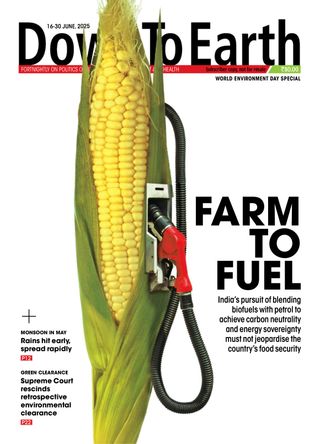
In times of climate change, a careful roadmap must be drawn to plan how much of food crops can be diverted to fuel production
-

SINCE THE start of the ethanol-blending programme, raw material availability has been a constant constraint. This has led to a series of knee jerk policy shifts, creating disruptions in agricultural markets and uncertainty among farmers and ethanol distilleries.
India allows production of ethanol from three food crops—rice, sugarcane and maize. Distilleries procure these feedstocks from different sources: surplus rice from Food Corporation of India (FCI), and broken and damaged rice from open market; sugarcane from the sugar industry; and maize from both open market and supplies from the National Agricultural Cooperative Marketing Federation (NAFED). But this does not mean a steady supply for distilleries.
Take the case of rice. In September 2022, the government imposed restrictions on the export of broken rice, except basmati. The ban came amid concerns of poor rice yield due to below-normal monsoon rains during the kharif season. However, industry insiders tell DTE that the real reason was the diversion of rice towards ethanol production. According to data provided by Union Ministry of Consumer Affairs, Food and Public Distribution, the allocation of FCI rice for ethanol drastically increased in 2021-22 to 1.38 million tonnes, compared to 0.08 million tonnes in 2020-21. Analysis of media reports suggest that once the government realised that the rice production was low, it placed restrictions on its exports, affecting India’s trade and export market. Then in July 2023, FCI abruptly stopped selling rice to ethanol plants, fearing food insecurity. This led to grain-based distilleries incurring losses.

Bu hikaye Down To Earth dergisinin June 16, 2025 baskısından alınmıştır.
Binlerce özenle seçilmiş premium hikayeye ve 9.000'den fazla dergi ve gazeteye erişmek için Magzter GOLD'a abone olun.
Zaten abone misiniz? Oturum aç
Down To Earth'den DAHA FAZLA HİKAYE

Down To Earth
MAJESTIC SARUS STAGES COMEBACK
Involvement of farmers in conservation helps the sarus crane population soar in eastern Uttar Pradesh over the past decade

5 mins
June 16, 2026

Down To Earth
Global resistance to AI data centres hardens
India must learn how to regulate environmentally disastrous data centres that guzzle more water and power than entire nations
4 mins
June 16, 2026

Down To Earth
SUMMER SMOG
Ground-level ozone is one of the national capital's least appreciated public health threat
1 mins
June 16, 2026

Down To Earth
A FOREST IN WAIT
For five decades, Abujhmad in Chhattisgarh was closed to the country. Now, as the region opens up, ANIL ASHWANI SHARMA travels to villages in its dense forests to see how isolation has impacted the people and development
6 mins
June 16, 2026

Down To Earth
DON'T WASTE THE FUTURE
Policymakers may need to focus less on expanding programmes and more on improving their effectiveness and reach, suggests the latest NFHS-6 data
3 mins
June 16, 2026
Down To Earth
NEED A FOREST TRIBUNAL
A tribunal will provide people a dedicated independent forum where they will have a statutory right to approach
2 mins
June 16, 2026
Down To Earth
Moment or movement
ONE DEFINITION of the word metamorphosis in the dictionary is “a striking alteration in appearance, character, or circumstances”.
2 mins
June 16, 2026

Down To Earth
El Niño, amplified
As a possible super El Niño looms in 2026, scientists warn of devastations that may extend into 2027
6 mins
June 16, 2026

Down To Earth
A mindless denial
District level bodies are increasingly refusing tribal population's rights over resources guaranteed by the forest rights Act
5 mins
June 16, 2026

Down To Earth
TOOR TOUR
What makes pigeon pea so ubiquitous across cuisines in India
4 mins
June 16, 2026
Listen
Translate
Change font size