
Passez à l'illimité avec Magzter GOLD
Obtenez un accès illimité à plus de 9 000 magazines, journaux et articles Premium pour seulement
Essayer OR - Gratuit
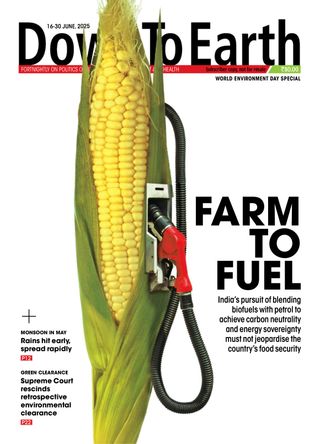
MIND THE TRADE-OFF
Down To Earth
|June 16, 2025
In times of climate change, a careful roadmap must be drawn to plan how much of food crops can be diverted to fuel production
-

SINCE THE start of the ethanol-blending programme, raw material availability has been a constant constraint. This has led to a series of knee jerk policy shifts, creating disruptions in agricultural markets and uncertainty among farmers and ethanol distilleries.
India allows production of ethanol from three food crops—rice, sugarcane and maize. Distilleries procure these feedstocks from different sources: surplus rice from Food Corporation of India (FCI), and broken and damaged rice from open market; sugarcane from the sugar industry; and maize from both open market and supplies from the National Agricultural Cooperative Marketing Federation (NAFED). But this does not mean a steady supply for distilleries.
Take the case of rice. In September 2022, the government imposed restrictions on the export of broken rice, except basmati. The ban came amid concerns of poor rice yield due to below-normal monsoon rains during the kharif season. However, industry insiders tell DTE that the real reason was the diversion of rice towards ethanol production. According to data provided by Union Ministry of Consumer Affairs, Food and Public Distribution, the allocation of FCI rice for ethanol drastically increased in 2021-22 to 1.38 million tonnes, compared to 0.08 million tonnes in 2020-21. Analysis of media reports suggest that once the government realised that the rice production was low, it placed restrictions on its exports, affecting India’s trade and export market. Then in July 2023, FCI abruptly stopped selling rice to ethanol plants, fearing food insecurity. This led to grain-based distilleries incurring losses.

Cette histoire est tirée de l'édition June 16, 2025 de Down To Earth.
Abonnez-vous à Magzter GOLD pour accéder à des milliers d'histoires premium sélectionnées et à plus de 9 000 magazines et journaux.
Déjà abonné ? Se connecter
PLUS D'HISTOIRES DE Down To Earth

Down To Earth
Bitter pill
THE WEB SERIES PHARMA EXPOSES HARSH TRUTHS OF THE PHARMACEUTICAL INDUSTRY, WHERE PROFIT OFTEN BECOMES MORE IMPORTANT THAN HUMAN HEALTH

3 mins
January 16, 2026

Down To Earth
CHAOS IN-DEFINITION
The Aravallis are perhaps India's most litigated hill range. More than 4,000 court cases have failed to arrest their destruction. The latest dispute concerns a narrow legal definition of this geological antiquity, much of which has been obliterated by mining and urban sprawl. While the Supreme Court has stayed its own judgement accepting that definition, it must see the underlying reality and help reconcile development and national security with conservation.
19 mins
January 16, 2026

Down To Earth
BITS: INDIA
Indore has recorded 16 deaths and more than 1,600 hospitalisations between December 24 and January 6.
1 min
January 16, 2026

Down To Earth
GUARANTEE EXPIRES
India's rural employment guarantee law is replaced with a centrally controlled, budget-capped scheme. Is this an attack on the right to work?
3 mins
January 16, 2026

Down To Earth
BLOOM OR BANE
Surge of vibrant pink water lilies in Kuttanad, Kerala, provides socio-economic benefits, but the plant's ecological impacts must be understood
4 mins
January 16, 2026

Down To Earth
INVISIBLE EMPLOYER
Field and academic evidence shows sharp falls in casual agricultural employment at places where groundwater access declines
3 mins
January 16, 2026

Down To Earth
Schemed for erasure
Does the VB-G RAMG Act address structural weaknesses long observed in MGNREGA's implementation?
10 mins
January 16, 2026

Down To Earth
School of change
An open school in Panagar, Madhya Pradesh, aims to protect children of tribal settlements from falling into the trap of addiction
2 mins
January 16, 2026

Down To Earth
PULSE OF RESILIENCE
As a climate-ready crop, cowpea shows potential for widespread use in India
3 mins
January 16, 2026
Down To Earth
BITS GLOBAL
Britain recorded its hottest and sunniest year ever in 2025, the country's meteorological office said on January 2.
1 min
January 16, 2026
Listen
Translate
Change font size