Poging GOUD - Vrij
MIND THE TRADE-OFF
Down To Earth
|June 16, 2025
In times of climate change, a careful roadmap must be drawn to plan how much of food crops can be diverted to fuel production
-

SINCE THE start of the ethanol-blending programme, raw material availability has been a constant constraint. This has led to a series of knee jerk policy shifts, creating disruptions in agricultural markets and uncertainty among farmers and ethanol distilleries.
India allows production of ethanol from three food crops—rice, sugarcane and maize. Distilleries procure these feedstocks from different sources: surplus rice from Food Corporation of India (FCI), and broken and damaged rice from open market; sugarcane from the sugar industry; and maize from both open market and supplies from the National Agricultural Cooperative Marketing Federation (NAFED). But this does not mean a steady supply for distilleries.
Take the case of rice. In September 2022, the government imposed restrictions on the export of broken rice, except basmati. The ban came amid concerns of poor rice yield due to below-normal monsoon rains during the kharif season. However, industry insiders tell DTE that the real reason was the diversion of rice towards ethanol production. According to data provided by Union Ministry of Consumer Affairs, Food and Public Distribution, the allocation of FCI rice for ethanol drastically increased in 2021-22 to 1.38 million tonnes, compared to 0.08 million tonnes in 2020-21. Analysis of media reports suggest that once the government realised that the rice production was low, it placed restrictions on its exports, affecting India’s trade and export market. Then in July 2023, FCI abruptly stopped selling rice to ethanol plants, fearing food insecurity. This led to grain-based distilleries incurring losses.
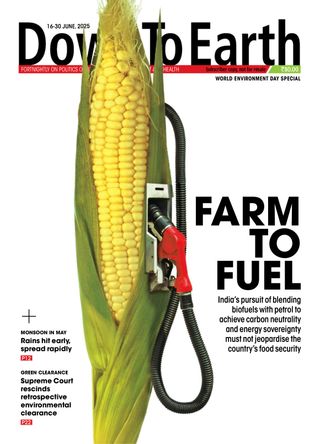

Dit verhaal komt uit de June 16, 2025-editie van Down To Earth.
Abonneer u op Magzter GOLD voor toegang tot duizenden zorgvuldig samengestelde premiumverhalen en meer dan 9000 tijdschriften en kranten.
Bent u al abonnee? Aanmelden
MEER VERHALEN VAN Down To Earth

Down To Earth
BEYOND COLLATERAL DAMAGE
Recent geopolitical conflicts are urging a reconsideration of what constitutes environmental harm in war and the limits of existing legal frameworks

3 mins
April 01, 2026

Down To Earth
Masterstroke
Residents of a small Kerala town reject an inadequate state-led development blueprint and create their own master plan that prioritises protection of historic water systems and urban commons
4 mins
April 01, 2026

Down To Earth
Rethinking E20
It is pertinent to explore potential of ethanol as high-value industrial feedstock
4 mins
April 01, 2026
Down To Earth
Food in the age of climate change
WHEN WE eat, we contribute to climate change. But food is also about livelihoods, about nutrition and about nature.
3 mins
April 01, 2026

Down To Earth
FADING WINTER
India's winters are warming, becoming shorter, shifting and spilling beyond their traditional bounds. The consequences are already evident in meltwater availability, forest-fire intensity and changes in flowering cycles and insect behaviour.
20 mins
April 01, 2026
Down To Earth
War on Iran strikes India's pharmaceuticals sector
Shortages of critical raw materials and rising input costs for the drug industry will have global consequences
4 mins
April 01, 2026

Down To Earth
POWER IN AN AGE OF INSECURITY
Energy transition is no longer solely about emission reduction but also about energy security
3 mins
April 01, 2026
Down To Earth
Re-discovery of fuelwood
THE WEST Asia conflict has made visible a multi-billion dollar energy market in India.
2 mins
April 01, 2026

Down To Earth
A CASE THAT RESHAPED INDIA'S ENVIRONMENT
The case of MC Mehta v Union of India stands as proof that a proactive judiciary can accelerate action even when the executive drags its feet
4 mins
April 01, 2026
Down To Earth
FOREVER DEPENDENT
India depends on global fertiliser supply chains for 70 per cent of its needs, leaving its food security exposed to geopolitical disruptions
6 mins
April 01, 2026
Listen
Translate
Change font size