
Magzter GOLD ile Sınırsız Olun
Sadece 9.000'den fazla dergi, gazete ve Premium hikayeye sınırsız erişim elde edin
Denemek ALTIN - Özgür
An Island Mystery
BBC History Magazine
|April 2022
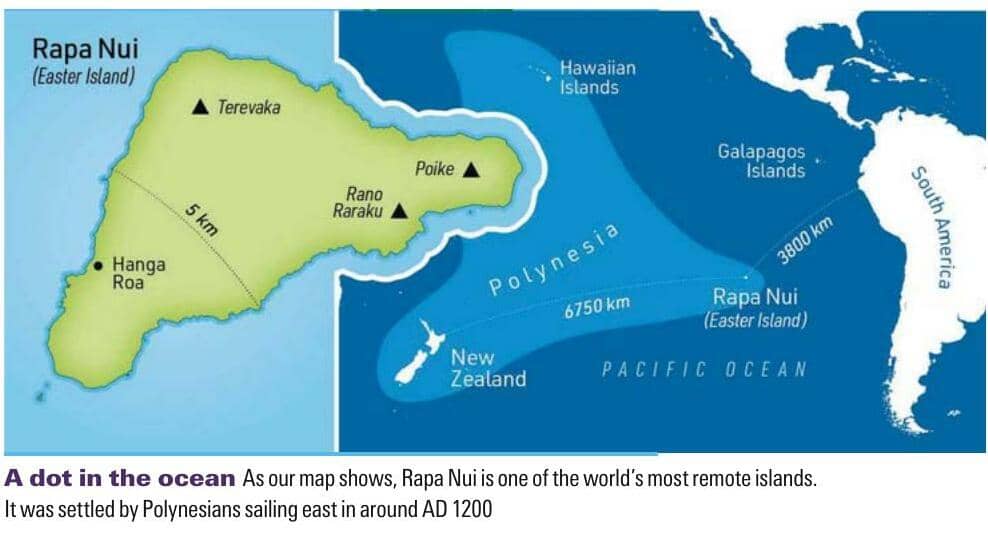
Three centuries ago, when European explorers first sighted the Pacific island of Rapa Nui, it was home to a thriving population and hundreds of haunting moai statues. But, within a few generations, the landscape was decimated and its population in sharp decline. So what happened? Cat Jarman untangles

On Easter Sunday 1722, the Dutch explorer Jacob Roggeveen sighted a small, largely treeless island on his journey across the Pacific Ocean. It was located almost 2,000 miles from South America, the nearest continent, and more than 1,200 miles from the nearest island; it was one of the most remote and isolated locations in the world. Roggeveen's crew rejoiced, and he gave to the land the name Paásch Eyland (Easter Island], because it was discovered by us on Easter Day.
Yet despite its remoteness, the sailor soon discovered that the island was already home to a population of settlers, who had arrived there centuries earlier: “We saw smoke rising in several places,” Roggeveen reported, “from which we concluded that there were people dwelling on the same.” Those people had named their home Te Pito o te Henua - the navel of the world - or, more commonly, Rapa Nui. The Dutch explorers estimated that the population, known as the Rapanui, numbered around 3,000, and described it as “healthy.
In 1774 Captian Cook also visited the island, while searching for a new continent in the frigid waters of the southern Pacific. After two months at sea, his crew were exhausted and debilitated by scurvy, and in desperate need of provisions. They headed to Rapa Nui but were surprised by what they found: a barren island with neither wood nor much fresh water on its roughly 164 sq km. Nature,” Cook noted, “has been exceedingly sparing of her favors to the spot.”

Bu hikaye BBC History Magazine dergisinin April 2022 baskısından alınmıştır.
Binlerce özenle seçilmiş premium hikayeye ve 9.000'den fazla dergi ve gazeteye erişmek için Magzter GOLD'a abone olun.
Zaten abone misiniz? Oturum aç
BBC History Magazine'den DAHA FAZLA HİKAYE
History Extra
Going for gold
PATRICIA FARA recommends a globetrotting, time-travelling account of the roots of chemistry

2 mins
May 2026

History Extra
Viking revenge
JAMES OSBORNE indulges his love of Norse history in a role-playing game that scores high on the visuals but only skates over the underlying history
1 mins
May 2026

History Extra
Siena in five places
One of Tuscany's most magical hilltop cities is a medieval marvel of civic pride.
3 mins
May 2026
History Extra
The great survivor
When Elizabeth II ascended the throne in 1952, she could barely have conceived the currents - imperial retreat, multiculturalism, de-industrialiation – that would transform the nation during her reign. On the centenary of the Queen's birth, David Cannadine explores how she navigated seven decades of dizzying change
10 mins
May 2026

History Extra
Georgian Chocolate Tart
ELEANOR BARNETT serves up a rich chocolate tart that was once fit for a recovering king
2 mins
May 2026
History Extra
Capital ideas
A Kingdom and a Village: A One -Thousand-Year History of Moscow
1 mins
May 2026
History Extra
War report
SAM WILLIS enjoys a richly detailed and entertaining account of Admiral Horatio Nelson's greatest victory and its complicated aftermath
2 mins
May 2026
History Extra
The Peasants Revolt erupts
Popular anger at rising living costs shakes feudal England to its core
1 mins
May 2026
History Extra
Tales of coexistence
HEATHER J SHARKEY is impressed by a sweeping yet nuanced book challenging the idea that Jews and Muslims have been locked in a perpetual state of war
2 mins
May 2026

History Extra
"Narratives of victimhood, resistance and sacrifice are core to the Iranian regime's identity"
Revolution, repression and recurring crisis have shaped Iran's recent past – and continue to define its volatile present
10 mins
May 2026
Translate
Change font size