Poging GOUD - Vrij
An Island Mystery
BBC History Magazine
|April 2022
Three centuries ago, when European explorers first sighted the Pacific island of Rapa Nui, it was home to a thriving population and hundreds of haunting moai statues. But, within a few generations, the landscape was decimated and its population in sharp decline. So what happened? Cat Jarman untangles

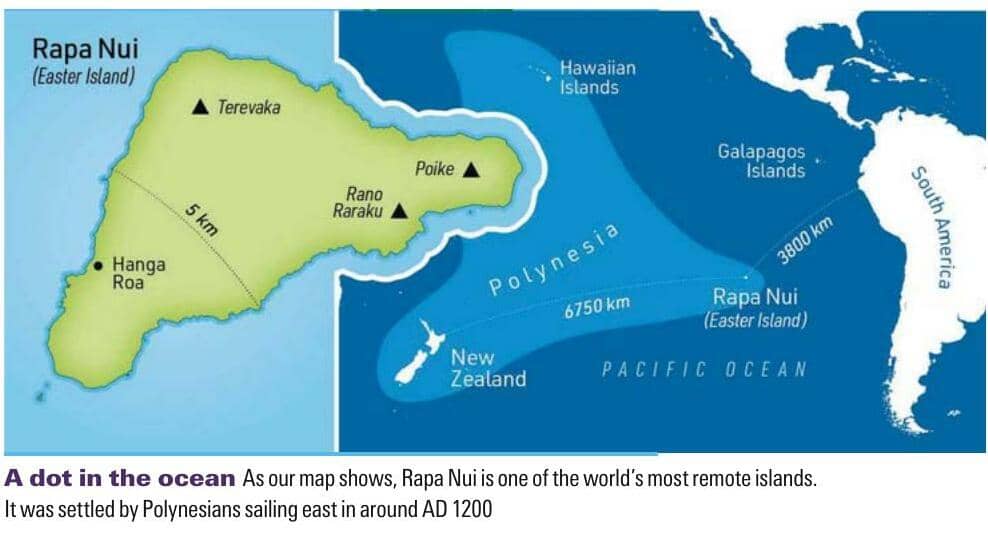
On Easter Sunday 1722, the Dutch explorer Jacob Roggeveen sighted a small, largely treeless island on his journey across the Pacific Ocean. It was located almost 2,000 miles from South America, the nearest continent, and more than 1,200 miles from the nearest island; it was one of the most remote and isolated locations in the world. Roggeveen's crew rejoiced, and he gave to the land the name Paásch Eyland (Easter Island], because it was discovered by us on Easter Day.
Yet despite its remoteness, the sailor soon discovered that the island was already home to a population of settlers, who had arrived there centuries earlier: “We saw smoke rising in several places,” Roggeveen reported, “from which we concluded that there were people dwelling on the same.” Those people had named their home Te Pito o te Henua - the navel of the world - or, more commonly, Rapa Nui. The Dutch explorers estimated that the population, known as the Rapanui, numbered around 3,000, and described it as “healthy.
In 1774 Captian Cook also visited the island, while searching for a new continent in the frigid waters of the southern Pacific. After two months at sea, his crew were exhausted and debilitated by scurvy, and in desperate need of provisions. They headed to Rapa Nui but were surprised by what they found: a barren island with neither wood nor much fresh water on its roughly 164 sq km. Nature,” Cook noted, “has been exceedingly sparing of her favors to the spot.”
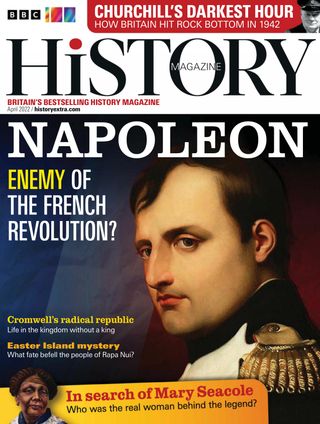

Dit verhaal komt uit de April 2022-editie van BBC History Magazine.
Abonneer u op Magzter GOLD voor toegang tot duizenden zorgvuldig samengestelde premiumverhalen en meer dan 9000 tijdschriften en kranten.
Bent u al abonnee? Aanmelden
MEER VERHALEN VAN BBC History Magazine

BBC History UK
On the skids
Richard Rodgers and Oscar Hammerstein II's smash musical Oklahoma! opened on Broadway on 31 March 1943.

1 min
Christmas 2025

BBC History UK
Small pleasures
Memory is imperfect, but what if you could get a professional model maker to recreate a moment from the past?
1 min
Christmas 2025

BBC History UK
Bath in five places
In the Georgian era, Bath became arguably Britain's most fashionable destination. KIRSTEN ELLIOTT promenades five historic highlights
3 mins
Christmas 2025
BBC History UK
End times
Why do civilisations that dominated their epoch fail? In an era of autocracy, climate change, the rise of Al and a first-hand understanding of how deadly pandemics can be, it's a question that seems pertinent.
1 min
Christmas 2025
BBC History UK
What are the origins of the Yule Lads?
To learn about the Jólasveinar (Yule Lads), we must start with their mother, the terrifying ogress Grýla. Her name appeared in Icelandic texts as early as the 13th century, although it wasn’t until later that those 13 mischievous lads became associated with her. Folk tales and poems tell how she descends from the mountains with an empty sack to stuff full of children. Grýla owns the monstrous Jólaköttur (Yule Cat), which roams the countryside on Christmas Eve, searching for children to gobble up if they're not wearing new clothes.
1 mins
Christmas 2025

BBC History UK
Santa Claus v Father Christmas
The true identity of the white-bearded, red-robed figure who fills children's stockings at Christmas has long been debated. Thomas Ruys Smith sizes up the merry contenders
8 mins
Christmas 2025

BBC History UK
Frontier friction
Set in Washington Territory in 1854, The Abandons is a Western that's unusual for having two matriarchs, women whose lives become entangled, at its centre.
1 min
Christmas 2025

BBC History UK
The Last Days of Pompeii: The Immersive Experience
Delve into the culture of daily Roman life, witness the momentous eruption of Mount Vesuvius, and follow its fallout in Immerse LDN's new exhibition. In a blend of cutting-edge technology and vivid storytelling, this exhibition launches visitors into Pompeii's rich history with recreations of the ancient city's beautiful pre-eruption landscape, a 360-degree virtual reality Roman amphitheatre experience, and a digital metaverse recreating Pompeii's 'Villa of Mysteries'.
1 min
Christmas 2025

BBC History UK
Elizabeth Marsh The corsair's captive
Taken hostage by a Barbary ship's captain in the 18th century, a young Englishwoman found herself fighting for her freedom in Marrakech. ADAM NICHOLS introduces a brave captive who later wrote a book about her dramatic experiences
6 mins
Christmas 2025
BBC History UK
29 DECEMBER 1170: Thomas Becket is murdered in Canterbury
Knights loyal to Henry II rid him of the “low-born cleric”
2 mins
Christmas 2025
Translate
Change font size