Try GOLD - Free
The Evolution of PostgreSQL in the Age of AI
Open Source For You
|August 2025
PostgreSQL, enhanced with the pgvector extension, brings semantic search capabilities into a traditional SQL environment. With support for both structured queries and Al-driven search, pgvector enables developers to build intelligent, cost-effective applications within a familiar ecosystem, positioning PostgreSQL as a future-ready, Al-native database. Let's learn more....
Traditional SQL is excellent for exact matches and structured querying.
But in an age of language models, recommendation engines, and semantic search, we need databases that can answer questions like: “Show me documents similar in meaning to this query, not just those with exact words.” This is where vector similarity search shines—mapping unstructured content like text, images, and code into multidimensional embeddings and comparing them using mathematical distance metrics.
As AI becomes more deeply integrated into our digital systems, there’s a growing need to store and search not just exact matches, but meaningful, semantic information. Vector embeddings come into play here. A vector embedding is a numeric representation of text, images, or even user behaviour. It captures the semantic meaning in a high-dimensional space.
Imagine you walk into an ice cream shop and tell the server: “I want something cold, sweet, and fruity.” Now, how can the computer understand what ‘cold’, ‘sweet’, or ‘fruity’ means? It converts that sentence into a vector like:
[0.8, 0.6, 0.1, 0.0, 0.7, 0.3, ...] (a list of numbers)
Each number in this list has some meaning — like ‘fruitiness’, ‘coldness’, ‘creaminess’, etc. Then, it compares this vector to the fingerprints of all ice creams it knows and recommends the closest match! These vectors are used to power recommendations, chatbots, anomaly detection, and more. Traditionally, we relied on search indices, relational joins, or keyword match. But they fall short in answering questions like:
“What items are similar in meaning to this one?”
“Which users behave similarly to this one?”
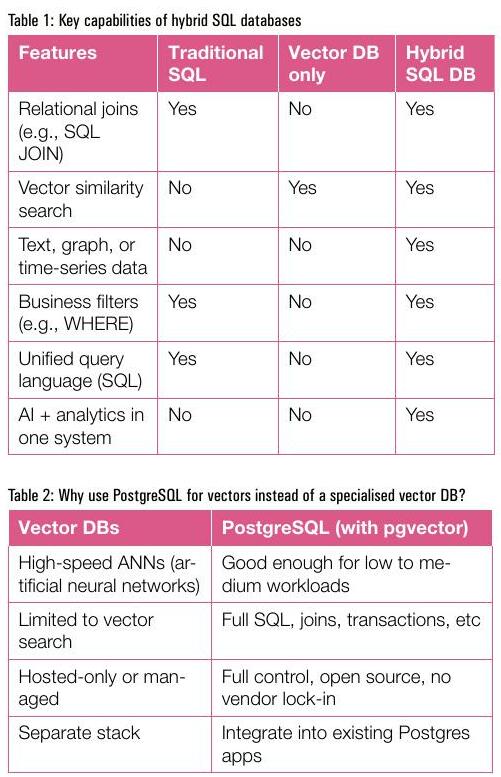 What is a hybrid SQL database and why do we need it?

This story is from the August 2025 edition of Open Source For You.
Subscribe to Magzter GOLD to access thousands of curated premium stories, and 10,000+ magazines and newspapers.
Already a subscriber? Sign In
MORE STORIES FROM Open Source For You

Open Source For You
Apache Paimon: Lakehouse Storage for Real-Time Analytics
Apache Paimon brings a streaming-first approach to lakehouse storage, making it ideal for real-time analytics and evolving data workloads.

2 mins
July 2026
Open Source For You
How Zero-Knowledge Proofs Enhance Privacy in Blockchains
Zero-Knowledge Proofs address a fundamental challenge that has existed since the birth of public blockchains: how can a decentralised network verify that the rules are being followed, without making all data public?
10 mins
July 2026

Open Source For You
Building Trust and Adoption Through Compliance in Open Source
Open source projects that adopt compliance as a core tenet lay the foundation for long-term success.
3 mins
July 2026

Open Source For You
The Necessity of Observability for AI and LLM Applications
Open source tools are allowing teams to build observability into AI and LLM applications without surrendering control of sensitive prompts, outputs, or internal workflows.
11 mins
July 2026

Open Source For You
Navigating the Security Paradox of IT/OT Convergence
With physical systems no longer isolated from the digital infrastructure, organisations must adopt new ways of ensuring cybersecurity.
10 mins
July 2026

Open Source For You
Building Intelligent Retrieval Augmented AI Systems
LLMs and vector databases work together to create intelligent Al systems that understand data.
6 mins
July 2026
Open Source For You
Securing AI Agents on Linux: Understanding Nvidia OpenShell
Nvidia OpenShell is an Apache 2.0-licensed open source runtime designed to provide security, privacy, and operational guardrails for AI workloads.
3 mins
July 2026

Open Source For You
A Beginner’s Guide to Open Source Security Tools
Open source security tools are as good as their commercial counterparts, if not better.
5 mins
July 2026
Open Source For You
From Black Box to Glass Box: Observability Strategies for Production AI
Most enterprises are running AI in production without being able to see what it's doing. Open source tools like OpenTelemetry, LangFuse, Grafana and Arize Phoenix bring real observability to LLM pipelines, agents, and inference at scale.
5 mins
July 2026

Open Source For You
Observability: The Nervous System of Modern Digital Infrastructure
Observability helps turn operational data into knowledge that enables resilient, efficient, and intelligent digital systems.
9 mins
July 2026
Listen
Translate
Change font size