Intentar ORO - Gratis
The Evolution of PostgreSQL in the Age of AI
Open Source For You
|August 2025
PostgreSQL, enhanced with the pgvector extension, brings semantic search capabilities into a traditional SQL environment. With support for both structured queries and Al-driven search, pgvector enables developers to build intelligent, cost-effective applications within a familiar ecosystem, positioning PostgreSQL as a future-ready, Al-native database. Let's learn more....

Traditional SQL is excellent for exact matches and structured querying.
But in an age of language models, recommendation engines, and semantic search, we need databases that can answer questions like: “Show me documents similar in meaning to this query, not just those with exact words.” This is where vector similarity search shines—mapping unstructured content like text, images, and code into multidimensional embeddings and comparing them using mathematical distance metrics.
As AI becomes more deeply integrated into our digital systems, there’s a growing need to store and search not just exact matches, but meaningful, semantic information. Vector embeddings come into play here. A vector embedding is a numeric representation of text, images, or even user behaviour. It captures the semantic meaning in a high-dimensional space.
Imagine you walk into an ice cream shop and tell the server: “I want something cold, sweet, and fruity.” Now, how can the computer understand what ‘cold’, ‘sweet’, or ‘fruity’ means? It converts that sentence into a vector like:
[0.8, 0.6, 0.1, 0.0, 0.7, 0.3, ...] (a list of numbers)
Each number in this list has some meaning — like ‘fruitiness’, ‘coldness’, ‘creaminess’, etc. Then, it compares this vector to the fingerprints of all ice creams it knows and recommends the closest match! These vectors are used to power recommendations, chatbots, anomaly detection, and more. Traditionally, we relied on search indices, relational joins, or keyword match. But they fall short in answering questions like:
“What items are similar in meaning to this one?”
“Which users behave similarly to this one?”
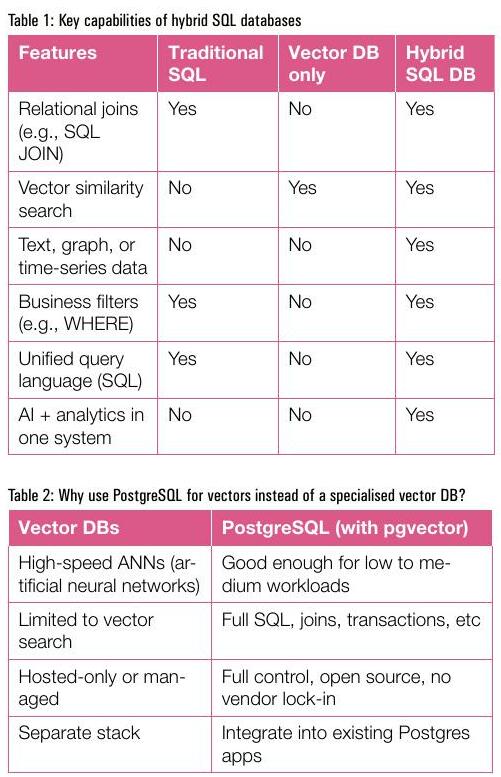 What is a hybrid SQL database and why do we need it?

Esta historia es de la edición August 2025 de Open Source For You.
Suscríbete a Magzter GOLD para acceder a miles de historias premium seleccionadas y a más de 9000 revistas y periódicos.
¿Ya eres suscriptor? Iniciar sesión
MÁS HISTORIAS DE Open Source For You

Open Source For You
Sending IoT Sensor Data to Public or Private Servers
This IoT system shows a simple and effective way to send sensor data using an ESP8266 microchip.

3 mins
March 2026

Open Source For You
Popular FOSS Tools for LLM Observability, Monitoring and Evaluation
This overview of popular tools for monitoring large language models also sheds light on how LLM-as-a-judge enhances their performance.
2 mins
March 2026
Open Source For You
Data Deduplication Done the Right Way
Deduplication helps to save space on Linux-based storage systems. Choose the right platform and check whether it meets your goals.
6 mins
March 2026

Open Source For You
The Relevance of Rubber Duck Debugging in the Age of AI
Discover why rubber duck debugging is a powerful process today. There's also a step-by-step guide on how to use it in the age of artificial intelligence.
4 mins
March 2026

Open Source For You
GitHub weighs turning off pull requests as AĬ slop floods projects
GitHub has formally acknowledged that AI-generated 'slop' is overwhelming open source projects, forcing maintainers to sift through poor pull requests (PRS), abandoned submissions and guideline violations - and is now considering restricting or even disabling pull requests, the core mechanism of open collaboration.
1 min
March 2026

Open Source For You
Global banks are deploying Ethereum's Layer-2 stack
Banks are standardising on Ethereum's open source stack as production financial infrastructure, shifting from experimental pilots and proprietary blockchains to live Layer-2 networks for tokenised deposits, interbank payments, and cross-border settlement.
1 min
March 2026

Open Source For You
OpenClaw's creator joins OpenAl
In a move that reinforces its commitment to open development rather than acquisition, OpenAI has brought Peter Steinberger, founder of OpenClaw, into the company while placing the popular AI agent under a foundation structure to ensure it remains open source.
1 min
March 2026
Open Source For You
LibreOffice 26.2 comes with native Markdown support
LibreOffice 26.2 has been released by The Document Foundation, strengthening its position as a fully free and open source office suite for Windows, macOS, and Linux, with support for more than 120 languages.
1 min
March 2026

Open Source For You
Indian government mandates labelling of Al-generated content and quicker deletion of illegal deepfakes
India has introduced sweeping AI content rules that immediately place pressure on social platforms and open source AI ecosystems to label, trace and rapidly remove AI Open ource synthetic media at scale.
1 min
March 2026
Open Source For You
I2C and I3C: How Modern Devices Communicate
I3C and I2C are both two-wire communication protocols that help exchange data between multiple devices. While I3C preserves the simplicity of I2C, it introduces new features suited for today's sensor-rich devices.
8 mins
March 2026
Listen
Translate
Change font size