Try GOLD - Free
SUPERIOR MOTION SENSOR Using Microwave Doppler Radar
Electronics For You
|December 2025
An earlier design introduced a touch solid-state AC switch. The new version advances this concept with a sophisticated human radar sensing system that can also be configured for IoT and smart automation. The system uses 70 per cent Indian components and is entirely Indian-engineered. At its core lies a microwave doppler radar sensor that detects human motion with far greater reliability than traditional PIR or IR-based systems. Unlike PIR sensors that depend on heat signatures and often malfunction under sunlight, near heaters, or behind curtains, the microwave radar delivers superior penetration through nonmetallic barriers, immunity to heat-induced false triggers, reduced sensitivity to small animals, and omnidirectional detection without requiring a direct line of sight.
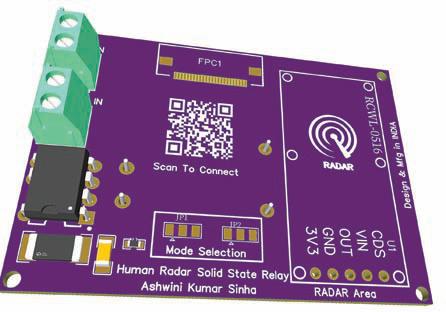
Where most motion switches rely on PIR sensors and frequently cause false triggers, this radar-based system eliminates such issues. It also integrates an LDR to function only under low-light or nighttime conditions, making it ideal for automated lighting systems.
The components for the system have been selected such that Indian substitutes are available wherever possible, enabling over 70 per cent localisation in the design. Table 1 lists the Bill of Materials, including part names, numbers, manufacturers, and Indian substitute options where applicable.
Design
In this upgraded version, the separate optocoupler and triac ICs have been replaced with a single integrated optotriac that combines both functions. This component, sourced from an Indian manufacturer, can directly drive AC loads up to 1A RMS across the 110-230V range, as specified in the VO2223A datasheet.
This capability enables automatic control of standard LED and CFL bulbs used in residential and commercial environments. An FPC connector allows interfacing with development boards, including the IndusBoard Coin, extending functionality for IoT-based human radar sensing or solid-state relay applications.
This single compact design supports multiple modes of operation, allowing configuration for standalone use or full IoT integration.
The RCWL microwave Doppler radar detects human presence using the Doppler effect. An optional LDR input allows night-only operation, keeping lights off during the day and automatically activating them at night when motion is detected.
According to the optotriac datasheet (refer Fig. 2), the triac can directly drive an AC bulb via pins 8 and 6. A snubber circuit may be added for inductive loads. Fig. 2 presents the VO2223A configuration circuit.
The design includes an FPC connector for IoT board integration and can be configured in four modes: Mode 1, Mode 2, Mode 3, and Mode 4.


This story is from the December 2025 edition of Electronics For You.
Subscribe to Magzter GOLD to access thousands of curated premium stories, and 10,000+ magazines and newspapers.
Already a subscriber? Sign In
MORE STORIES FROM Electronics For You
Electronics For You
FM RADIO RECEIVER Using TDA7000
This FM radio receiver demonstrates the practical application of RF engineering and analogue signal-processing techniques.

4 mins
July 2026
Electronics For You
Latest 3D chip stacking method could extend Moore's Law
Engineered by a team at the University of Illinois Grainger College of Engineering in Urbana-Champaign, the process uses ultrathin single-crystalline silicon nanomembranes transferred at temperatures below 200°C, avoiding heat damage to underlying circuits.
1 min
July 2026
Electronics For You
Stretchable patch detects heart failure risks
Researchers at the University of Chicago's Pritzker School of Molecular Engineering in Chicago have developed an AI-powered stretchable computing patch capable of processing health data directly on the body in milliseconds, eliminating the need for external servers or wireless connections.
1 min
July 2026
Electronics For You
Simple 12V To 24V VOLTAGE DOUBLER
Many electronic circuits require a voltage higher than that available from the power supply.
3 mins
July 2026
Electronics For You
Crystal stress method reshapes nanochip manufacturing techniques
Research conducted at Rice University in Houston, Texas, demonstrated that alpha-molybdenum trioxide crystals can deform under an electron beam, generating highly ordered nanoscale wrinkles that function as optical gratings for guiding and manipulating light on chips.
1 min
July 2026

Electronics For You
Hidden Costs In IoT PRODUCT DEVELOPMENT
Hardware mistakes do not show up early in development. The most expensive hardware mistakes are rarely the obvious ones. Decisions made during design, testing, and architecture shape costs for years.
7 mins
July 2026
Electronics For You
Temperature-Based DUAL SAFETY SYSTEM For Smart Homes
A temperature-based dual safety system addresses common household risks through intelligent control.
4 mins
July 2026

Electronics For You
Smart material developed to fight counterfeiting
Engineered by a team at the Indian Institute of Technology Guwahati, the technology uses perovskite nanocrystals with a double-layer protective coating that improves resistance to heat and chemicals while maintaining optical performance.
1 min
July 2026

Electronics For You
President Murmu inaugurates semiconductor training fab at IISc
On June 3, 2026, President Droupadi Murmu inaugurated IISc Bengaluru’s Semiconductor Training Fab at CeNSE, established with support from the Ministry of Tribal Affairs.
4 mins
July 2026

Electronics For You
Quantum Li-Fi secures networks
Research conducted in Germany by a consortium led by KEEQuant and supported by Fraunhofer IPMS highlights a pathway toward flexible, high-security next-generation wireless networks.
1 min
July 2026
Listen
Translate
Change font size