Try GOLD - Free
War's New Fuel
Scientific American
|April 2026
The Pentagon needs nuclear power. A start-up plans to harvest it from radioactive waste the U.S. leaves sitting idle
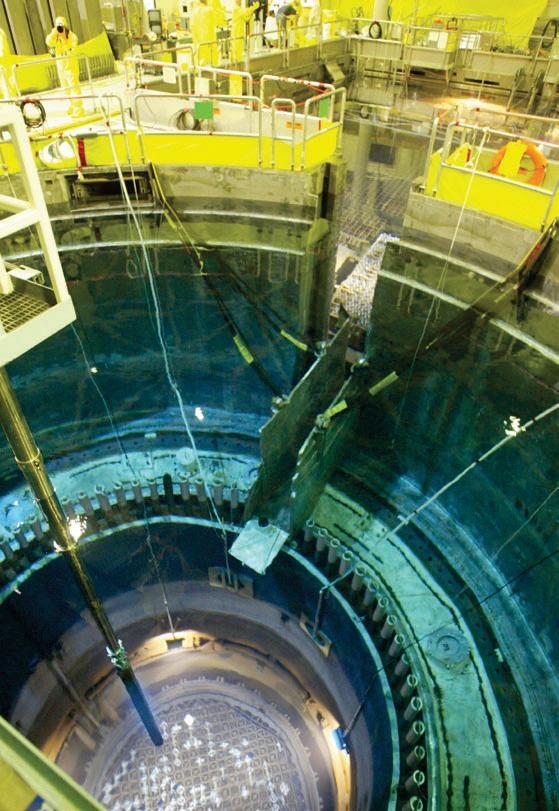
EVERY ATOM IS A COILED SOURCE OF POWER. But some atoms pack more punch than others. The radioactive elements fueling nuclear reactors can be coaxed into generating so much power that in the mid-1950s Lewis Strauss, then chair of the U.S. Atomic Energy Commission, predicted electricity would soon be “too cheap to meter.” Civilian nuclear power fell short of that utopian hype, but it succeeded in creating a lot of waste. This residue is not the glowing green sludge of popular imagination, although it is dangerous: some components of spent fuel remain thermally hot for years and radioactive for millennia.
To some countries, that pulsing energy is a potential resource. Project Omega, a Rhode Island-based start-up that emerged from stealth mode in February, wants to take that trash and make it new again.
“What we do today is take that spent fuel out of the reactor, put it into a pool of water for a few years just to let it cool down, and then put it onto a concrete pad next to the reactor,” says Stafford Sheehan, Project Omega’s founder and CEO. He wants to move the waste from the concrete pad to a bath of hot salts, extract the useful elements and feed them back into nuclear reactors—or into other technology such as long-lived sensors that power military satellites.

This story is from the April 2026 edition of Scientific American.
Subscribe to Magzter GOLD to access thousands of curated premium stories, and 10,000+ magazines and newspapers.
Already a subscriber? Sign In
MORE STORIES FROM Scientific American
Scientific American
Let There Be Weapons
The Department of Energy’s new Genesis Mission promises AI-accelerated discovery. Seven of its first 26 challenges focus on nuclear weapons and national security

4 mins
July/August 2026

Scientific American
How to Fix Science
The federal funding system for scientific research in the U.S. needs reform
9 mins
July/August 2026

Scientific American
Robots Can Now Fold Your Laundry
Home-helper tasks are becoming easier for robotic assistants
4 mins
July/August 2026

Scientific American
50, 100 & 150 Years
NATURAL FISSION REACTOR
3 mins
July/August 2026

Scientific American
Anna Ho
Describing the characteristics of short-lived astrophysical events
1 mins
July/August 2026

Scientific American
THE SOLILOQUY OF SCHRÖDINGER'S CAT
A MEDITATION ON LIFE AND THE VON NEUMANN–WIGNER INTERPRETATION OF QUANTUM MECHANICS
1 min
July/August 2026

Scientific American
Mikhail Kolmogorov
Developing software to reveal large genetic changes that lead to cancer
1 mins
July/August 2026

Scientific American
Jaye Gardiner
Learning how the matrix around cells and tissues impacts cancers
1 mins
July/August 2026

Scientific American
Timnit Gebru
On safeguarding independent research in the age of big tech
3 mins
July/August 2026

Scientific American
A Youthful Illusion Sharpens Memory
By making people feel as if their face is a younger version of itself, researchers can bring childhood memories into sharper focus
4 mins
July/August 2026
Listen
Translate
Change font size