Try GOLD - Free
The Mystery of the Vanishing Mussels
Scientific American
|May 2026
What's driving America's freshwater mussels toward extinction?
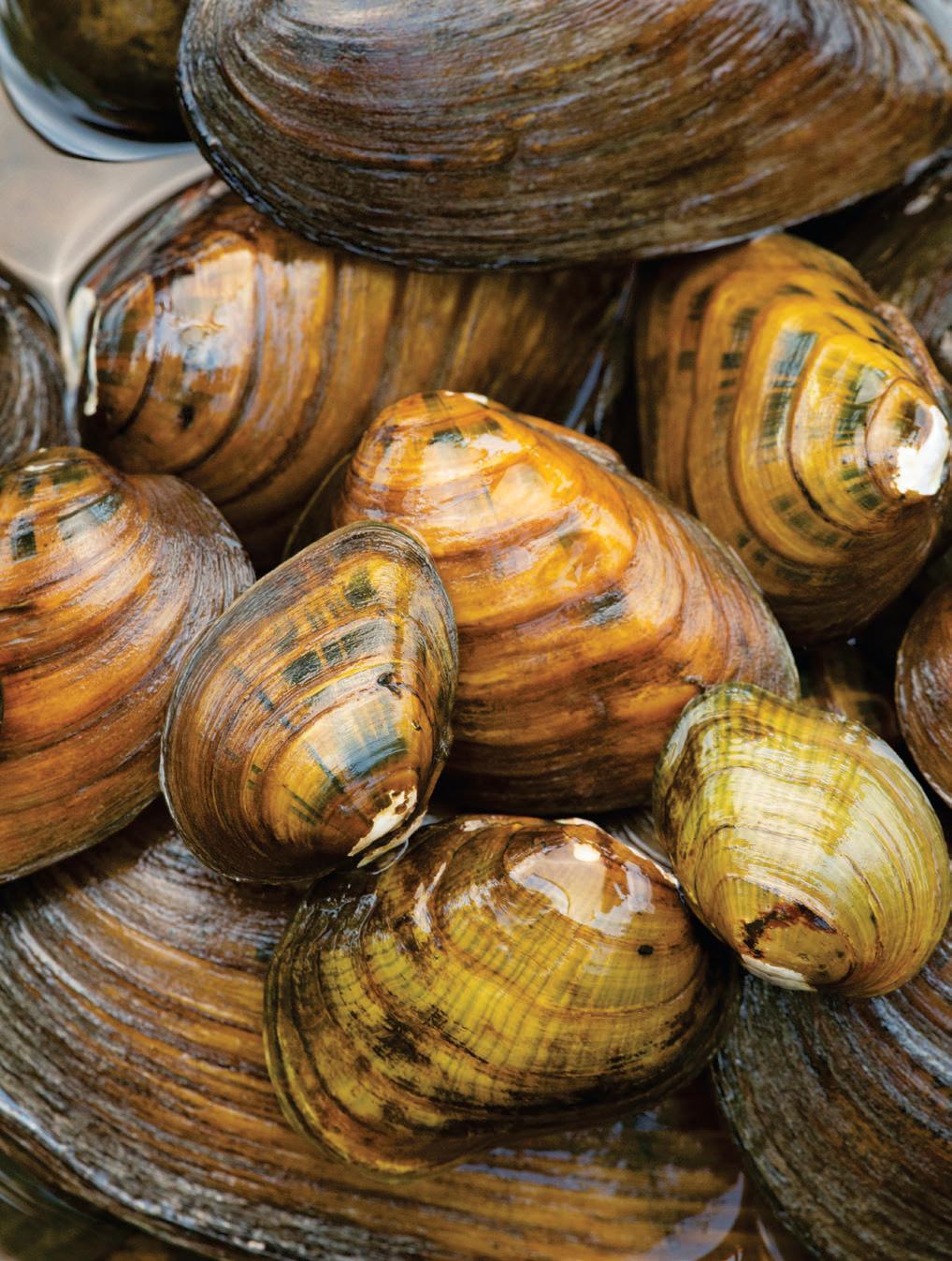
American streambeds were once paved with these beautiful burrowing creatures—300 species of them.
Some 10 percent are extinct already. Many more are endangered, including the Northern riffleshell (pale with fine green rays, at bottom) and the clubshell (with darker splotches, at middle).
THROUGH MY SWIM MASK, I could see what Wendell Haag's finger was pointing at two feet below me on the riverbed. But I couldn't immediately see that it was alive. It looked like a rock with some kind of grayish goo stuck to it. We were in the South Fork of the Kentucky River, and I was on my hands and knees with my face in the water and my backside in the air—an inelegant pose I had learned from mussel biologists such as Haag. Finally, after a long, dumb stare, I recognized the mussel. It was mostly buried, but it, too, had left its posterior exposed, and the shell was slightly agape. Draped around that dark slit were fleshy protrusions that flapped like pennants in the current. The mussel, called a pocketbook, was fishing for bass.
A bass, it seems, would mistake those protrusions for an edible minnow. It would snap at the lure, whereupon, instead of food, it would get a mouth blast of mussel larvae—thousands of bivalved vampires smaller than salt grains, some of which would immediately latch on to its gills and start feeding on its blood.


This story is from the May 2026 edition of Scientific American.
Subscribe to Magzter GOLD to access thousands of curated premium stories, and 10,000+ magazines and newspapers.
Already a subscriber? Sign In
MORE STORIES FROM Scientific American
Scientific American
Let There Be Weapons
The Department of Energy’s new Genesis Mission promises AI-accelerated discovery. Seven of its first 26 challenges focus on nuclear weapons and national security

4 mins
July/August 2026

Scientific American
How to Fix Science
The federal funding system for scientific research in the U.S. needs reform
9 mins
July/August 2026

Scientific American
Robots Can Now Fold Your Laundry
Home-helper tasks are becoming easier for robotic assistants
4 mins
July/August 2026

Scientific American
50, 100 & 150 Years
NATURAL FISSION REACTOR
3 mins
July/August 2026

Scientific American
Anna Ho
Describing the characteristics of short-lived astrophysical events
1 mins
July/August 2026
Scientific American
THE SOLILOQUY OF SCHRÖDINGER'S CAT
A MEDITATION ON LIFE AND THE VON NEUMANN–WIGNER INTERPRETATION OF QUANTUM MECHANICS
1 min
July/August 2026

Scientific American
Mikhail Kolmogorov
Developing software to reveal large genetic changes that lead to cancer
1 mins
July/August 2026

Scientific American
Jaye Gardiner
Learning how the matrix around cells and tissues impacts cancers
1 mins
July/August 2026

Scientific American
Timnit Gebru
On safeguarding independent research in the age of big tech
3 mins
July/August 2026

Scientific American
A Youthful Illusion Sharpens Memory
By making people feel as if their face is a younger version of itself, researchers can bring childhood memories into sharper focus
4 mins
July/August 2026
Listen
Translate
Change font size