Try GOLD - Free
The Business of Space Weather
Scientific American
|April 2026
A company aims to offer better forecasts based on a new solar model
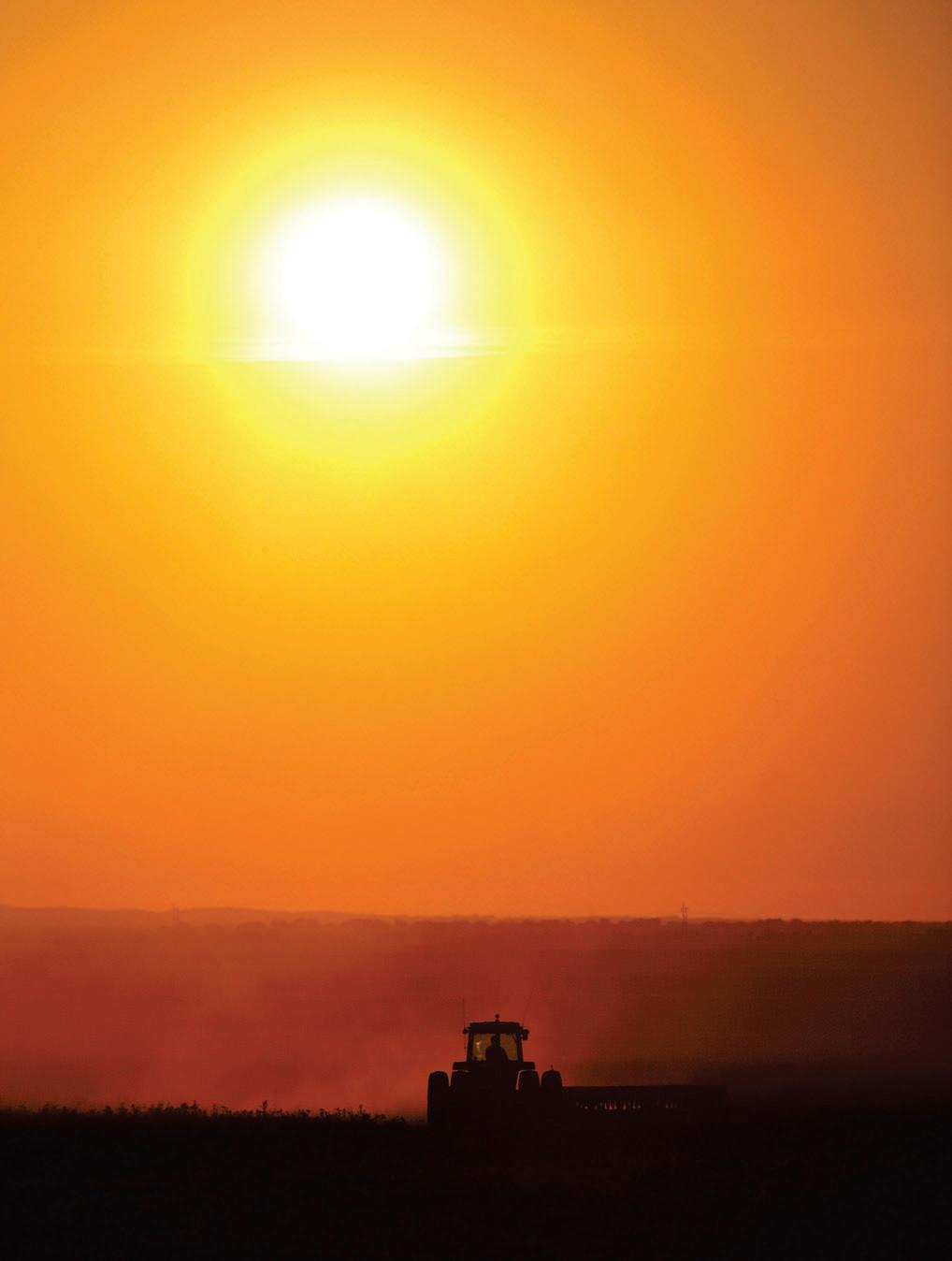
When solar storms flare up, they can scramble the GPS signals that farmers rely on to guide their high-tech tractors.
ON MAY 10, 2024, a John Deere dealer sent out a strange press release. “Please be advised that there is significant solar flare and space weather activity,” it read. The company, a maker of tractors and ball caps, isn’t the first entity you'd turn to for advice about the sun. But the star’s storms were messing with the GPS systems on John Deere’s precision agricultural equipment, which uses geographic guidance to help farmers precisely plant, spray and harvest crops. “We apologize for the inconvenience,” the press release continued, even though no one should have to apologize on behalf of space.
We tend to think of the sun in terms of its regular daily activities (rising, setting). But “solar activity” causes eruptions from the sun’s surface that release energy and charged particles into space. Those eruptions have a profound effect on terrestrial life. Solar storms produce space weather that can irradiate astronauts and people in planes, disrupt satellites' electronics and drag their orbits down, and even affect the electrical grid and cellphone coverage.
These problems are part of why scientists try to predict how active the sun will be at given times, so they can tell farmers when their tractor might drift down the wrong alfalfa row or let electric companies know when they might experience outages. There’s just one problem: we don’t really understand how the sun works in the present, let alone how it will act in the future. Still, heliophysicists, as sun scientists are called, have different, if imperfect, ways of modeling the nearest star so they can make better forecasts.

This story is from the April 2026 edition of Scientific American.
Subscribe to Magzter GOLD to access thousands of curated premium stories, and 10,000+ magazines and newspapers.
Already a subscriber? Sign In
MORE STORIES FROM Scientific American
Scientific American
Let There Be Weapons
The Department of Energy’s new Genesis Mission promises AI-accelerated discovery. Seven of its first 26 challenges focus on nuclear weapons and national security

4 mins
July/August 2026

Scientific American
How to Fix Science
The federal funding system for scientific research in the U.S. needs reform
9 mins
July/August 2026

Scientific American
Robots Can Now Fold Your Laundry
Home-helper tasks are becoming easier for robotic assistants
4 mins
July/August 2026
Scientific American
50, 100 & 150 Years
NATURAL FISSION REACTOR
3 mins
July/August 2026

Scientific American
Anna Ho
Describing the characteristics of short-lived astrophysical events
1 mins
July/August 2026
Scientific American
THE SOLILOQUY OF SCHRÖDINGER'S CAT
A MEDITATION ON LIFE AND THE VON NEUMANN–WIGNER INTERPRETATION OF QUANTUM MECHANICS
1 min
July/August 2026

Scientific American
Mikhail Kolmogorov
Developing software to reveal large genetic changes that lead to cancer
1 mins
July/August 2026

Scientific American
Jaye Gardiner
Learning how the matrix around cells and tissues impacts cancers
1 mins
July/August 2026

Scientific American
Timnit Gebru
On safeguarding independent research in the age of big tech
3 mins
July/August 2026
Scientific American
A Youthful Illusion Sharpens Memory
By making people feel as if their face is a younger version of itself, researchers can bring childhood memories into sharper focus
4 mins
July/August 2026
Listen
Translate
Change font size