
Go Unlimited with Magzter GOLD
Get unlimited access to 10,000+ magazines, newspapers and Premium stories for just
Try GOLD - Free
Strange Circles in the Sky
Scientific American
|July/August 2025
Odd radio circles are one of the weirdest recent space discoveries
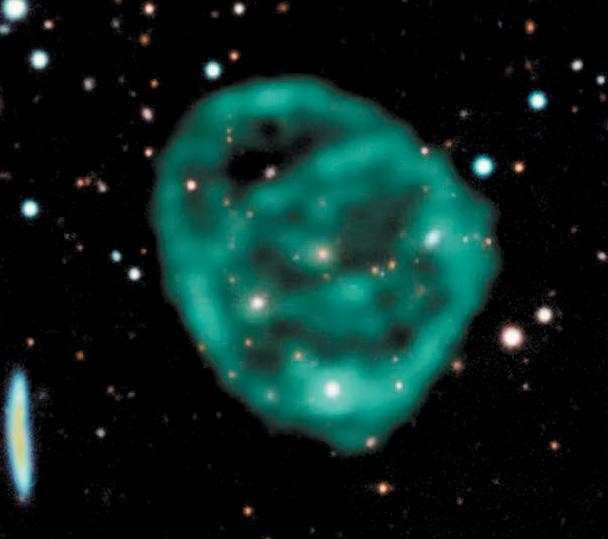
IT’S RARE THESE DAYS for astronomers to find a new class of object in the heavens. After all, we've been searching the skies for centuries, so all the easy stuff has already been found. Adding new capabilities to our searches does tend to result in new discoveries, however. Looking in different wavelengths of the electromagnetic spectrum, for example, is a good way to uncover novel things because different objects emit light in different ways.
Objects in newly discovered classes also tend to be faint because, again, bright objects will have been spotted already. This fact is why identifying something completely new is unusual. It’s also why such findings can be baffling—by definition, we’ve never seen anything like them before.
In 2019 astronomers stumbled on just such a thing when they found multiple examples of a previously unknown kind of structure. The objects turned up in a pilot survey using the at-the-time newly completed radio telescope called the Australian Square Kilometer Array Pathfinder telescope (ASKAP), a collection of 36 radio dishes, each 12 meters wide, located in Western Australia.
The newfound celestial objects were relatively big and circular—a common shape for astronomical bodies. When something out there looks circular, it’s very likely that we're actually seeing a spherical shell, like a soap bubble. Near the middle of the bubble our line of sight goes through only a small amount of material, but near the edges that path intersects more of it. If the material glows, then it will look like a circle from any viewing direction. Dying stars that are blowing off winds of gas tend to make these kinds of structures, and many examples are known.


This story is from the July/August 2025 edition of Scientific American.
Subscribe to Magzter GOLD to access thousands of curated premium stories, and 10,000+ magazines and newspapers.
Already a subscriber? Sign In
MORE STORIES FROM Scientific American

Scientific American
The Quiet Math Problem That Runs the Planet
How Diffie-Hellman key exchange secures everything from your text messages to government secrets

7 mins
May 2026

Scientific American
The Fog of Science
Did an adversary just invent a world-changing weapon, or are they making it up? DARPA is building an AI to instantly call their bluff
4 mins
May 2026
Scientific American
The Hubble Space Telescope Is Still Awesome
Hubble is going strong despite its decades in space and next-generation successors
4 mins
May 2026

Scientific American
Meet America's Native Bees
Scientists estimate there are about 4,000 species of native bees in the U.S.
5 mins
May 2026

Scientific American
The Chemistry of Desire
Inside the secretive laboratories where scientists build novel molecules to make luxury fragrance feel like pure emotion
5 mins
May 2026

Scientific American
Scanning the Stone
As ore gets harder to find, the mining industry is turning to subatomic-particle sensors to push deep underground
8 mins
May 2026

Scientific American
YOUR HEART IN FLAMES
Inflammation may be the true cause of cardiovascular diseaseand there's a drug to treat it
13 mins
May 2026

Scientific American
Ancient Lexicon
Stone Age art may reveal a 40,000-year-old precursor to writing
2 mins
May 2026

Scientific American
Thermal Breakthrough
A new super heat conductor challenges fundamental physics
2 mins
May 2026

Scientific American
How to Vacation in Space
Planned orbital hotels promise luxury, but can they deliver?
4 mins
May 2026
Listen
Translate
Change font size