
Go Unlimited with Magzter GOLD
Get unlimited access to 10,000+ magazines, newspapers and Premium stories for just
Try GOLD - Free
Stellar Caravan
Scientific American
|June 2026
The sun traveled across the Milky Way alongside thousands of stars
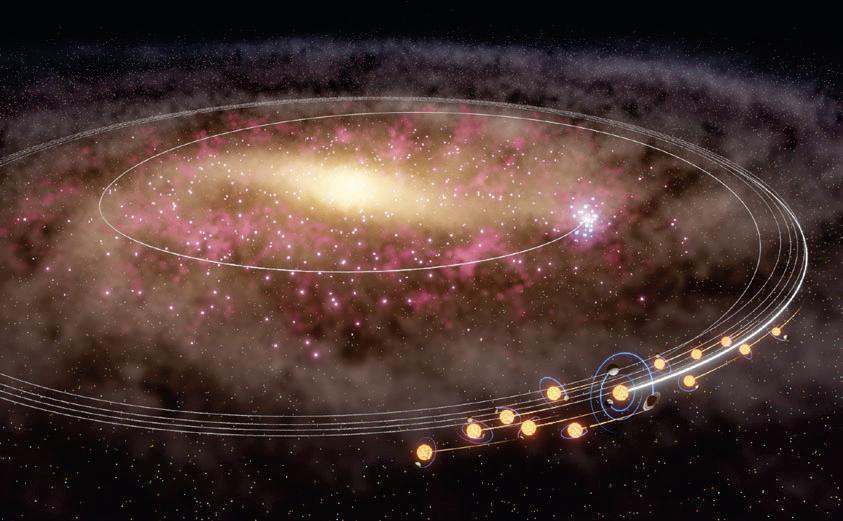
OUR SUN WAS BORN 4.6 BILLION YEARS AGO near the crowded center of the Milky Way and then migrated roughly 10,000 light-years outward to the peaceful galactic suburbs it currently occupies. Now a pair of recent studies in Astronomy and Astrophysics argues that the sun did not make this trip alone.
Details of the sun’s journey can be found in its chemical composition, says Tokyo Metropolitan University astronomer Daisuke Taniguchi, a coauthor on both studies. “Astronomers know that the sun’s birthplace lies closer to the galactic core than its current position,” Taniguchi explains. The Milky Way’s dense inner regions formed stars faster and accumulated heavy metals far more quickly than the outer edges—and a star with the sun’s age and chemical components would not have been able to form at its present location. But getting there required crossing a dramatic border.
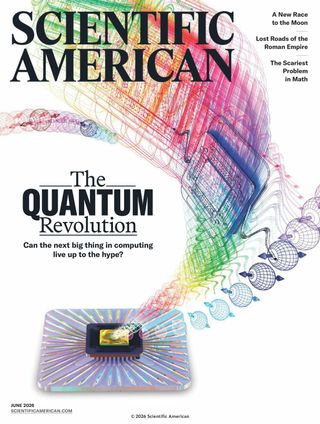

This story is from the June 2026 edition of Scientific American.
Subscribe to Magzter GOLD to access thousands of curated premium stories, and 10,000+ magazines and newspapers.
Already a subscriber? Sign In
MORE STORIES FROM Scientific American

Scientific American
War in Plain Sight
Near-real-time satellite coverage means militaries can no longer hide. So they are learning to lie better

4 mins
June 2026

Scientific American
A Bridge-Crossing Puzzle Led to New Math
Are you smarter than an 18th-century Prussian?
5 mins
June 2026

Scientific American
Nocturnal Navigation
These ants use a sophisticated lunar compass
2 mins
June 2026
Scientific American
Early Plates
Scientists found the oldest direct evidence for Earth’s tectonic motion
3 mins
June 2026

Scientific American
Mating Arm
Reproduction in octopuses is even weirder than you think
3 mins
June 2026

Scientific American
Battleship Science
Game-playing AI can show us how to do science better
2 mins
June 2026

Scientific American
WHAT’S A QUANTUM COMPUTER GOOD FOR, ANYWAY?
Quantum computing promises profound power in cryptography, materials design, telecommunications, and much more. But those dreams won’t become reality overnight—if ever
11 mins
June 2026

Scientific American
Atomic Snowflakes
Could each atom in the universe be unique?
2 mins
June 2026
Scientific American
The New Moon Race
The triumphant Artemis II mission marks a new era of lunar exploration and science. Here’s how it went down and what comes next
7 mins
June 2026

Scientific American
What’s Wrong with Quantum Mechanics
A 100-year-old theory might explain the confusion
6 mins
June 2026
Listen
Translate
Change font size