Try GOLD - Free
A Bridge-Crossing Puzzle Led to New Math
Scientific American
|June 2026
Are you smarter than an 18th-century Prussian?
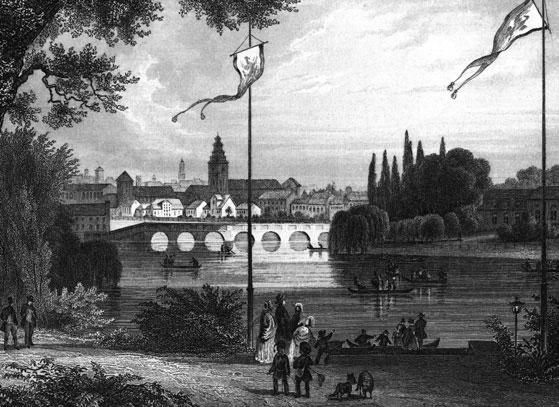
DURING THE 18TH CENTURY the denizens of the Prussian city of Königsberg wrestled with a puzzle: How could they find a walking path through the city that crossed each of its storied seven bridges exactly once?
The bridges spanned a river containing two large islands. No matter how people strategized their routes, they couldn’t avoid repeating a bridge.
The problem stymied local thinkers, who eventually wrote a letter to well-known Swiss mathematician Leonhard Euler (pronounced “oiler”) begging him to lay their curiosity to rest. Euler responded dismissively, claiming the problem had “little relationship to mathematics.” In a way, he was right because the relevant math hadn’t been invented yet. Despite his initial demurral, Euler did end up solving the puzzle of the seven bridges of Königsberg, unaware that in the process he had birthed two new branches of math.
Say you were a resident of Königsberg. Looking at the map (top on opposite page), could you design a path that traverses every bridge once? You’d have to think like a mathematician. The first step in wrangling any math problem is to strip away extraneous information until only the essential elements remain, a process called abstraction. Many features of the map don’t affect the question at hand. The lengths of the bridges, the sizes of the landmasses, even the geographic orientation of the land and bridges can all be discarded. All that matters is which pieces of land connect to which other ones and how many times. Now we can create a much simpler diagram consisting only of circles and lines to represent land and bridges, respectively (bottom on opposite page).

This story is from the June 2026 edition of Scientific American.
Subscribe to Magzter GOLD to access thousands of curated premium stories, and 10,000+ magazines and newspapers.
Already a subscriber? Sign In
MORE STORIES FROM Scientific American

Scientific American
War in Plain Sight
Near-real-time satellite coverage means militaries can no longer hide. So they are learning to lie better

4 mins
June 2026
Scientific American
A Bridge-Crossing Puzzle Led to New Math
Are you smarter than an 18th-century Prussian?
5 mins
June 2026

Scientific American
Nocturnal Navigation
These ants use a sophisticated lunar compass
2 mins
June 2026
Scientific American
Early Plates
Scientists found the oldest direct evidence for Earth’s tectonic motion
3 mins
June 2026

Scientific American
Mating Arm
Reproduction in octopuses is even weirder than you think
3 mins
June 2026
Scientific American
Battleship Science
Game-playing AI can show us how to do science better
2 mins
June 2026

Scientific American
WHAT’S A QUANTUM COMPUTER GOOD FOR, ANYWAY?
Quantum computing promises profound power in cryptography, materials design, telecommunications, and much more. But those dreams won’t become reality overnight—if ever
11 mins
June 2026
Scientific American
Atomic Snowflakes
Could each atom in the universe be unique?
2 mins
June 2026
Scientific American
The New Moon Race
The triumphant Artemis II mission marks a new era of lunar exploration and science. Here’s how it went down and what comes next
7 mins
June 2026

Scientific American
What’s Wrong with Quantum Mechanics
A 100-year-old theory might explain the confusion
6 mins
June 2026
Listen
Translate
Change font size