
Go Unlimited with Magzter GOLD
Get unlimited access to 10,000+ magazines, newspapers and Premium stories for just
Try GOLD - Free
RNA, Not DNA, Is the Key to Life
Scientific American
|September 2025
DNA holds our genetic blueprints, but its cousin, RNA, conducts our daily lives
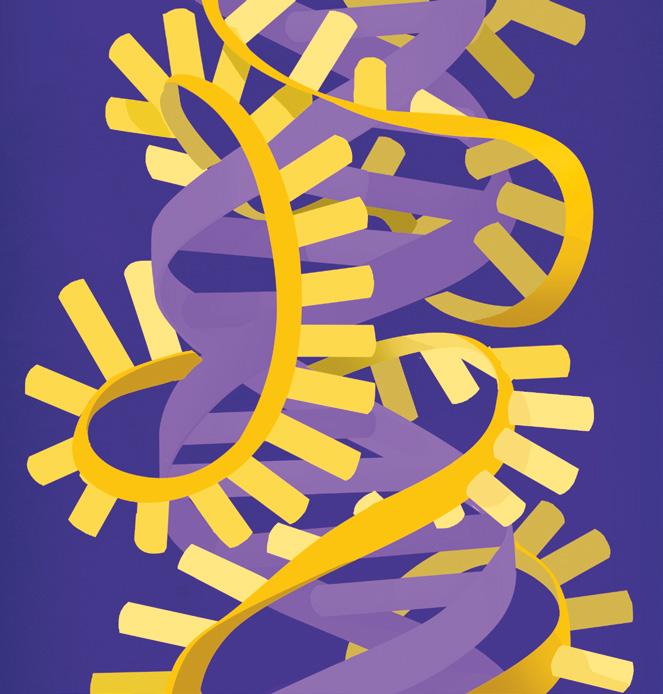
IN 1957, JUST FOUR YEARS AFTER Francis Crick and other scientists solved the riddle of DNA’s structure—the now famous double helix—Crick laid out what he called the “central dogma” of molecular biology, which his colleague James Watson later said implied that biological information flows inexorably from DNA to RNA to proteins. Although Watson was oversimplifying, the message was that the purpose of the double helix in our chromosomes is to hold, in encoded form, blueprints for the proteins that build and maintain our bodies. DNA’s chemical cousin, RNA, was the messenger that carries DNA instructions from the double helix in the cell’s nucleus to the protein-making machinery, called the ribosome, scattered around the cell.
Molecular biology’s mission, it seemed, was to decipher those genetic instructions. But in recent years researchers have discovered a dizzying array of “noncoding” RNA (ncRNA) molecules that do something other than ferry DNA instructions for proteins. They perform a surprisingly wide range of biochemical functions. It now seems that our genome may be at least as much a repository of plans for vital, noncoding RNA as it is for proteins. This shift in thinking has been “revolutionary,” says Thomas Cech, who shared the 1989 Nobel Prize in Chemistry with Sidney Altman for discovering RNA molecules, called ribozymes, that can catalyze biochemical reactions. “DNA is old stuff, 20th-century stuff,” Cech says. “It’s a one-trick pony. All it does is store biological information, which it does exquisitely well. But it’s inert—it can’t do anything without its children, RNA and proteins.”

This story is from the September 2025 edition of Scientific American.
Subscribe to Magzter GOLD to access thousands of curated premium stories, and 10,000+ magazines and newspapers.
Already a subscriber? Sign In
MORE STORIES FROM Scientific American

Scientific American
The Quiet Math Problem That Runs the Planet
How Diffie-Hellman key exchange secures everything from your text messages to government secrets

7 mins
May 2026

Scientific American
The Fog of Science
Did an adversary just invent a world-changing weapon, or are they making it up? DARPA is building an AI to instantly call their bluff
4 mins
May 2026
Scientific American
The Hubble Space Telescope Is Still Awesome
Hubble is going strong despite its decades in space and next-generation successors
4 mins
May 2026

Scientific American
Meet America's Native Bees
Scientists estimate there are about 4,000 species of native bees in the U.S.
5 mins
May 2026

Scientific American
The Chemistry of Desire
Inside the secretive laboratories where scientists build novel molecules to make luxury fragrance feel like pure emotion
5 mins
May 2026

Scientific American
Scanning the Stone
As ore gets harder to find, the mining industry is turning to subatomic-particle sensors to push deep underground
8 mins
May 2026

Scientific American
YOUR HEART IN FLAMES
Inflammation may be the true cause of cardiovascular diseaseand there's a drug to treat it
13 mins
May 2026

Scientific American
Ancient Lexicon
Stone Age art may reveal a 40,000-year-old precursor to writing
2 mins
May 2026

Scientific American
Thermal Breakthrough
A new super heat conductor challenges fundamental physics
2 mins
May 2026

Scientific American
How to Vacation in Space
Planned orbital hotels promise luxury, but can they deliver?
4 mins
May 2026
Listen
Translate
Change font size