Try GOLD - Free
Plastic Was Supposed to Be Sustainable
Scientific American
|September 2025
Synthetic polymers became one of our biggest environmental crises instead
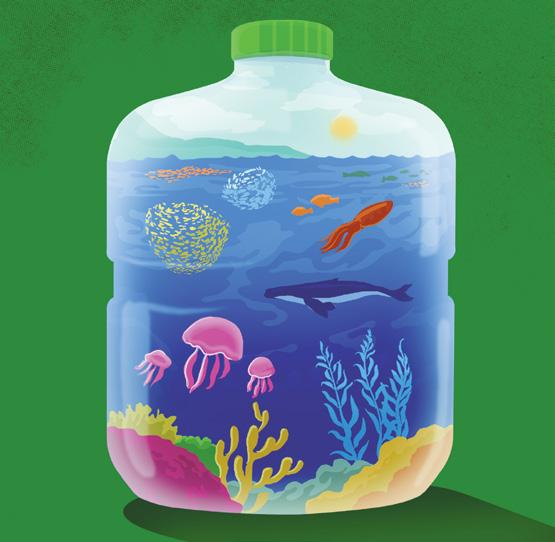
IN 1864 SCIENTIFIC AMERICAN published a competition launched by a billiard-table manufacturing company: “Ten Thousand Dollars for a Substitute for Ivory.” The owners of Phelan & Collender were pleased to see it; they wrote to the magazine to elaborate on what they were looking for in an “ivory alternative” that could be used to make billiard balls and hoped it would “have the effect of stimulating the genius of some of your numerous readers.” The real stuff from elephant tusks had become scarce, but its elasticity, hardness and density were hard to find in another material.
A printer from Albany, N.Y., named John Wesley Hyatt came up with an answer in celluloid, a moldable, compound material made up of cellulose nitrate, a polymer that held the ball together; camphor, an organic compound that provided flexibility and durability; and ground-up cow bone, to give the ball the right mechanics for play. Rather than accepting the $10,000 reward and signing away the rights to his invention, Hyatt patented his object in 1869 and started his own company, selling celluloid billiard balls that conservation scientist Artur Neves, writing in 2023, called “the founding object of the plastics industry.”
The creation of the “first plastic” was essentially an answer to a sustainability problem. There were only so many elephants, tortoises and silkworms to go around, and their tusks, shells and fibers were increasingly in demand. Articles and advertisements from the early era of the plastics industry portray such materials as relieving pressure on natural resources. In a 2023 paper in PNAS Nexus, Neves and his colleagues called Hyatt’s celluloid billiard balls one of “the first successful efforts to substitute materials to assist the survival of endangered animals.”


This story is from the September 2025 edition of Scientific American.
Subscribe to Magzter GOLD to access thousands of curated premium stories, and 10,000+ magazines and newspapers.
Already a subscriber? Sign In
MORE STORIES FROM Scientific American
Scientific American
Let There Be Weapons
The Department of Energy’s new Genesis Mission promises AI-accelerated discovery. Seven of its first 26 challenges focus on nuclear weapons and national security

4 mins
July/August 2026

Scientific American
How to Fix Science
The federal funding system for scientific research in the U.S. needs reform
9 mins
July/August 2026

Scientific American
Robots Can Now Fold Your Laundry
Home-helper tasks are becoming easier for robotic assistants
4 mins
July/August 2026

Scientific American
50, 100 & 150 Years
NATURAL FISSION REACTOR
3 mins
July/August 2026

Scientific American
Anna Ho
Describing the characteristics of short-lived astrophysical events
1 mins
July/August 2026
Scientific American
THE SOLILOQUY OF SCHRÖDINGER'S CAT
A MEDITATION ON LIFE AND THE VON NEUMANN–WIGNER INTERPRETATION OF QUANTUM MECHANICS
1 min
July/August 2026

Scientific American
Mikhail Kolmogorov
Developing software to reveal large genetic changes that lead to cancer
1 mins
July/August 2026

Scientific American
Jaye Gardiner
Learning how the matrix around cells and tissues impacts cancers
1 mins
July/August 2026

Scientific American
Timnit Gebru
On safeguarding independent research in the age of big tech
3 mins
July/August 2026

Scientific American
A Youthful Illusion Sharpens Memory
By making people feel as if their face is a younger version of itself, researchers can bring childhood memories into sharper focus
4 mins
July/August 2026
Listen
Translate
Change font size