Try GOLD - Free
Midwestern Melt
Scientific American
|September 2025
The core of the U.S. may be “dripping” away
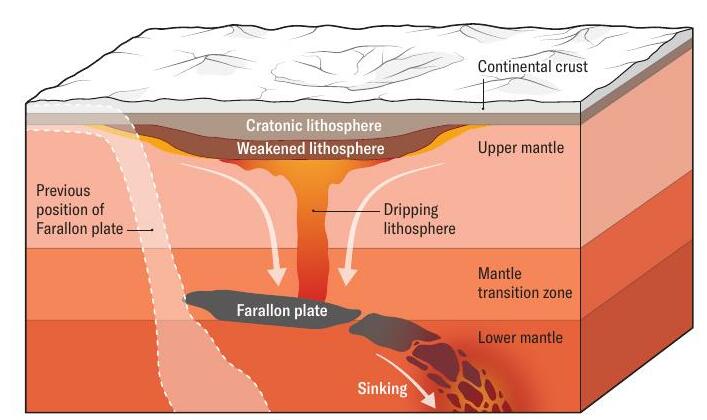
SOMETHING VERY STRANGE appears to be happening deep, deep underneath the U.S. Midwest and the Ohio Valley.
North America’s geological core has persisted for more than a billion years; it's what scientists call a craton, a massive block of continental rock that withstands the natural recycling system of plate tectonics. Typically scientists think of cratons as unchanging, nigh eternal. But research published in Nature Geoscience suggests that a long-lost geological plate may be siphoning molten rock from the underside of the North American craton and eroding it from below, right under our feet.
Such a scenario would not be unprecedented—scientists have evidence that the North China craton thinned dramatically millions of years ago—but it would certainly be surprising and intriguing to study in real time. “Cratons are the oldest cores of continents, so they have been sitting near Earth’s surface for billions of years,” says Claire Currie, a geophysicist at the University of Alberta, who was not involved in the new research. “They’ve persisted through time, so this is quite unusual.”


This story is from the September 2025 edition of Scientific American.
Subscribe to Magzter GOLD to access thousands of curated premium stories, and 10,000+ magazines and newspapers.
Already a subscriber? Sign In
MORE STORIES FROM Scientific American
Scientific American
Let There Be Weapons
The Department of Energy’s new Genesis Mission promises AI-accelerated discovery. Seven of its first 26 challenges focus on nuclear weapons and national security

4 mins
July/August 2026

Scientific American
How to Fix Science
The federal funding system for scientific research in the U.S. needs reform
9 mins
July/August 2026

Scientific American
Robots Can Now Fold Your Laundry
Home-helper tasks are becoming easier for robotic assistants
4 mins
July/August 2026

Scientific American
50, 100 & 150 Years
NATURAL FISSION REACTOR
3 mins
July/August 2026

Scientific American
Anna Ho
Describing the characteristics of short-lived astrophysical events
1 mins
July/August 2026
Scientific American
THE SOLILOQUY OF SCHRÖDINGER'S CAT
A MEDITATION ON LIFE AND THE VON NEUMANN–WIGNER INTERPRETATION OF QUANTUM MECHANICS
1 min
July/August 2026

Scientific American
Mikhail Kolmogorov
Developing software to reveal large genetic changes that lead to cancer
1 mins
July/August 2026

Scientific American
Jaye Gardiner
Learning how the matrix around cells and tissues impacts cancers
1 mins
July/August 2026

Scientific American
Timnit Gebru
On safeguarding independent research in the age of big tech
3 mins
July/August 2026

Scientific American
A Youthful Illusion Sharpens Memory
By making people feel as if their face is a younger version of itself, researchers can bring childhood memories into sharper focus
4 mins
July/August 2026
Listen
Translate
Change font size