Try GOLD - Free
Journey to Titan
Scientific American
|July/August 2026
Inside NASA’s Dragonfly mission to Saturn’s largest moon
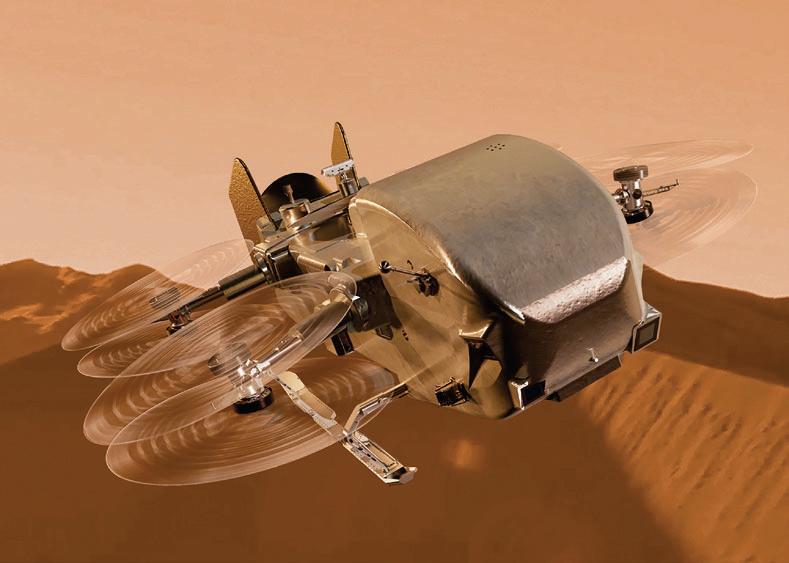
IN 2034 NASA SCIENTISTS will be flying around Titan.
Remotely, of course—Titan, Saturn’s largest moon, is more than a billion kilometers away from Earth, a journey no human can yet make. It’s also deathly cold, being so far from the sun. But our robotic proxies can endure the chill and make the trip, and, as it happens, we humans are getting pretty good at making these machines.
Still, even compared with the astounding missions that we’ve already launched to explore other worlds, this one, called Dragonfly, is massively ambitious. The spacecraft is not a lander or a rover; it’s a helicopter, or more accurately an octocopter, with four pairs of spinning blades to take it aloft and let it sail the giant moon’s frigid air. Powered and warmed by a nuclear battery, it will explore Titan for a nominal three-year mission, examining its brutally cold surface and atmosphere. It will even look for signs of extraterrestrial life—or at least its precursors.
“Ambitious” may be too small a word for Dragonfly.
Titan is a world well worth our attention. At roughly 5,150 kilometers wide, it’s the solar system’s second-largest moon (Jupiter’s Ganymede is slightly larger), and it’s bigger than Mercury. Sans Saturn, we might be tempted to call Titan a planet on its own. It’s the only moon known to have a dense atmosphere, with a surface pressure about 1.5 times that of Earth’s. And much like Earth’s atmosphere, Titan’s air is mostly nitrogen, albeit with small and distinctly unearthly amounts of methane and hydrogen. The moon’s cryogenic cold is what really makes it alien: Titan’s surface temperature is about –180 degrees Celsius, so it’s a bit chillier than home. That’s so cold, in fact, that water there is as solid as granite here on Earth.

This story is from the July/August 2026 edition of Scientific American.
Subscribe to Magzter GOLD to access thousands of curated premium stories, and 10,000+ magazines and newspapers.
Already a subscriber? Sign In
MORE STORIES FROM Scientific American
Scientific American
Let There Be Weapons
The Department of Energy’s new Genesis Mission promises AI-accelerated discovery. Seven of its first 26 challenges focus on nuclear weapons and national security

4 mins
July/August 2026

Scientific American
How to Fix Science
The federal funding system for scientific research in the U.S. needs reform
9 mins
July/August 2026

Scientific American
Robots Can Now Fold Your Laundry
Home-helper tasks are becoming easier for robotic assistants
4 mins
July/August 2026

Scientific American
50, 100 & 150 Years
NATURAL FISSION REACTOR
3 mins
July/August 2026

Scientific American
Anna Ho
Describing the characteristics of short-lived astrophysical events
1 mins
July/August 2026

Scientific American
THE SOLILOQUY OF SCHRÖDINGER'S CAT
A MEDITATION ON LIFE AND THE VON NEUMANN–WIGNER INTERPRETATION OF QUANTUM MECHANICS
1 min
July/August 2026

Scientific American
Mikhail Kolmogorov
Developing software to reveal large genetic changes that lead to cancer
1 mins
July/August 2026

Scientific American
Jaye Gardiner
Learning how the matrix around cells and tissues impacts cancers
1 mins
July/August 2026

Scientific American
Timnit Gebru
On safeguarding independent research in the age of big tech
3 mins
July/August 2026

Scientific American
A Youthful Illusion Sharpens Memory
By making people feel as if their face is a younger version of itself, researchers can bring childhood memories into sharper focus
4 mins
July/August 2026
Listen
Translate
Change font size