Try GOLD - Free
Is All Math Solvable?
Scientific American
|February 2026
Thousands of notoriously difficult problems in computer science are actually the same problem in disguise
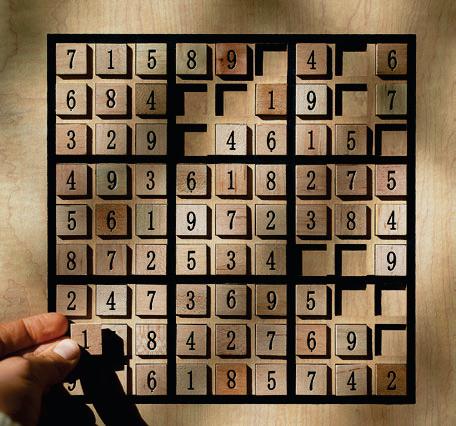
With NP-complete problems, you could discover a fast algorithm to solve Sudoku puzzles that could also break the encryption schemes that protect our digital economy.
COMPUTER SCIENCE SEEMINGLY RIDES A CURVE of unstoppable progress. Mere decades took us from vacuum tubes to microchips, from dial-up to high-speed Internet, and from Office Assistant Clippy to ChatGPT. Yet thousands of everyday problems across science and industry remain just as unsolvable as ever for today’s fleet of supercomputers powered by artificial intelligence.
People working on these notoriously hard “NP-complete” problems could win a million-dollar prize, awarded by the nonprofit Clay Mathematics Institute, for either finding their fast solution or proving that none exists. An amazing insight from the 1970s makes this challenge even more tantalizing: these 1,000-plus problems are, in a deep sense, one and the same. If you solve one, you solve them all. This concept, now fundamental in the field of theoretical computer science, shows that certain groups of computational problems form a unified web. Discover a fast algorithm that solves Sudoku puzzles of any size, and you can now break the encryption schemes that protect our digital economy. Reveal a shortcut for scheduling a flight tour within a budget, and you can use it to solve nearly any famous open math problem.

This story is from the February 2026 edition of Scientific American.
Subscribe to Magzter GOLD to access thousands of curated premium stories, and 10,000+ magazines and newspapers.
Already a subscriber? Sign In
MORE STORIES FROM Scientific American
Scientific American
Let There Be Weapons
The Department of Energy’s new Genesis Mission promises AI-accelerated discovery. Seven of its first 26 challenges focus on nuclear weapons and national security

4 mins
July/August 2026

Scientific American
How to Fix Science
The federal funding system for scientific research in the U.S. needs reform
9 mins
July/August 2026

Scientific American
Robots Can Now Fold Your Laundry
Home-helper tasks are becoming easier for robotic assistants
4 mins
July/August 2026

Scientific American
50, 100 & 150 Years
NATURAL FISSION REACTOR
3 mins
July/August 2026

Scientific American
Anna Ho
Describing the characteristics of short-lived astrophysical events
1 mins
July/August 2026

Scientific American
THE SOLILOQUY OF SCHRÖDINGER'S CAT
A MEDITATION ON LIFE AND THE VON NEUMANN–WIGNER INTERPRETATION OF QUANTUM MECHANICS
1 min
July/August 2026

Scientific American
Mikhail Kolmogorov
Developing software to reveal large genetic changes that lead to cancer
1 mins
July/August 2026

Scientific American
Jaye Gardiner
Learning how the matrix around cells and tissues impacts cancers
1 mins
July/August 2026

Scientific American
Timnit Gebru
On safeguarding independent research in the age of big tech
3 mins
July/August 2026

Scientific American
A Youthful Illusion Sharpens Memory
By making people feel as if their face is a younger version of itself, researchers can bring childhood memories into sharper focus
4 mins
July/August 2026
Listen
Translate
Change font size