
Go Unlimited with Magzter GOLD
Get unlimited access to 10,000+ magazines, newspapers and Premium stories for just
Try GOLD - Free
DEADLY MIRROR
Scientific American
|February 2026
A new form of life, eerily like us, is almost within reach of science. It could destroy our planet. Here's how to stop it
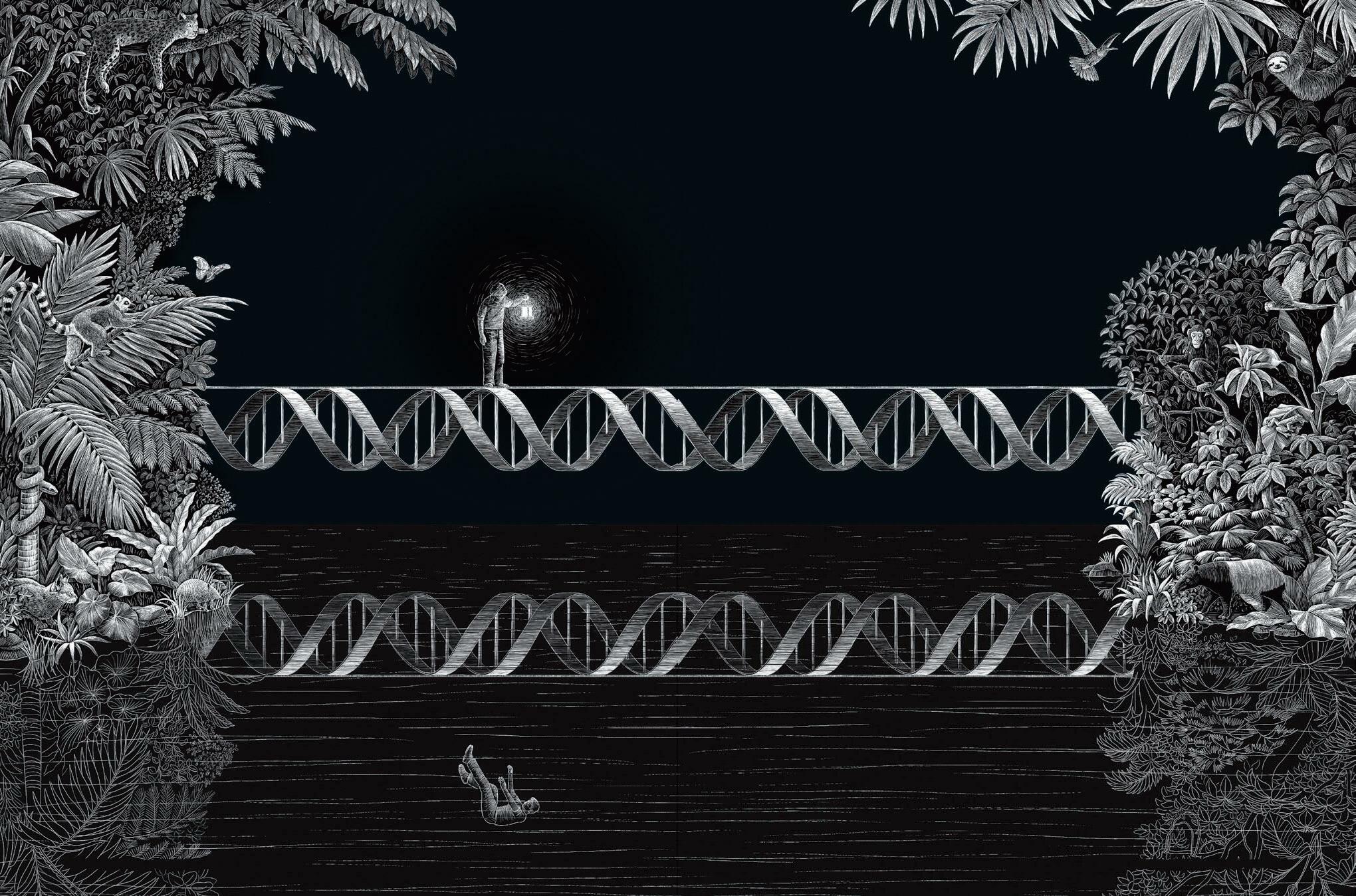
LET'S SAY IT'S 2036, and scientists are working on a new class of drugs. These medications are mirror-image versions of the molecules your body uses to fight disease. Their big advantage is that reverse compounds last longer in the body because destructive enzymes don't recognize them and rip them apart. Yet the compounds are still effective against invading microbes. Clinical trials have been promising, and the team is eager to scale up production.
The researchers turn to engineered mirror bacteria—single cells made of reversed molecules—for the job.
Bacterial factories aren't a far-fetched idea. Today, for instance, pharmaceutical companies use bacteria to manufacture synthetic insulin for diabetics. Curious about whether mirror cells could be used in a similar way, the scientists experiment on a mirrored version of the common bacterium Escherichia coli.
Unfortunately, a researcher with a small cut on her thumb from dry skin forgets to put on her gloves and touches a surface contaminated with just a few of these cells. The bacteria get into her blood.
Her immune cells, which usually kill off intruders, don't recognize the mirror proteins on the novel bacteria and fail to react. The mirror microbes multiply and spread within her. Defensive antibodies never appear. After a few days at home, the scientist falls gravely ill. She's taken to a hospital, where she's loaded with antibiotics that can't make up for the massive failures of her immune system. Three days later she dies.

This story is from the February 2026 edition of Scientific American.
Subscribe to Magzter GOLD to access thousands of curated premium stories, and 10,000+ magazines and newspapers.
Already a subscriber? Sign In
MORE STORIES FROM Scientific American

Scientific American
The Quiet Math Problem That Runs the Planet
How Diffie-Hellman key exchange secures everything from your text messages to government secrets

7 mins
May 2026

Scientific American
The Fog of Science
Did an adversary just invent a world-changing weapon, or are they making it up? DARPA is building an AI to instantly call their bluff
4 mins
May 2026
Scientific American
The Hubble Space Telescope Is Still Awesome
Hubble is going strong despite its decades in space and next-generation successors
4 mins
May 2026

Scientific American
Meet America's Native Bees
Scientists estimate there are about 4,000 species of native bees in the U.S.
5 mins
May 2026

Scientific American
The Chemistry of Desire
Inside the secretive laboratories where scientists build novel molecules to make luxury fragrance feel like pure emotion
5 mins
May 2026
Scientific American
Scanning the Stone
As ore gets harder to find, the mining industry is turning to subatomic-particle sensors to push deep underground
8 mins
May 2026

Scientific American
YOUR HEART IN FLAMES
Inflammation may be the true cause of cardiovascular diseaseand there's a drug to treat it
13 mins
May 2026

Scientific American
Ancient Lexicon
Stone Age art may reveal a 40,000-year-old precursor to writing
2 mins
May 2026

Scientific American
Thermal Breakthrough
A new super heat conductor challenges fundamental physics
2 mins
May 2026
Scientific American
How to Vacation in Space
Planned orbital hotels promise luxury, but can they deliver?
4 mins
May 2026
Listen
Translate
Change font size