Try GOLD - Free
Challenging Measures
Scientific American
|June 2026
Depression questionnaires may not work the same for highly intelligent people
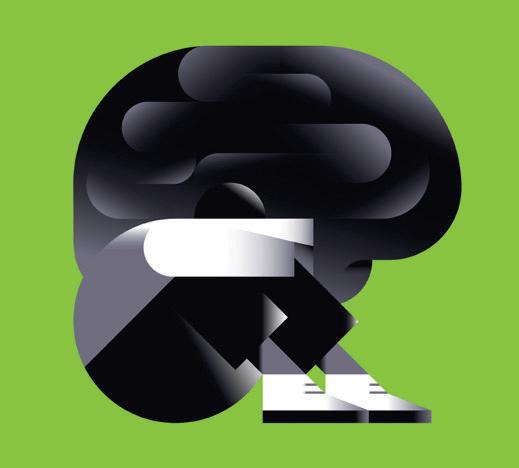
PSYCHOLOGISTS HAVE FOUND that two common questionnaires for assessing depression don't work for comparing people of differing intelligence-and the problem may extend to other conditions and traits.
For a recent study in the journal Intelligence, Stanisław Czerwiński of the University of Gdańsk in Poland and his colleagues investigated how intelligence correlates with mental health. They hypothesized that the association between intelligence and better mental health starts out positive as it approaches the high end of the IQ scale, then turns negative.
The researchers analyzed data from two U.S. surveys that tracked thousands of people over decades. To estimate IQ, these surveys used an aptitude test that measures math and language abilities. Each used a different well-established mental health scale containing questions about things such as mood, sleep and appetite.

This story is from the June 2026 edition of Scientific American.
Subscribe to Magzter GOLD to access thousands of curated premium stories, and 10,000+ magazines and newspapers.
Already a subscriber? Sign In
MORE STORIES FROM Scientific American

Scientific American
Let There Be Weapons
The Department of Energy’s new Genesis Mission promises AI-accelerated discovery. Seven of its first 26 challenges focus on nuclear weapons and national security

4 mins
July/August 2026

Scientific American
How to Fix Science
The federal funding system for scientific research in the U.S. needs reform
9 mins
July/August 2026

Scientific American
Robots Can Now Fold Your Laundry
Home-helper tasks are becoming easier for robotic assistants
4 mins
July/August 2026

Scientific American
50, 100 & 150 Years
NATURAL FISSION REACTOR
3 mins
July/August 2026

Scientific American
Anna Ho
Describing the characteristics of short-lived astrophysical events
1 mins
July/August 2026

Scientific American
THE SOLILOQUY OF SCHRÖDINGER'S CAT
A MEDITATION ON LIFE AND THE VON NEUMANN–WIGNER INTERPRETATION OF QUANTUM MECHANICS
1 min
July/August 2026

Scientific American
Mikhail Kolmogorov
Developing software to reveal large genetic changes that lead to cancer
1 mins
July/August 2026

Scientific American
Jaye Gardiner
Learning how the matrix around cells and tissues impacts cancers
1 mins
July/August 2026

Scientific American
Timnit Gebru
On safeguarding independent research in the age of big tech
3 mins
July/August 2026

Scientific American
A Youthful Illusion Sharpens Memory
By making people feel as if their face is a younger version of itself, researchers can bring childhood memories into sharper focus
4 mins
July/August 2026
Listen
Translate
Change font size