Try GOLD - Free
Are Ultraprocessed Foods Addictive?
Scientific American
|April 2026
The perils of highly processed snacks
-
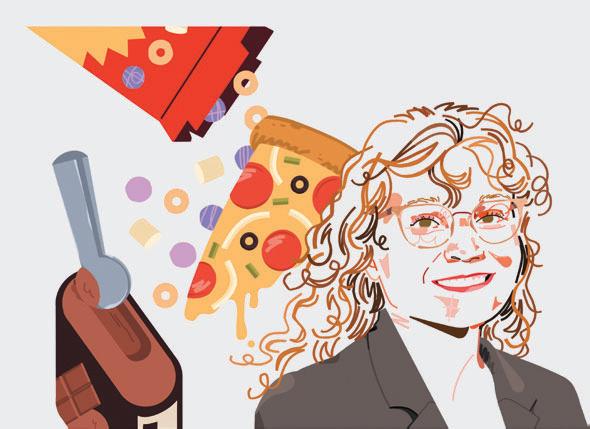
THE RECENT SURGE in the use of GLP-1-agonist weight-loss drugs has propelled addiction-adjacent terms such as “food noise” and “food cravings” into common vernacular. Now some neuroscientists and food-behavior researchers are trying to understand whether food—particularly ultraprocessed foods—can actually be addictive in the same way as other known substances such as cigarettes, alcohol and cocaine.
Potentially addictive foods are often “created in a way that is most palatable and most delicious,” says Alex DiFeliceantonio, an appetitive neuroscientist at Virginia Tech. “When you look at the food environment, those items tend to be ultraprocessed.”
SCIENTIFIC AMERICAN spoke with DiFeliceantonio about research unpacking whether food addiction is real, whether certain types of foods might have more addictive qualities and how related eating disorders can be addressed.
An edited transcript of the interview follows.
What does it mean to have a food addiction?
When we're thinking about food addiction and looking qualitatively at what people are eating when they are saying they can’t stop eating, we have to put it in the framework of a substance use disorder. These disorders affect life in an untenable way. Food addiction isn’t in the Diagnostic and Statistical Manual of Mental Disorders (DSM) like substance use disorder is, but there is a proposal to have it put in the DSM.
We typically look to the Yale Food Addiction Scale for clinical evaluation. The scale was designed to assess the same criteria as for substance use disorder in the

This story is from the April 2026 edition of Scientific American.
Subscribe to Magzter GOLD to access thousands of curated premium stories, and 10,000+ magazines and newspapers.
Already a subscriber? Sign In
MORE STORIES FROM Scientific American

Scientific American
Let There Be Weapons
The Department of Energy’s new Genesis Mission promises AI-accelerated discovery. Seven of its first 26 challenges focus on nuclear weapons and national security

4 mins
July/August 2026

Scientific American
How to Fix Science
The federal funding system for scientific research in the U.S. needs reform
9 mins
July/August 2026

Scientific American
Robots Can Now Fold Your Laundry
Home-helper tasks are becoming easier for robotic assistants
4 mins
July/August 2026

Scientific American
50, 100 & 150 Years
NATURAL FISSION REACTOR
3 mins
July/August 2026

Scientific American
Anna Ho
Describing the characteristics of short-lived astrophysical events
1 mins
July/August 2026

Scientific American
THE SOLILOQUY OF SCHRÖDINGER'S CAT
A MEDITATION ON LIFE AND THE VON NEUMANN–WIGNER INTERPRETATION OF QUANTUM MECHANICS
1 min
July/August 2026

Scientific American
Mikhail Kolmogorov
Developing software to reveal large genetic changes that lead to cancer
1 mins
July/August 2026

Scientific American
Jaye Gardiner
Learning how the matrix around cells and tissues impacts cancers
1 mins
July/August 2026

Scientific American
Timnit Gebru
On safeguarding independent research in the age of big tech
3 mins
July/August 2026

Scientific American
A Youthful Illusion Sharpens Memory
By making people feel as if their face is a younger version of itself, researchers can bring childhood memories into sharper focus
4 mins
July/August 2026
Listen
Translate
Change font size