Try GOLD - Free
A NEW KIND OF MAGNET
Scientific American
|May 2026
How the discovery of altermagnets could change physics and computing
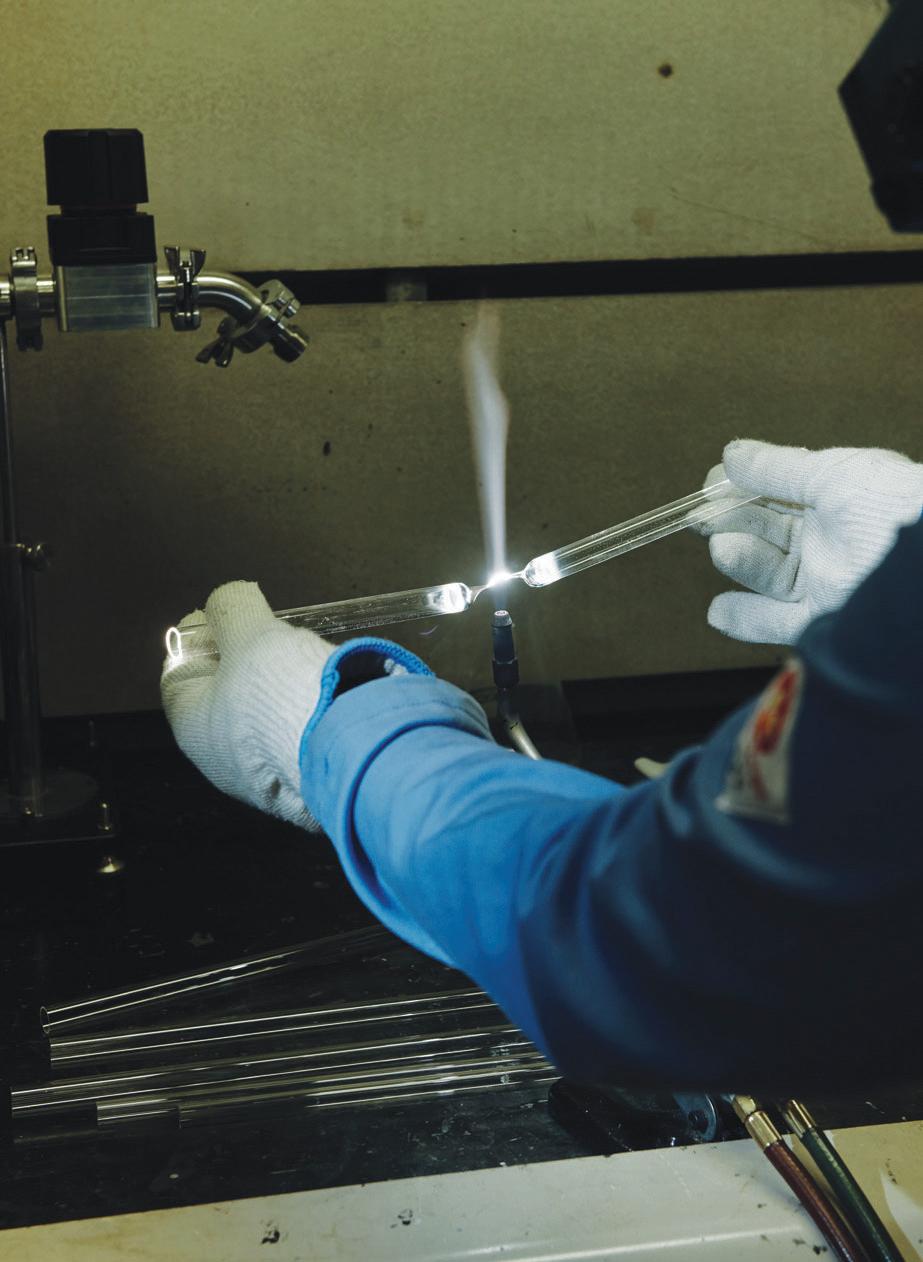
Scientists have recently discovered materials with new magnetic properties. In a laboratory at the Massachusetts Institute of Technology, scientists manipulate quartz tubes containing crystals that produce p-wave magnetism.
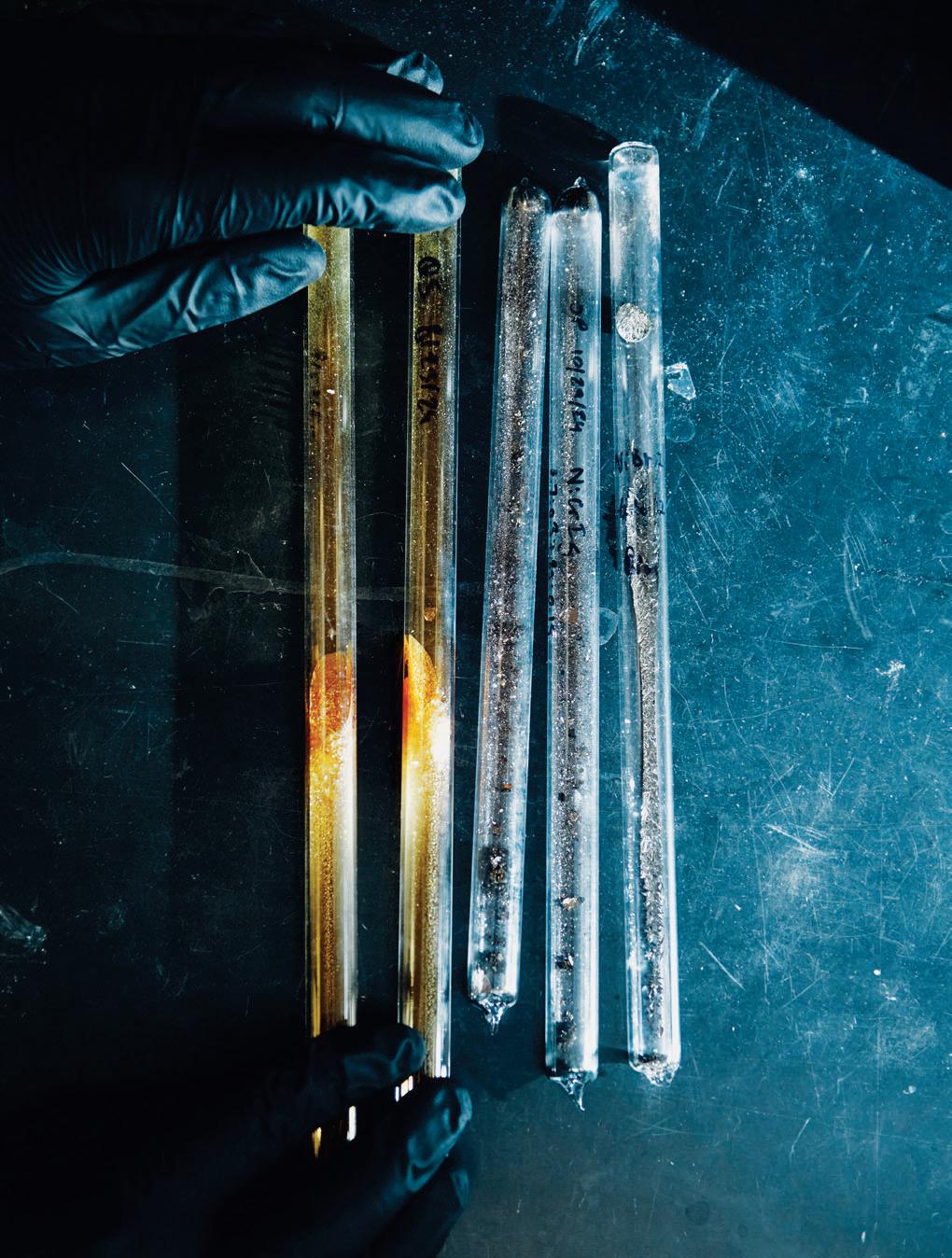 ON A BREEZY AFTERNOON last autumn in Cambridge, Mass., in a laboratory thrumming with the huff-whish-huff sound of refrigeration pumps, Massachusetts Institute of Technology graduate student Jiaruo Li was crafting a new device for storing digital data. She was aiming to use an exotic kind of magnetism discovered in the same lab the previous year to make the device faster and more energy-efficient than any competing technology. Her goal was timely given the current AI-driven boom in data centers and the exploding demand for power it portends.
At that moment Li was focused on finding her version of a needle in a haystack: a barely visible flake of nickel bromide with just the right attributes. To get to this point, she'd grown a dime-sized crystal of the compound by baking a glass tube containing nickel bromide powder for 10 days at high temperatures in a computer-controlled oven in an M.I.T. lab. Then, seeking an atomically thin sample, she'd applied a special tape to her creation, peeled it off and transferred the flakes on the tape to a shiny silicon wafer. Now, holding the wafer up to the light, she eyed a galaxy of thousands of tiny golden crystals against a purple mirrored background. “From all these,” she said, “only one or two of them is going to be thin enough.”


This story is from the May 2026 edition of Scientific American.
Subscribe to Magzter GOLD to access thousands of curated premium stories, and 10,000+ magazines and newspapers.
Already a subscriber? Sign In
MORE STORIES FROM Scientific American
Scientific American
Let There Be Weapons
The Department of Energy’s new Genesis Mission promises AI-accelerated discovery. Seven of its first 26 challenges focus on nuclear weapons and national security

4 mins
July/August 2026

Scientific American
How to Fix Science
The federal funding system for scientific research in the U.S. needs reform
9 mins
July/August 2026

Scientific American
Robots Can Now Fold Your Laundry
Home-helper tasks are becoming easier for robotic assistants
4 mins
July/August 2026

Scientific American
50, 100 & 150 Years
NATURAL FISSION REACTOR
3 mins
July/August 2026

Scientific American
Anna Ho
Describing the characteristics of short-lived astrophysical events
1 mins
July/August 2026

Scientific American
THE SOLILOQUY OF SCHRÖDINGER'S CAT
A MEDITATION ON LIFE AND THE VON NEUMANN–WIGNER INTERPRETATION OF QUANTUM MECHANICS
1 min
July/August 2026

Scientific American
Mikhail Kolmogorov
Developing software to reveal large genetic changes that lead to cancer
1 mins
July/August 2026

Scientific American
Jaye Gardiner
Learning how the matrix around cells and tissues impacts cancers
1 mins
July/August 2026

Scientific American
Timnit Gebru
On safeguarding independent research in the age of big tech
3 mins
July/August 2026

Scientific American
A Youthful Illusion Sharpens Memory
By making people feel as if their face is a younger version of itself, researchers can bring childhood memories into sharper focus
4 mins
July/August 2026
Listen
Translate
Change font size