Try GOLD - Free
A NEW ORDER OF TRADE
Down To Earth
|February 16, 2023
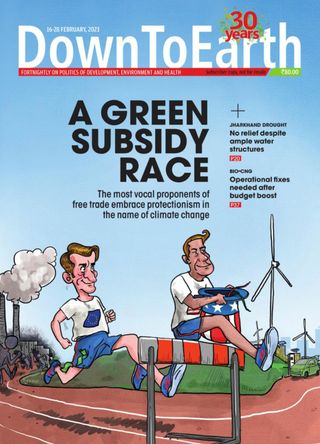
The global superpowers are abandoning free trade to fight climate change. Armed with massive subsidies and tariffs, the US and EU are leading this charge towards protectionism. This may change the global trade system as we know it. But will developing countries and the climate gain from it? An analysis

THE RACE to build a low-carbon economy is heating up. Countries have in recent months proposed or introduced policies and laws to speed up the transition from fossil fuels, promote manufacturing of clean-energy technologies at scale and decarbonise industries. On the face of it, this race appears to be part of the global effort to cut greenhouse gas emissions. But it has sparked fears of economic rivalry and neo-protectionism, as governments on the pretext of climate action try to reshore green industries and dominate the global supply chain of goods and technologies essential to avert a climate catastrophe.
Some of the new climate-focused trade measures that threaten globalisation as we know it are by the US and EU—the largest and second largest historical emitters of greenhouse gases.
Consider the Inflation Reduction Act (ira), passed by the US in August 2022. It has been billed as the most serious effort yet by the US to face up to climate change. Under ira, the government aims to unleash subsidies, about $370 billion, mainly through tax credits, over 10 years for sectors such as renewable energy, electric vehicles, energy efficient appliances and leading-edge technologies like carbon capture and storage and clean hydrogen. An analysis by McKinsey, a global management consulting firm, shows that corporations are the biggest recipient of ira funding, with an estimated $216 billion worth of tax credits. There are indirect subsidies for manufacturers too, in the form of tax credits worth $43 billion, that aim to make low-carbon purchases such as electric vehicles and rooftop solar panels more affordable.

This story is from the February 16, 2023 edition of Down To Earth.
Subscribe to Magzter GOLD to access thousands of curated premium stories, and 10,000+ magazines and newspapers.
Already a subscriber? Sign In
MORE STORIES FROM Down To Earth

Down To Earth
The world is not enough
LAND IS A FINITE RESOURCE, BEST LEFT UNDISTURBED FOR OPTIMAL ENVIRONMENTAL BENEFITS. SINCE THAT IS NOT A FEASIBLE OPTION, THE NEED IS TO IMPROVE AGRARIAN PRODUCTIVITY

2 mins
July 01, 2026

Down To Earth
What suicide statistics conceal
Health problems are becoming a bigger driver of suicide in India, with cases rising by nearly 45 per cent in a decade
5 mins
July 01, 2026

Down To Earth
Sticky decline
India’s lac production struggles despite strong global demand and high prices, as climate volatility and myopic policy take their toll
6 mins
July 01, 2026
Down To Earth
Goal keeping after 2030
AFTER A decade of adoption and with only five years left to achieve the 17 UN-mandated Sustainable Development Goals (SDGs), the world stands at a crossroads.
2 mins
July 01, 2026

Down To Earth
KNOWN UNKNOWNS
Marine litter is on the rise worldwide. Plastics now make up most of the waste that reaches the oceans, travelling through cities and waterways. AKSHIT SANGOMLA and K A SHREYA travel along India’s coast to document the environmental and economic costs of this floating threat. They also examine why there are no comprehensive policies in place at either the global or national level to tackle marine litter effectively, and explore possible solutions
16 mins
July 01, 2026

Down To Earth
Community healers
Women health workers in Uttarakhand's Tehri district spread awareness on menstrual hygiene, identify health concerns among women, and earn in the process
2 mins
July 01, 2026

Down To Earth
India hobbled by industry’s failure to fund R&D
The chronically low investment in research and development by the private sector has now reached a crisis point
4 mins
July 01, 2026

Down To Earth
'Many nations headed the wrong way'
American journalist Michael Grunwald, author of We Are Eating the Earth, tells Shagun how popular climate solutions, from biofuels to regenerative farming to reducing livestock production, could do more harm than good
5 mins
July 01, 2026

Down To Earth
A customised role
The coal ministry is preparing a customised corporate social responsibility framework for the coal sector
4 mins
July 01, 2026

Down To Earth
Death of a star
A giant star in a neighbouring galaxy is edging towards a supernova, a rare event that modern astronomy has never observed in such detail
5 mins
July 01, 2026
Translate
Change font size