Try GOLD - Free
What Does It Mean To Lose Balance?
Heartfulness eMagazine
|April 2023
ROSALIND PEARMAIN explores the notion of losing balance and restoring it, and how we have to lose our old balance in order to find a new one.

A Pilates teacher once suggested that if you ever suffer an ankle injury, it helps to practice standing on that foot alone (when it is sufficiently recovered) as often as you can. Why? Because the nerves are also injured in sprains and the neural connectivity between the foot and the brain is undermined. Standing on one leg restores the passage of information from the ankle to the brain so that your balance and movement become more resilient again.
I find this a good metaphor. Balance is a shifting and dynamic notion; not about achieving a static point but sustaining dynamic equilibrium, which is far more fluid in living systems. It tells me that what is important with a balance is opening and restoring the flow of information. We could say that we become imbalanced whenever we block or close down to a wider understanding of our situation, our relation, and our context. We lose the ground upon which we stand and substitute for more abstract thoughts and memories. It is as if we literally lose our understanding.
This happens for me when I fall back on old patterns and get stuck. It could happen when I repeat past judgments and ideas about a person or situation that has changed, and get into conflict. We can see this happen with our friends, families, bosses, and also in political situations all the time.
It seems that we have to apparently lose our balance, our old stance, in order to find a new one. We have to sometimes let go of what we hold on to in order to keep our sense of upright strength, in order to move forward and explore new territory. Is this what we do every time we take a step and walk forward?
Within psychology, there are many different ways to make sense of how we lose balance in our relationship with the world:
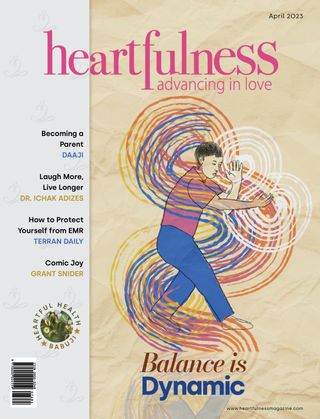

This story is from the April 2023 edition of Heartfulness eMagazine.
Subscribe to Magzter GOLD to access thousands of curated premium stories, and 10,000+ magazines and newspapers.
Already a subscriber? Sign In
MORE STORIES FROM Heartfulness eMagazine

Heartfulness eMagazine
A Touch of Heaven
Irish singer and teacher, EILISH BUTLER, combines the mystical chant of Saint Hildegard von Bingen (1098-1176) with the evolutionary path of Uncovering the Voice, satisfying her passion for mystical spirituality and music.

2 mins
November 2025

Heartfulness eMagazine
FROM INNER STILLNESS TO OUTER AGENCY:
How Heartfulness Builds an Internal Locus of Control and Workplace Success
3 mins
November 2025

Heartfulness eMagazine
Virtual Intelligence
Author and cultural commentator CHARLES EISENSTEIN extends last month's argument about virtual substitutes hollowing out reality-this time to Al's imitation of intimacy-and points to what only embodied relationships can restore.
10 mins
November 2025

Heartfulness eMagazine
Grace Is the Creative Spark
Do you sometimes feel that life is blessed and things are unfolding effortlessly, without force or struggle? Some people say it is because of “grace” or “God’s grace.
5 mins
November 2025

Heartfulness eMagazine
Zuri's Guiding Light
A luminous fable from LIAA KUMAR on self-trust, belonging, and inner guidance.
3 mins
November 2025

Heartfulness eMagazine
I AM
In a quiet meditation on desire, stillness, and the witnessing Self, JARNA KHIMANI traces the shift from seeking to being.
3 mins
November 2025

Heartfulness eMagazine
Courage: From Relief to Presence
JASON NUTTING on why relief is temporary-and how courage, rooted in the heart, endures.
3 mins
November 2025

Heartfulness eMagazine
Embracing The Value Within
DR. ROXANNE M. ST. CLAIR on seeing the value in you—and in others—and making it a daily practice.
4 mins
November 2025
Heartfulness eMagazine
Gratitude's Gift
A Creston woman recently recounted her experience in a checkout line.
2 mins
November 2025

Heartfulness eMagazine
HAPPINESS and Gut Health
Q: How does gut health influence mental well-being, and can practices like meditation actively support a healthier digestive system? The gut is often called the second brain because it has over 500 million neurons that constantly talk to the brain through the vagus nerve.
2 mins
November 2025
Translate
Change font size