
Go Unlimited with Magzter GOLD
Get unlimited access to 10,000+ magazines, newspapers and Premium stories for just
Try GOLD - Free
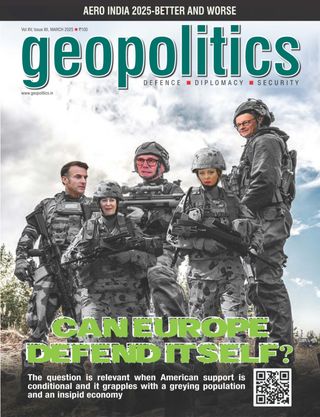
CAN EUROPE DEVELOP ITS MILITARY?
Geopolitics
|March 2025
If the Europeans want to seriously militarise, they will have to make a difficult choice between buying guns or continuing to adequately fund butter (social welfare programs). Given current budgetary constraints, raising military expenditure for most countries would require cutting back on social programs and that would be unacceptable to the ageing populations of these countries,

After the Russian invasion of Ukraine, Europe’s national security establishments firmly believed a new era of remilitarisation was in store for the North Atlantic Treaty Organization (NATO) nations. The military-strategic community in Europe, and its counterparts in Washington, saw NATO returning as a viable military force that would be able to project military power both on the European continent and abroad. Europeans also believed that the West was once more a credible force in international affairs and NATO went as far as to list China as a challenge to the global order.
However, with the advent of the Trump presidency, there are serious doubts about how far Europe can go in its militarisation efforts because of demographic and social factors as well as due to the question, “What exactly does Europe mean by remilitarization?”.
The Demographic Time Bomb
Europe is the victim of a demographic time bomb as its population is both greying and in some countries is actually shrinking. Table 1 below shows the major nations of Europe (including Russia), i.e., the countries with large standing armed forces, and as can be seen their median age is expected to rise and, in the case of Italy, Spain, Greece, and Germany, the population shrinks. (See table-1)
These numbers paint a bleak future for while the nations listed above have the largest and most capable armed forces among NATO, they all have greying populations and, by 2030, except for Turkey, will have a median age that is greater than 40 while Italy is in serious demographic trouble with a median age of 50.8—Spain and Greece also have a median age of nearly 50. Worse, Germany, Greece, Italy, and Spain, are all going to see a major decline in their populations.

This story is from the March 2025 edition of Geopolitics.
Subscribe to Magzter GOLD to access thousands of curated premium stories, and 10,000+ magazines and newspapers.
Already a subscriber? Sign In
MORE STORIES FROM Geopolitics

Geopolitics
Navy Flags Critical Engine Dependency Gap
Despite significant advances in indigenous warship construction, India's continued reliance on foreign marine propulsion systems remains a critical vulnerability in its defence framework.

1 mins
April 2026

Geopolitics
GTRE Advances Engine Testing With Su-30
India's aero-engine development programme is set to accelerate as GTRE proceeds to convert two Su-30 MKI fighters into dedicated flying testbeds, enabling real-time validation of indigenous propulsion technologies.
1 mins
April 2026
Geopolitics
Indigenous Anti-Tank Missile Nears Production Clearance
India's indigenous man-portable anti-tank guided missile is approaching final clearance for mass production following successful validation trials against moving targets.
1 min
April 2026
Geopolitics
A RE-LOOK AT INDIAN MILITARY LOGISTICS & THEATRE COMMANDS
JOSEPH P CHACKO explains why logistics systems must be integrated to be capable of seamlessly supporting modern warfare operations, which necessitate rapid, coordinated responses across multiple domains
14 mins
April 2026
Geopolitics
Defence Spending Drives Acquisition Surge
India's defence modernisation programme has entered a phase of rapid implementation, with FY 2025-26 seeing full utilisation of capital expenditure and a clear focus on addressing critical capability gaps across the armed forces.
3 mins
April 2026

Geopolitics
K9 Vajra Hits mega Indigenisation
India's India's flagship tracked artillery programme has reached a crucial turning point, with the K9 Vajra-T now achieving over 82 per cent indigenous content at the work package level, marking a fundamental shift in domestic defence manufacturing capability.
1 min
April 2026

Geopolitics
NUCLEAR SHARKS OF STEEL!
India’s third Arihant-class submarine, INS Aridhaman, was commissioned into the Indian Navy on April 3, 2026, at Visakhapatnam by Defence Minister Rajnath Singh.
2 mins
April 2026

Geopolitics
Army Eyes Tank-Launched Drone Strikes
The Indian Army is advancing a new concept to equip its main battle tanks with indigenous loitering munitions that can be deployed directly from existing 81mm smoke grenade launchers.
1 min
April 2026

Geopolitics
THE ANATOMY OF A POLARISED FRONTIER
West Bengal has changed from a longtime “Red Bastion” to one of the most hotly contested states in Indian politics.
2 mins
April 2026

Geopolitics
Navy Advances Drone-Ready Amphibious Carriers
India's next-generation amphibious warfare programme has entered a crucial -phase as the Navy advances its evaluation of four large-deck platforms designed to revolutionise expeditionary operations.
1 mins
April 2026
Listen
Translate
Change font size