
Go Unlimited with Magzter GOLD
Get unlimited access to 10,000+ magazines, newspapers and Premium stories for just
Try GOLD - Free
Free the Word
Outlook
|July 11, 2025
Book bans are about fear, control and the desperate need to manage public imagination
Tall began when the Texas State Board of Education mistook a brown bear for a potential red threat that might turn kids into communists. In 2010, the Texas State Board of Education banned Brown Bear, Brown Bear, What Do You See? It was not because it was a piece of subversive literature corrupting young minds, but because they confused its author, Bill Martin Jr., with a completely different Bill Martin, a Marxist philosopher who wrote Ethical Marxism: The Categorical Imperative of Liberation (2008).
Joseph Maximillian Dunnigan, founder of the Banned Books Museum in Estonia, shared this absurd anecdote during a conversation with Outlook. He said, “When they banned this Bill Martin, they also accidentally banned the children’s author Bill Martin. That was very embarrassing, of course, and they had to apologise. But it shows, I think, something very important, which is censorship is not a very useful, effective tool. And usually it is used by people who are not very, let's say, skillful and thoughtful.”
Apparently, a children’s book featuring a yellow duck and a blue horse was dangerously close to igniting a proletarian uprising or so they thought!
As bizarre as it sounds, this episode isn’t an outlier. It stands as a perfect example for the absurd logic that governs censorship worldwide. Whether it’s a misread author bio in the United States of America or a line about religious identity in India, bans are rarely about books themselves.
The Roots of Censorship
Book bans are about fear, control and the desperate need to manage public imagination. Throughout history, censorship has been wielded by those in power to suppress ideas that threaten their authority, often cloaked in the guise of protecting society. The
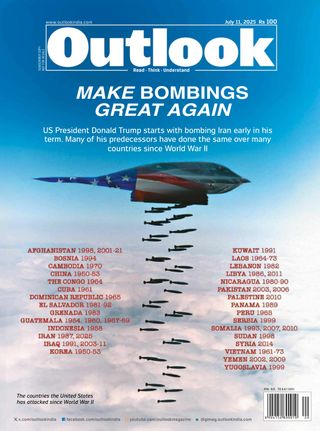

This story is from the July 11, 2025 edition of Outlook.
Subscribe to Magzter GOLD to access thousands of curated premium stories, and 10,000+ magazines and newspapers.
Already a subscriber? Sign In
MORE STORIES FROM Outlook

Outlook
'Why GDP Growth Doesn't Always Translate Into Votes'
The recent election results have once again shown that economic growth alone does not guarantee electoral victory.

3 mins
June 06, 2026
Outlook
Lights, Camera, Othering
The establishment of Israel has been accompanied by a national cinema devoted to negating and erasing the Palestinian Other
5 mins
June 06, 2026

Outlook
Goodbye to All That
Booker-winning British author Julian Barnes' Departure(s) is a unique hybrid work: playful, philosophical, whimsical
4 mins
June 06, 2026

Outlook
Collapse of Trust
As the NEET-UG 2026 paper leak forced the cancellation of India’s biggest medical entrance exam, more than 22 lakh aspirants find themselves trapped in uncertainty
11 mins
June 06, 2026

Outlook
NO LONGER A TWELFTH MAN
Bihar cricket, which has languished in the shadows for long, is all set to improve its strike rate, thanks to Vaibhav Sooryavanshi, the new Bihari kid on the block
5 mins
June 06, 2026

Outlook
BLAZE OF GLORY
The challenges of being a celebrity cricketer at a young age can be tough to handle
5 mins
June 06, 2026

Outlook
THE SWASHBUCKLERS
A new generation of fearless stars is emerging and finding its feet at the very top of an extremely competitive cricketing environment
5 mins
June 06, 2026

Outlook
THE TEEN TORNAD
At the age of 15, Vaibhav Sooryavanshi is already a cricketing legend
10 mins
June 06, 2026

Outlook
A Journey to Remember
The prerecorded message crackled over the din in the compartment: ‘Welcome to the Shatabdi Express.
4 mins
June 06, 2026

Outlook
Crossing Borders
Ruth Martin is the translator of German-Iranian author Shida Bazyar’s novel The Nights are Quiet in Tehran (originally written in German), which has been shortlisted for the 2026 International Booker Prize.
4 mins
June 06, 2026
Listen
Translate
Change font size