
Go Unlimited with Magzter GOLD
Get unlimited access to 10,000+ magazines, newspapers and Premium stories for just
Try GOLD - Free
ASK OHJ
Old House Journal
|January - February 2026
For the past year or so, the brick surround of my fireplace (below the opening, underneath a stone hearth) has been producing a white-ish dust.
-
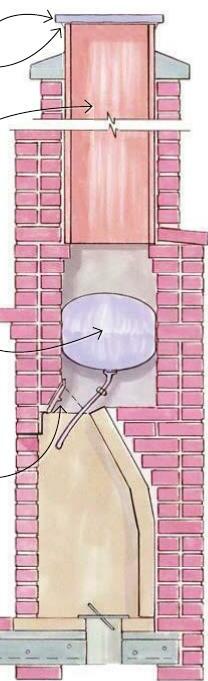
WHITE DUST ON BRICK?
The fireplace is over a crawlspace; both the crawlspace and one foot of the first floor flooded during Hurricane Sandy, in 2012. We had the entire first floor torn up and refinished and did the necessary remediation in the crawlspace. It appears that the white substance is “growing” on the mortar. What is causing the white dust, and what, if anything, can I do about it?
—Sharon Streger, Fairfield, Conn.
JOHN CARROLL, a North Carolina mason and author of The Complete Visual Guide to Building a House, responds: The white stains on your brick hearth were, and may still be, caused by excessive moisture in the masonry. When brick gets saturated, water-soluble compounds in the bricks and mortar dissolve. Then, as the surface of the masonry dries, these compounds are left behind in the form of white powder or stains.
This process, called efflorescence, comes in two forms.
Water-soluble efflorescence is caused by the leaching of dissolved salts to the surface. This type is powdery and can be washed away with clean water and a brush.
Water-insoluble efflorescence, or calcium-carbonate staining, is caused by the dissolution and leaching of calcium hydroxide to the surface. Calcium hydroxide does not dissolve as easily as salt and occurs only in the presence of heavy, prolonged saturation, such as a flood. When it reacts to the carbon dioxide in the air, the calcium hydroxide hardens and becomes a water-insoluble calcium-carbonate stain, removable only with masonry cleaning solutions. Calcium hydroxide is present in both portland cement and lime, so the calcium carbonate stains usually appear at mortar joints.


This story is from the January - February 2026 edition of Old House Journal.
Subscribe to Magzter GOLD to access thousands of curated premium stories, and 10,000+ magazines and newspapers.
Already a subscriber? Sign In
MORE STORIES FROM Old House Journal
Old House Journal
Un-muddling!
MAKING IT WRIGHT The Ross Home was completed in 1916 as part of a small subdivision called Ravine Bluffs, in Glencoe, Illinois, designed by Frank Lloyd Wright.

1 min
May - June 2026

Old House Journal
Vintage, Retro, Wow
For their own house, this artistic pair created an eclectic farmhouse kitchen.
3 mins
May - June 2026

Old House Journal
New Window in a Brick House
Redundant flashings and attention to detail keep out air and water.
6 mins
May - June 2026

Old House Journal
Interpreting MCM, outdoors
ADOPTING A MID-CENTURY HOUSE, A GARDENER IS INSPIRED BY THE EXPANSIVE VIEWS FROM INSIDE TO CREATE AN INTERPRETIVE LANDSCAPE—THINKING OUTSIDE THE (GLASS) BOX.
4 mins
May - June 2026

Old House Journal
stewards of home PAST & FUTURE
In Milwaukee, a striking limestone Tudor retains its history as it gains luxury and function through a deft renovation.
3 mins
May - June 2026

Old House Journal
Eichlers get an upgrade
Performance improvements for the prized homes of an influential developer who wanted us all to be able to own one.
7 mins
May - June 2026

Old House Journal
Houses Before 1800
These are survivors in styles ancient and vernacular.
1 min
May - June 2026

Old House Journal
Weaving Sidewall Shingle Corners
Some house styles and shingle applications don't rely on corner boards. Here's how to make an attractive, waterproof corner.
2 mins
May - June 2026

Old House Journal
serenity IN A LANDMARK HOUSE
In Berkeley, a preservation-minded couple reinvigorate a picturesque 1914 house designed by famed California architect Julia Morgan.
4 mins
May - June 2026

Old House Journal
SITE-BUILT TRIM RACK
I built this trim rack because I wanted our job sites to be more efficient and organized.
1 min
May - June 2026
Listen
Translate
Change font size