
Go Unlimited with Magzter GOLD
Get unlimited access to 10,000+ magazines, newspapers and Premium stories for just
Try GOLD - Free
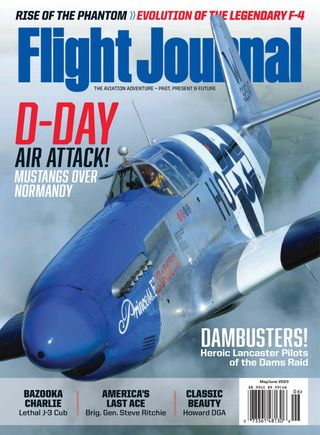
RISE OF THE PHANTOM - Evolution of the Legendary F-4
Flight Journal
|May - June 2023
IT WAS MAY 10, 1972, when four Air Force F-4D Phantoms, using their AIM-7 Sparrow missiles, initiated a head-on engagement with a four-ship formation of MiG-21s. The MiGs had no weapons capable of engaging from a fontal aspect. Oyster Flight was part of a 28-ship F-4D prestrike MiGCAP configured to intercept any Vietnamese People’s Air Force (VPAF) MiGs that might attack the 92-plane strike force that followed. The target was the Paul Doumer Bridge, part of the highway network from China into Hanoi.

A pair of German-owned F-4F Phantom IIs fly over New Mexico during a training sortie. The German F-4Fs sported U.S. Air Force markings since they were based at Holloman AFB, New Mexico (for the better weather and ranges). Both U.S. and German instructors manned the unit, the 20th Fighter Squadron. (Photo by Ted Carlson/fotodynamics.com) Disco, an EC-12 1 radar aircraft, had warned of MiG-21 “Fishbeds” departing the VNAF’s Kep Air Base near Hanoi. In addition, Red Crown, which provided radar coverage from the USS Chicago, manned by Radioman Larry Nowell, reported four separate MiG elements just getting airborne. After repeatedly feinting towards the Phantoms, at 0942 hours the MiGs headed for the area where the MiGCAP interceptors were orbiting. Oyster Flight had turned to meet them. Oyster 01, flown by Maj. Robert Lodge and WSO (Weapons System Officer) Capt. Roger Locher (a crew with two previous kills), enjoyed a “missilefree” condition, wherein visual identification was not required. They were also equipped with newly acquired Combat Tree capability, wherein they could see the enemy’s IFF (Identification Friend or Foe) on their radar. (This was thanks to covert acquisition of Soviet IFF transponders from the Israelis.) At eight nautical miles and at 1.4 Mach, Maj. Lodge fired a single AIM-7. The missile climbed and tracked but detonated early when its motor burned out. Lodge then fired a second and saw the missile climbing about 20 degrees towards its still invisible target.

This story is from the May - June 2023 edition of Flight Journal.
Subscribe to Magzter GOLD to access thousands of curated premium stories, and 10,000+ magazines and newspapers.
Already a subscriber? Sign In
MORE STORIES FROM Flight Journal

Flight Journal
RESCUE CATS -PBY Catalina crews save airmen from hostile seas
\"TO A COLD, WET AND HUNGRY AIRMAN, sitting in a rubber dinghy in enemy waters, 600 miles from the nearest friendly base and 600 yards from the nearest enemy installation, the PBY is a breathtakingly beautiful sight.

16 mins
May - June 2026
Flight Journal
A ROLL OF THE DICE
A lucky Liberator crew survives
13 mins
May - June 2026
Flight Journal
DH Sea Vixen
ARGUABLY ONE OF THE MOST IMPRESSIVE CLASSIC JETS, even nearly seven decades after the type entered service, surely is the DH Sea Vixen “Foxy Lady” XP924 (civil registration G-CVIX).
2 mins
May - June 2026
Flight Journal
DESPERATE FIGHT! French fighters of WW II
HISTORY HAS A WAY OF REWRITING ITSELF.
9 mins
May - June 2026

Flight Journal
Powering the Age of Flight
GLENN HAMMOND CURTISS (1878-1930) was often called “The Colossus of Aviation” with good reason.
2 mins
May - June 2026
Flight Journal
DESPERATE MEASURES
Volksjäger, the Luftwaffe's last hope
10 mins
January - February 2026
Flight Journal
THE Fairey Swordfish
Antiquated, yet devastatingly effective
14 mins
January - February 2026
Flight Journal
Tuskegee RED TAILS
The men, the machines, the missions
11 mins
January - February 2026
Flight Journal
THE HIGH-VELOCITY RAPTOR
The F-22A thrust vectoring system is the “bread and butter” of the Raptor's incredible maneuvering capability.
14 mins
January - February 2026
Flight Journal
Mitchells over the Mediterranean
Wavetop warfare: skip-bombing and big guns
13 mins
January - February 2026
Translate
Change font size