Try GOLD - Free
BMI: IT'S FLAWED, SO WHY DO WE USE IT?
BBC Focus - Science & Technology
|June 2021
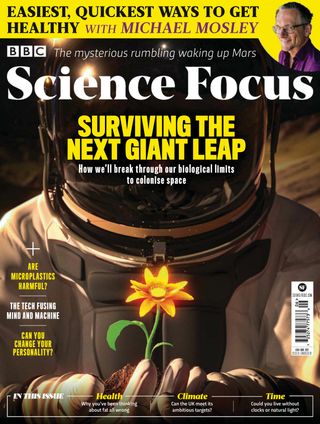
A report published by the Women and Equalities Committee says that the use of the Body Mass Index should be scrapped. Is there a better way to calculate if you’re a healthy weight?

Barely a day goes by without a news piece or television documentary breathlessly reporting on the current pandemic of obesity. Nearly 60 per cent of us in the UK and US are either overweight or living with obesity. Where does this ominous 60 per cent figure originate from? Well, it has emerged from population-wide BMI statistics.
BMI, or Body Mass Index, is the ratio of body weight in kilograms divided by the square of one’s height in meters, and hence is represented as kg/m2. A ‘normal’ BMI is 20-25kg/m2. Anything below a BMI of 18 would be considered underweight, a BMI of 25-30kg/m2 is considered overweight, and if you have a BMI north of 30kg/m2, you would be classed as living with obesity. The reputation of BMI however, has in recent years been tarnished. At best, it’s considered a poor proxy for fat mass and health; at its worst, it can and often is used as a cudgel to ‘fat-shame the larger among us in society. But what has BMI done to deserve this, and should it be replaced with anything else?
The problem is that BMI as a measure of ‘fatness’ is flawed because it is derived using purely your weight and your height. Thus it cannot, for instance, differentiate between a rugby player and a Joe Public of similar height and weight, but carrying substantially more fat. So why not just measure the amount of fat instead?

This story is from the June 2021 edition of BBC Focus - Science & Technology.
Subscribe to Magzter GOLD to access thousands of curated premium stories, and 10,000+ magazines and newspapers.
Already a subscriber? Sign In
MORE STORIES FROM BBC Focus - Science & Technology

BBC Science Focus
HEALTH: Eating oats could lower your cholesterol in just two days
The health benefits of a two-day porridge diet lasted for weeks afterwards

1 mins
April 2026

BBC Science Focus
Most people are too sure they can identify fake human faces
Even 'super recognisers' struggle with the challenge. Can you do better?
1 min
April 2026

BBC Science Focus
WHAT'S THE WORST THING YOU CAN DO FOR THE PLANET ONLINE?
Human beings can barely move a muscle without some kind of deleterious effect on the environment around us.
2 mins
April 2026

BBC Science Focus
A bug in the system
The complex arrangement of equipment you see here is part of a particle accelerator.
1 min
April 2026

BBC Science Focus
Snug as a bug in a rug
At first glance, you might feel envious of this little leafhopper, swaddled beneath the folds of what appears to be a luxurious fur blanket.
1 min
April 2026

BBC Science Focus
WHY DO WE ROOT FOR THE VILLAIN IN MOVIES?
Whether it's Darth Vader or Cruella de Vil, we all have a favourite movie villain.
1 mins
April 2026

BBC Science Focus
A TURN TO DISPERSE
Why a fart walk after dinner does more than release your gas
3 mins
April 2026
BBC Science Focus
Hatching a nebula
Welcome to the Egg Nebula, an enigmatic structure formed by ejected stardust in the Cygnus constellation around 1,000 light-years from Earth.
1 min
April 2026

BBC Science Focus
7 TIMES AI GOT IT SPECTACULARLY WRONG
For the past four years, AI has been reshaping how we work and live. But its failures are proving just as transformative as its triumphs
8 mins
April 2026
BBC Science Focus
CHARLES ADCOCK, VIA EMAIL: COULD DARK MATTER BE ALL AROUND PLANET EARTH BUT UNDETECTABLE?
Astronomers have gathered overwhelming evidence that 80 per cent of all matter in the Universe is invisible.
1 min
April 2026
Translate
Change font size