Try GOLD - Free
We Are All Harappans
Outlook
|August 13, 2018
The Rakhigarhi project shines light on an old enigma: the Harappans were genetically ‘Ancestral South Indian’ stock. Which is to say, all of us in South Asia are their children.

JUST three-and-a-half hours due northwest of Delhi, the GPS takes you unerringly to ancient India. Not a mythic world, but one made of bricks dried in an age-old sun. It’s a part of Haryana that can pass, at one glance, for Assam: the wet green of paddy stretches to the flat, misty horizons. Some spans of time are as endless—it boggles the mind, for instance, to think that the duration between the early onset of civilisation and its decline in these parts is longer than what separates us now from Harappa.
Or shall we say, Rakhigarhi.
Yes, the shift in centre of gravity is as fundamental as that. The Harappan site at Rakhigarhi, in Hisar district, is the biggest one known yet—at up to 550 hectares, it’s more than twice the size of Mohenjodaro. It’s also the one with the deepest time-scale, taking shape at 5500 BC and running four millennia. The nearby satellite site of Bhirrana, part of this Bronze Age metropolitan network, is even older: it offers the classic arc of evolution, beginning from early Neolithic farming around 7500 BC. Almost 10 millennia ago. Even with India’s endless capacity for imagining deep time, that’s serious depth. On the edge of modern Rakhigarhi village, buffaloes amble out of a pond placidly, unmindful of passing archaeologists or of the runic mysteries glimmering under the undulating mounds.
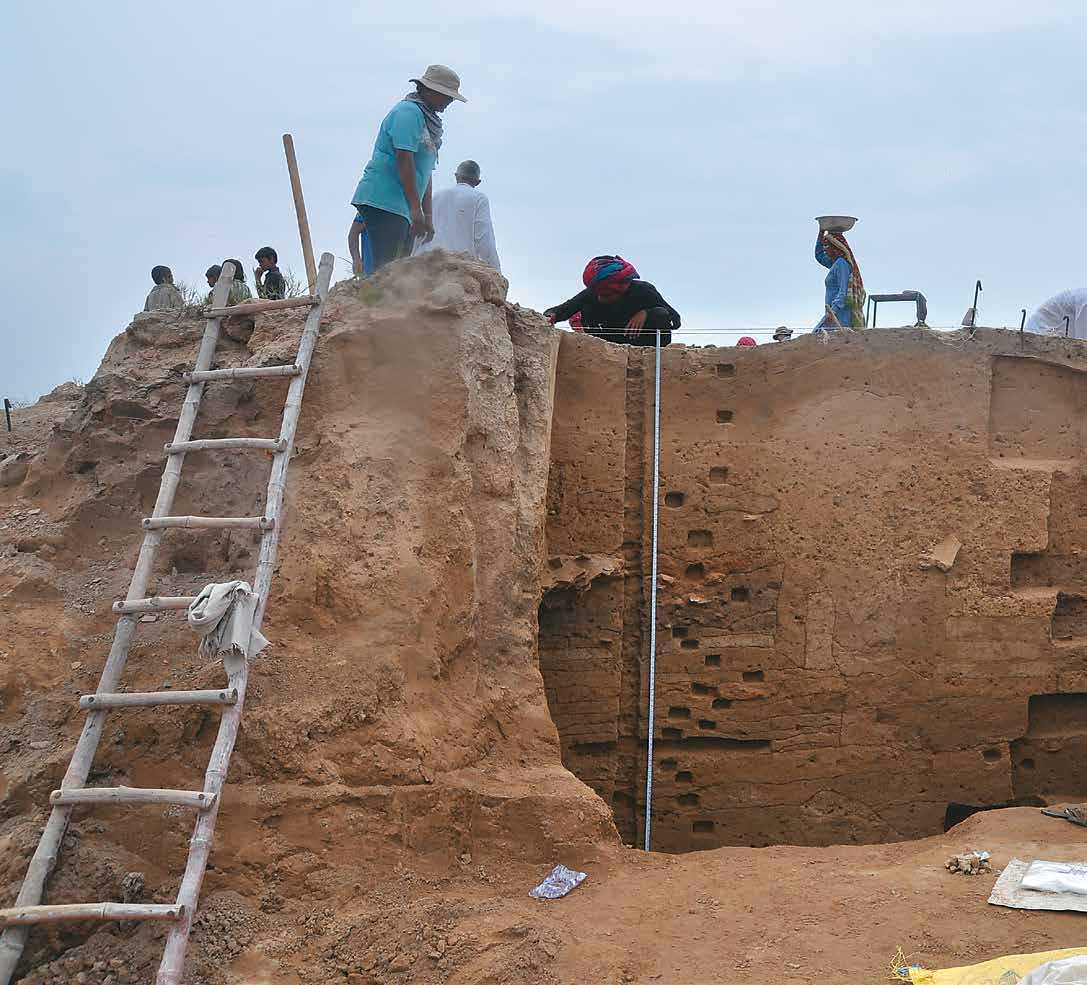
Decades ago, Wazir Chand would come to these mounds as a dreamy little boy tending to his buffaloes. He started picking up pieces of terracotta bangles, shards of pottery, little bric-a-brac…
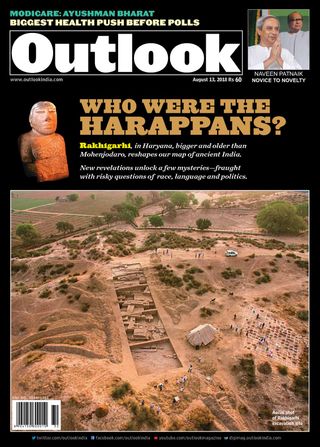

This story is from the August 13, 2018 edition of Outlook.
Subscribe to Magzter GOLD to access thousands of curated premium stories, and 10,000+ magazines and newspapers.
Already a subscriber? Sign In
MORE STORIES FROM Outlook
Outlook
'Why GDP Growth Doesn't Always Translate Into Votes'
The recent election results have once again shown that economic growth alone does not guarantee electoral victory.

3 mins
June 06, 2026

Outlook
Lights, Camera, Othering
The establishment of Israel has been accompanied by a national cinema devoted to negating and erasing the Palestinian Other
5 mins
June 06, 2026

Outlook
Goodbye to All That
Booker-winning British author Julian Barnes' Departure(s) is a unique hybrid work: playful, philosophical, whimsical
4 mins
June 06, 2026

Outlook
Collapse of Trust
As the NEET-UG 2026 paper leak forced the cancellation of India’s biggest medical entrance exam, more than 22 lakh aspirants find themselves trapped in uncertainty
11 mins
June 06, 2026

Outlook
NO LONGER A TWELFTH MAN
Bihar cricket, which has languished in the shadows for long, is all set to improve its strike rate, thanks to Vaibhav Sooryavanshi, the new Bihari kid on the block
5 mins
June 06, 2026

Outlook
BLAZE OF GLORY
The challenges of being a celebrity cricketer at a young age can be tough to handle
5 mins
June 06, 2026

Outlook
THE SWASHBUCKLERS
A new generation of fearless stars is emerging and finding its feet at the very top of an extremely competitive cricketing environment
5 mins
June 06, 2026

Outlook
THE TEEN TORNAD
At the age of 15, Vaibhav Sooryavanshi is already a cricketing legend
10 mins
June 06, 2026
Outlook
A Journey to Remember
The prerecorded message crackled over the din in the compartment: ‘Welcome to the Shatabdi Express.
4 mins
June 06, 2026

Outlook
Crossing Borders
Ruth Martin is the translator of German-Iranian author Shida Bazyar’s novel The Nights are Quiet in Tehran (originally written in German), which has been shortlisted for the 2026 International Booker Prize.
4 mins
June 06, 2026
Translate
Change font size