
Go Unlimited with Magzter GOLD
Get unlimited access to 10,000+ magazines, newspapers and Premium stories for just
Try GOLD - Free
Rani & Rogues
Outlook
|December 04, 2017
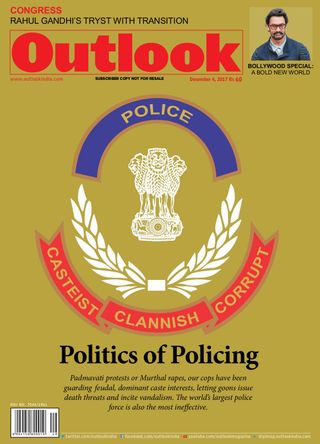
The contrast between the way the police dealt with protests by Dalits in UP’s Saharanpur and Rajputs in Rajasthan is part of a pattern of selective aggression and selective silence that goes deep and wide.

THE police. The very mention of the word could touch off conflicted responses. Frustration would be a universally shared feeling. Their presence is likely to bring on a sense of fear, rather than security. More troubling, however, is their absence—the patterns of where they choose not to be. This week brought a fresh instance in the controversy around Bollywood film Padmavati. The aggressive, violent protests by Rajputs have an unstated enabling factor: the silence of the police.
That hate speech could fill the airwaves with such impunity is a sign of how feudal attitudes and caste structures shield dominant groups, allowing them to use the state and the police to establish their writ. Contrast the role of police in two recent cases. One relates to Dalits, in UP’s Saharanpur. And the other is of the Rajputs, who overran two fort-palaces in Rajasthan, denied the public access to these popular tourist destinations and vandalised a theatre.
The leader of a caste outfit called Shree Rajput Karni Sena even threatened to disfigure top actress Deepika Padukone, who plays the lead role in Padmavati. An array of politicians too promised exorbitant “rewards” to “behead” Deepika and murder producer-director Sanjay Leela Bhansali. While Maharashtra has ramped up protection for the two, no police force has yet tried to arrest the rampaging clansmen.
The police in Rajasthan, where the protests began, have not tried to detain Karni Sena members. The rabble-rousers are roaming the country, delivering provocative speeches. They have arm-twisted authorities into delaying Padmavati’s release, while disrupting everyday life in Rajasthan and elsewhere. It’s almost as if they are the law.

This story is from the December 04, 2017 edition of Outlook.
Subscribe to Magzter GOLD to access thousands of curated premium stories, and 10,000+ magazines and newspapers.
Already a subscriber? Sign In
MORE STORIES FROM Outlook

Outlook
'Why GDP Growth Doesn't Always Translate Into Votes'
The recent election results have once again shown that economic growth alone does not guarantee electoral victory.

3 mins
June 06, 2026

Outlook
Lights, Camera, Othering
The establishment of Israel has been accompanied by a national cinema devoted to negating and erasing the Palestinian Other
5 mins
June 06, 2026

Outlook
Goodbye to All That
Booker-winning British author Julian Barnes' Departure(s) is a unique hybrid work: playful, philosophical, whimsical
4 mins
June 06, 2026

Outlook
Collapse of Trust
As the NEET-UG 2026 paper leak forced the cancellation of India’s biggest medical entrance exam, more than 22 lakh aspirants find themselves trapped in uncertainty
11 mins
June 06, 2026

Outlook
NO LONGER A TWELFTH MAN
Bihar cricket, which has languished in the shadows for long, is all set to improve its strike rate, thanks to Vaibhav Sooryavanshi, the new Bihari kid on the block
5 mins
June 06, 2026

Outlook
BLAZE OF GLORY
The challenges of being a celebrity cricketer at a young age can be tough to handle
5 mins
June 06, 2026

Outlook
THE SWASHBUCKLERS
A new generation of fearless stars is emerging and finding its feet at the very top of an extremely competitive cricketing environment
5 mins
June 06, 2026

Outlook
THE TEEN TORNAD
At the age of 15, Vaibhav Sooryavanshi is already a cricketing legend
10 mins
June 06, 2026

Outlook
A Journey to Remember
The prerecorded message crackled over the din in the compartment: ‘Welcome to the Shatabdi Express.
4 mins
June 06, 2026

Outlook
Crossing Borders
Ruth Martin is the translator of German-Iranian author Shida Bazyar’s novel The Nights are Quiet in Tehran (originally written in German), which has been shortlisted for the 2026 International Booker Prize.
4 mins
June 06, 2026
Translate
Change font size