Intentar ORO - Gratis
Rani & Rogues
Outlook
|December 04, 2017
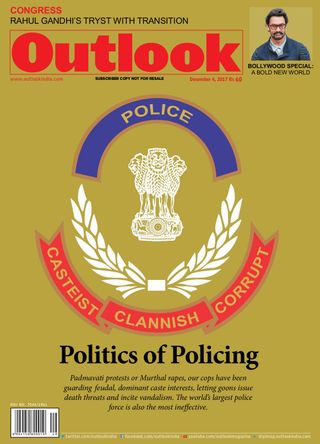
The contrast between the way the police dealt with protests by Dalits in UP’s Saharanpur and Rajputs in Rajasthan is part of a pattern of selective aggression and selective silence that goes deep and wide.

THE police. The very mention of the word could touch off conflicted responses. Frustration would be a universally shared feeling. Their presence is likely to bring on a sense of fear, rather than security. More troubling, however, is their absence—the patterns of where they choose not to be. This week brought a fresh instance in the controversy around Bollywood film Padmavati. The aggressive, violent protests by Rajputs have an unstated enabling factor: the silence of the police.
That hate speech could fill the airwaves with such impunity is a sign of how feudal attitudes and caste structures shield dominant groups, allowing them to use the state and the police to establish their writ. Contrast the role of police in two recent cases. One relates to Dalits, in UP’s Saharanpur. And the other is of the Rajputs, who overran two fort-palaces in Rajasthan, denied the public access to these popular tourist destinations and vandalised a theatre.
The leader of a caste outfit called Shree Rajput Karni Sena even threatened to disfigure top actress Deepika Padukone, who plays the lead role in Padmavati. An array of politicians too promised exorbitant “rewards” to “behead” Deepika and murder producer-director Sanjay Leela Bhansali. While Maharashtra has ramped up protection for the two, no police force has yet tried to arrest the rampaging clansmen.
The police in Rajasthan, where the protests began, have not tried to detain Karni Sena members. The rabble-rousers are roaming the country, delivering provocative speeches. They have arm-twisted authorities into delaying Padmavati’s release, while disrupting everyday life in Rajasthan and elsewhere. It’s almost as if they are the law.

Esta historia es de la edición December 04, 2017 de Outlook.
Suscríbete a Magzter GOLD para acceder a miles de historias premium seleccionadas y a más de 9000 revistas y periódicos.
¿Ya eres suscriptor? Iniciar sesión
MÁS HISTORIAS DE Outlook

Outlook
The Spectacle of the Woman Accused
Media narratives—especially when women are involved—can end up amplifying suspicion and weaponising gender

7 mins
March 11, 2026

Outlook
The Stink of Epstein
Why are the rich and powerful of the world scared of what lies buried in the Jeffrey Epstein files?
6 mins
March 11, 2026

Outlook
Passing the Watermelon
Narendra Modi's presence in Israel is being read not just as a bilateral engagement, but as an endorsement of Israeli action in Gaza and the West Bank
5 mins
March 11, 2026

Outlook
For Phoolan, Who Wasn't a Devi
“Whether or not it is the Truth is no longer relevant. The point is that it will, (if it hasn’t already) - become the Truth. Phoolan Devi, the woman has ceased to be important. (Yes of course she exists. She has eyes, ears, limbs, hair etc. Even an address now) But she is suffering from a case of Legenditis. She’s only a version of herself. There are other versions of her that are jostling for attention. Particularly Shekhar Kapur’s “Truthful” one, which we are currently being bludgeoned into believing.”–Arundhati Roy in ‘The Great Indian Rape-Trick I’, on the film Bandit Queen by Shekhar Kapur based on Phoolan, whom he never met because he didn’t think he needed to meet her. The film was based on journalist Mala Sen’s book India’s Bandit Queen: The True Story of Phoolan Devi.
5 mins
March 11, 2026

Outlook
The Chic Cartel
Women are not just victims or side characters in recent crime-and-power OTT dramas. They are complex forces-capable of empathy, strategy and ruthlessness-whose narratives demand both recognition and reckoning
5 mins
March 11, 2026

Outlook
The Hierarchy of Sympathy
In crimes against women, justice is shaped not only in courtrooms but in newsrooms where narrative determines whose suffering becomes national conscience and whose fades into procedural silence
5 mins
March 11, 2026

Outlook
Dasyu Sundari
Media accounts simultaneously cast her as victim and avenger, until a life shaped by caste violence and gendered oppression was repackaged into a consumable myth of dishonour and revenge
8 mins
March 11, 2026

Outlook
Prince Pervert
Are rumours of the death of the rule of law vastly exaggerated?
4 mins
March 11, 2026
Outlook
Together, Apart
Poonam Saxena's translations of Mannu Bhandari and Rajendra Yadav's memoirs present a portrait of the trailblazing Hindi writer-couple's marriage and of newly independent India
3 mins
March 11, 2026

Outlook
The Great Indian Rape Trick'
The trope of transforming sexual violence against women into a springboard for rage that can only be channelled through counter-violence has long served as a popular framework in cinema, both globally and in India
6 mins
March 11, 2026
Translate
Change font size