Poging GOUD - Vrij
NEED NOT BE A DIRTY AFFAIR
Down To Earth
|September 01, 2025
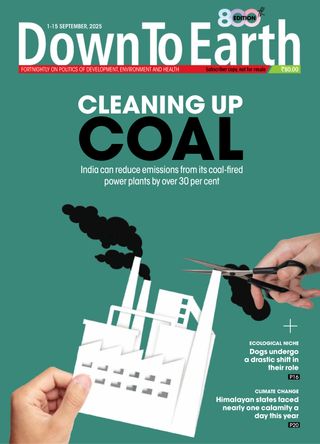
The potential to reduce emissions from India's coal-based thermal power plants is huge, and it needs more than just shifting to efficient technologies.
THE SUPREME Court has recently asked the Union Ministry of Power to convene an urgent meeting with the country's top energy regulators-the Central Electricity Authority (CEA) and the Central Electricity Regulatory Commission (CERC)—to prepare an action plan for slashing greenhouse gas emissions from the power sector. The court's directive came in response to a petition by Ridhima Pandey, a 17-year-old climate activist from Uttarakhand, who urged the judiciary to take action against climate change through stricter measures. Acknowledging that climate change has ascended as one of the most existential global predicaments, wielding profound ramifications beyond mere environmental degradation, escalating temperatures, erratic weather patterns, the court stated: “it is compelling for individuals and institutions to converge and adopt a coordinated effort to effecting deal with the emerging situations. We now propose to consider the impact of power generation and the consequential carbon emissions on climate change.” The court had asked the ministry and the electricity regulatory bodies to submit the action plan by August 19. While the authorities have sought more time to formulate a decarbonisation plan, the Centre for Science and Environment (CSE), a research and advocacy organisation in Delhi, has prepared a roadmap that may offer valuable guidance.
The report, titled "Decarbonizing the coal-based thermal power sector in India", analyses the current and future emissions from coal-based power plants, which are largely responsible for power sector emissions, and identifies significant opportunities to reduce greenhouse gas (GHG) emissions from these plants. The report states that decarbonising the thermal power sector in India could lead to a reduction of over 30 per cent in GHG emissions by 2031-32. This is more than the combined emissions from two other hard-to-abate sectors: iron and steel, and cement.

Dit verhaal komt uit de September 01, 2025-editie van Down To Earth.
Abonneer u op Magzter GOLD voor toegang tot duizenden zorgvuldig samengestelde premiumverhalen en meer dan 9000 tijdschriften en kranten.
Bent u al abonnee? Aanmelden
MEER VERHALEN VAN Down To Earth

Down To Earth
KING OF BIRDS
Revered for centuries, western tragopan now needs protection as its forests shrink, human pressures mount

3 mins
December 16, 2025

Down To Earth
WHISKERS ALL AQUIVER
Climate change threatens creatures that have weathered extreme environments for thousands of years
2 mins
December 16, 2025

Down To Earth
GOLDEN SPIRIT
Survival of the shy primate is closely tied to the health of Western Ghats
3 mins
December 16, 2025

Down To Earth
RINGED EYES IN THE CANOPY
Rapid habitat destruction forces arboreal langur to alter habits
2 mins
December 16, 2025

Down To Earth
HANGING BY THE CLIFF
The Himalaya's rarest wild goat is on the brink of local extinction
2 mins
December 16, 2025

Down To Earth
ANGEL OF THE BEAS
Conservation reserves, citizen science, and habitat protection give the Indus River dolphin a fighting chance in India
2 mins
December 16, 2025

Down To Earth
UNDER MOONLIT SCRUB
Survival of this hidden guardian tells us whether our scrublands still breathe
2 mins
December 16, 2025

Down To Earth
SYMBOL OF SILENT VALLEY
Lion-tailed macaque remains vulnerable despite past victories
2 mins
December 16, 2025

Down To Earth
THE APE IN OUR STORIES
India's only non-human ape species is a cultural icon threatened by forest fragmentation
2 mins
December 16, 2025

Down To Earth
SENTINEL OF THE HIGH COLD DESERT
The bird's evocative call may not continue to roll across the cold desert valley for long
3 mins
December 16, 2025
Listen
Translate
Change font size