يحاول ذهب - حر
NEED NOT BE A DIRTY AFFAIR
September 01, 2025
|Down To Earth
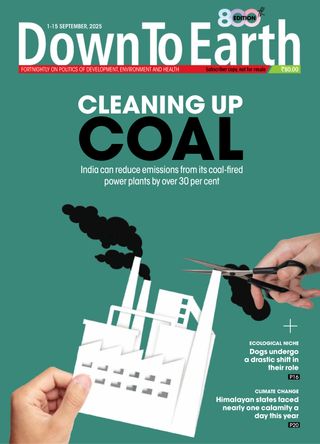
The potential to reduce emissions from India's coal-based thermal power plants is huge, and it needs more than just shifting to efficient technologies.
THE SUPREME Court has recently asked the Union Ministry of Power to convene an urgent meeting with the country's top energy regulators-the Central Electricity Authority (CEA) and the Central Electricity Regulatory Commission (CERC)—to prepare an action plan for slashing greenhouse gas emissions from the power sector. The court's directive came in response to a petition by Ridhima Pandey, a 17-year-old climate activist from Uttarakhand, who urged the judiciary to take action against climate change through stricter measures. Acknowledging that climate change has ascended as one of the most existential global predicaments, wielding profound ramifications beyond mere environmental degradation, escalating temperatures, erratic weather patterns, the court stated: “it is compelling for individuals and institutions to converge and adopt a coordinated effort to effecting deal with the emerging situations. We now propose to consider the impact of power generation and the consequential carbon emissions on climate change.” The court had asked the ministry and the electricity regulatory bodies to submit the action plan by August 19. While the authorities have sought more time to formulate a decarbonisation plan, the Centre for Science and Environment (CSE), a research and advocacy organisation in Delhi, has prepared a roadmap that may offer valuable guidance.
The report, titled "Decarbonizing the coal-based thermal power sector in India", analyses the current and future emissions from coal-based power plants, which are largely responsible for power sector emissions, and identifies significant opportunities to reduce greenhouse gas (GHG) emissions from these plants. The report states that decarbonising the thermal power sector in India could lead to a reduction of over 30 per cent in GHG emissions by 2031-32. This is more than the combined emissions from two other hard-to-abate sectors: iron and steel, and cement.

هذه القصة من طبعة September 01, 2025 من Down To Earth.
اشترك في Magzter GOLD للوصول إلى آلاف القصص المتميزة المنسقة، وأكثر من 9000 مجلة وصحيفة.
هل أنت مشترك بالفعل؟ تسجيل الدخول
المزيد من القصص من Down To Earth

Down To Earth
BEYOND COLLATERAL DAMAGE
Recent geopolitical conflicts are urging a reconsideration of what constitutes environmental harm in war and the limits of existing legal frameworks

3 mins
April 01, 2026

Down To Earth
Masterstroke
Residents of a small Kerala town reject an inadequate state-led development blueprint and create their own master plan that prioritises protection of historic water systems and urban commons
4 mins
April 01, 2026

Down To Earth
Rethinking E20
It is pertinent to explore potential of ethanol as high-value industrial feedstock
4 mins
April 01, 2026
Down To Earth
Food in the age of climate change
WHEN WE eat, we contribute to climate change. But food is also about livelihoods, about nutrition and about nature.
3 mins
April 01, 2026

Down To Earth
FADING WINTER
India's winters are warming, becoming shorter, shifting and spilling beyond their traditional bounds. The consequences are already evident in meltwater availability, forest-fire intensity and changes in flowering cycles and insect behaviour.
20 mins
April 01, 2026
Down To Earth
War on Iran strikes India's pharmaceuticals sector
Shortages of critical raw materials and rising input costs for the drug industry will have global consequences
4 mins
April 01, 2026

Down To Earth
POWER IN AN AGE OF INSECURITY
Energy transition is no longer solely about emission reduction but also about energy security
3 mins
April 01, 2026
Down To Earth
Re-discovery of fuelwood
THE WEST Asia conflict has made visible a multi-billion dollar energy market in India.
2 mins
April 01, 2026

Down To Earth
A CASE THAT RESHAPED INDIA'S ENVIRONMENT
The case of MC Mehta v Union of India stands as proof that a proactive judiciary can accelerate action even when the executive drags its feet
4 mins
April 01, 2026
Down To Earth
FOREVER DEPENDENT
India depends on global fertiliser supply chains for 70 per cent of its needs, leaving its food security exposed to geopolitical disruptions
6 mins
April 01, 2026
Listen
Translate
Change font size