Poging GOUD - Vrij
SENTINEL OF THE HIGH COLD DESERT
Down To Earth
|December 16, 2025
The bird's evocative call may not continue to roll across the cold desert valley for long
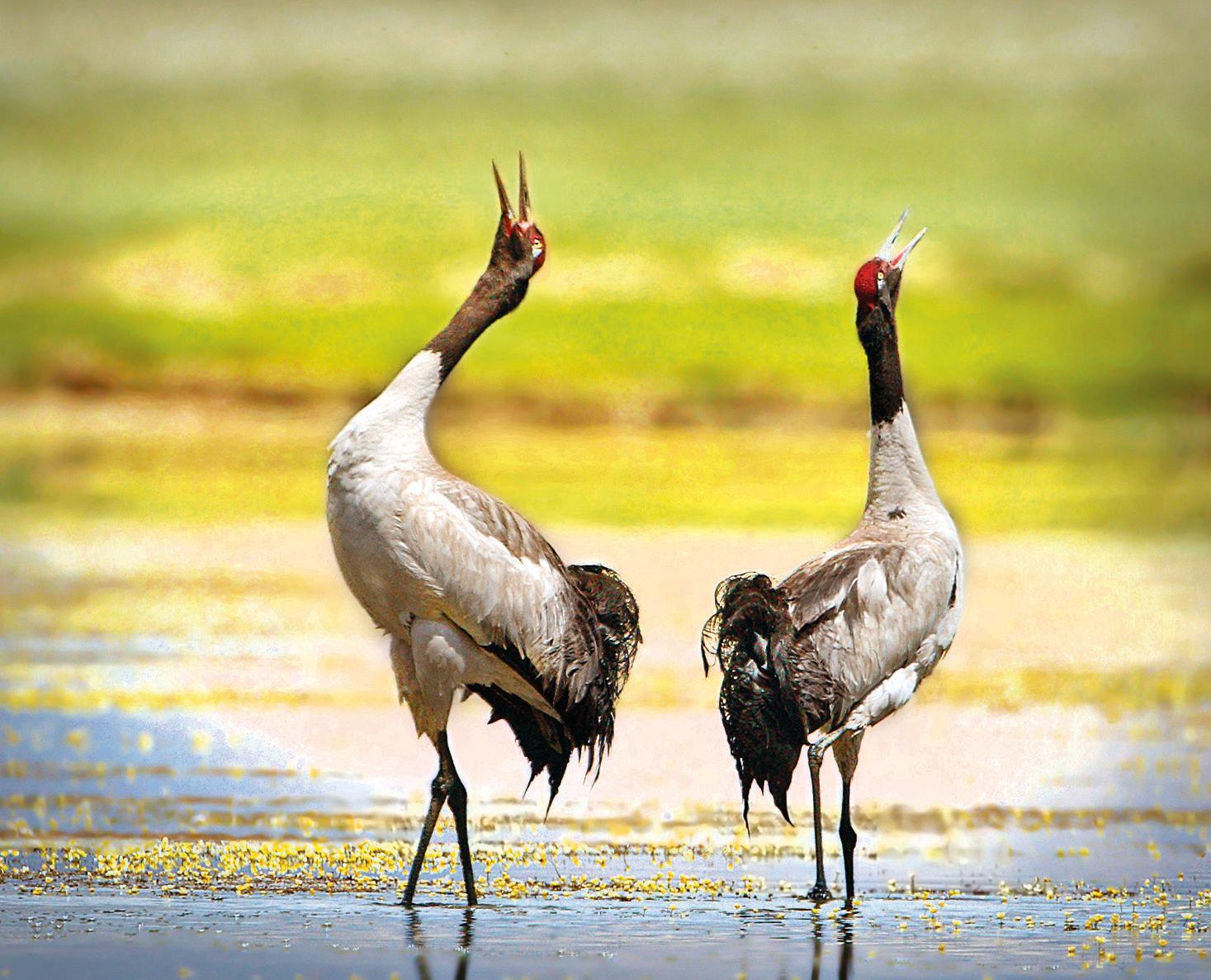
In the stark, windswept landscapes of the Tibetan and Trans-Himalayan plateau, a haunting, resonant call rises over the marshes each summer. It belongs to the black-necked crane, one of the region's most iconic birds. Standing nearly 1.4 metres tall, the crane cuts a striking figure: a largely whitish-grey body contrasted by a jet-black head and upper neck, splashes of red around the eye, and long, elegant legs built for wading through alpine bogs. Juveniles, cloaked in darker grey with a rusty tinge, shadow their parents as the family moves through meadows blooming with sedges and wildflowers.
Globally, only 13,000 to 15,000 black-necked cranes survive, most on the Qinghai-Tibetan plateau. The International Union for Conservation of Nature (IUCN) lists the species as Near Threatened. In India, particularly in Ladakh, its fragile population is edging downwards. Locally, the bird is known as “cha thung-thung” in Ladakh and “thungdung karma” in Arunachal Pradesh, names that echo through generations of pastoral communities who share the high-altitude wetlands with these cranes.


Dit verhaal komt uit de December 16, 2025-editie van Down To Earth.
Abonneer u op Magzter GOLD voor toegang tot duizenden zorgvuldig samengestelde premiumverhalen en meer dan 9000 tijdschriften en kranten.
Bent u al abonnee? Aanmelden
MEER VERHALEN VAN Down To Earth
Down To Earth
KING OF BIRDS
Revered for centuries, western tragopan now needs protection as its forests shrink, human pressures mount

3 mins
December 16, 2025

Down To Earth
WHISKERS ALL AQUIVER
Climate change threatens creatures that have weathered extreme environments for thousands of years
2 mins
December 16, 2025

Down To Earth
GOLDEN SPIRIT
Survival of the shy primate is closely tied to the health of Western Ghats
3 mins
December 16, 2025

Down To Earth
RINGED EYES IN THE CANOPY
Rapid habitat destruction forces arboreal langur to alter habits
2 mins
December 16, 2025

Down To Earth
HANGING BY THE CLIFF
The Himalaya's rarest wild goat is on the brink of local extinction
2 mins
December 16, 2025

Down To Earth
ANGEL OF THE BEAS
Conservation reserves, citizen science, and habitat protection give the Indus River dolphin a fighting chance in India
2 mins
December 16, 2025
Down To Earth
UNDER MOONLIT SCRUB
Survival of this hidden guardian tells us whether our scrublands still breathe
2 mins
December 16, 2025
Down To Earth
SYMBOL OF SILENT VALLEY
Lion-tailed macaque remains vulnerable despite past victories
2 mins
December 16, 2025

Down To Earth
THE APE IN OUR STORIES
India's only non-human ape species is a cultural icon threatened by forest fragmentation
2 mins
December 16, 2025

Down To Earth
SENTINEL OF THE HIGH COLD DESERT
The bird's evocative call may not continue to roll across the cold desert valley for long
3 mins
December 16, 2025
Listen
Translate
Change font size