Poging GOUD - Vrij
AGAINST THE GRAIN
Down To Earth
|March 16, 2025
India's two most valuable timbers-sandalwood and red sanders-have long been bound by restrictive regulations designed to curb illegal trade. Encouraged by the government decades ago with promises of windfall profits, farmers took to commercial cultivation, investing years of patience and effort. Now, as they prepare to harvest, a harsh reality is setting in-the promise of big profits is not quite holding up. HIMANSHU NITNAWARE travels to 19 villages across Karnataka, Andhra Pradesh and Telangana to explore the reasons
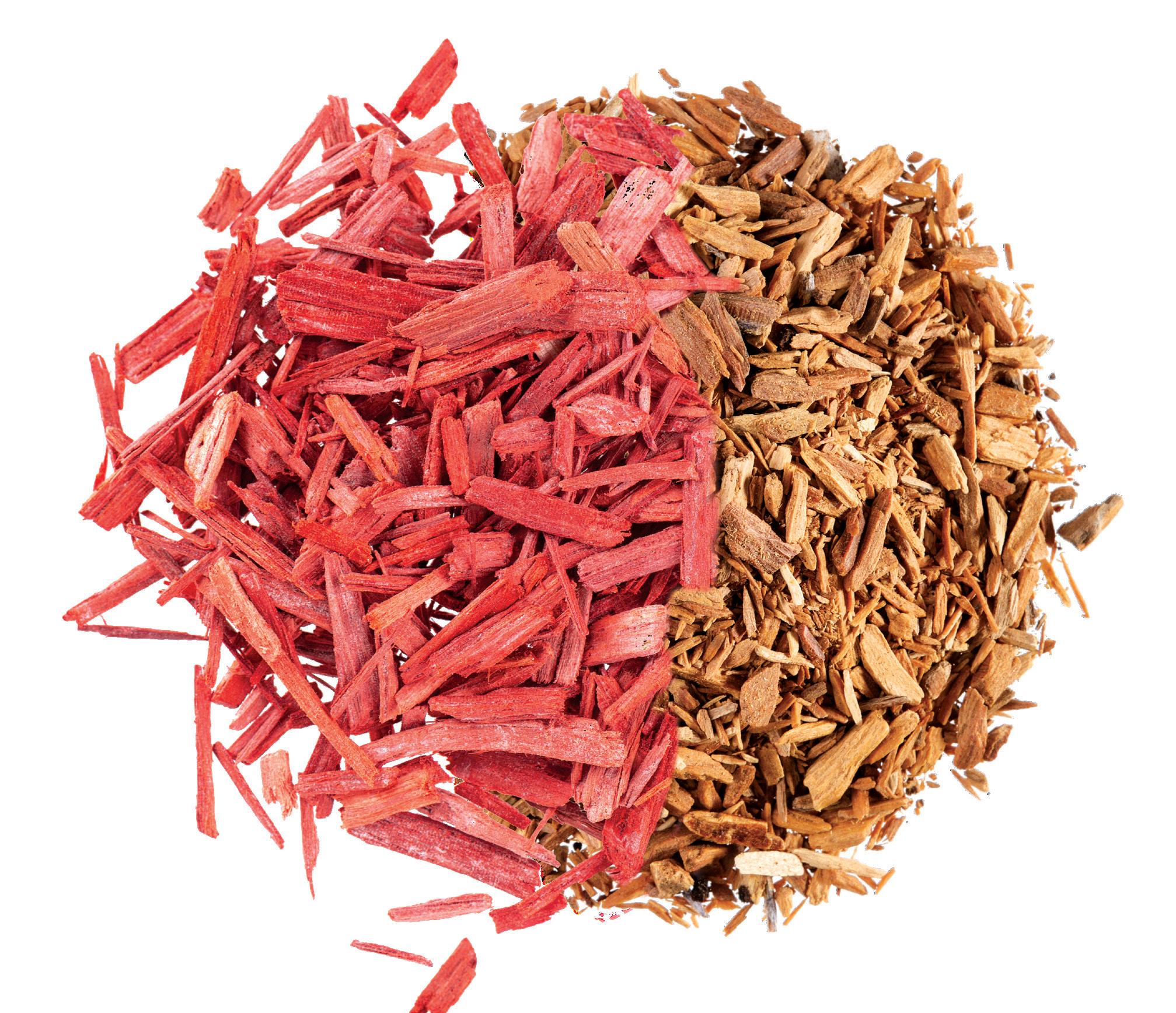
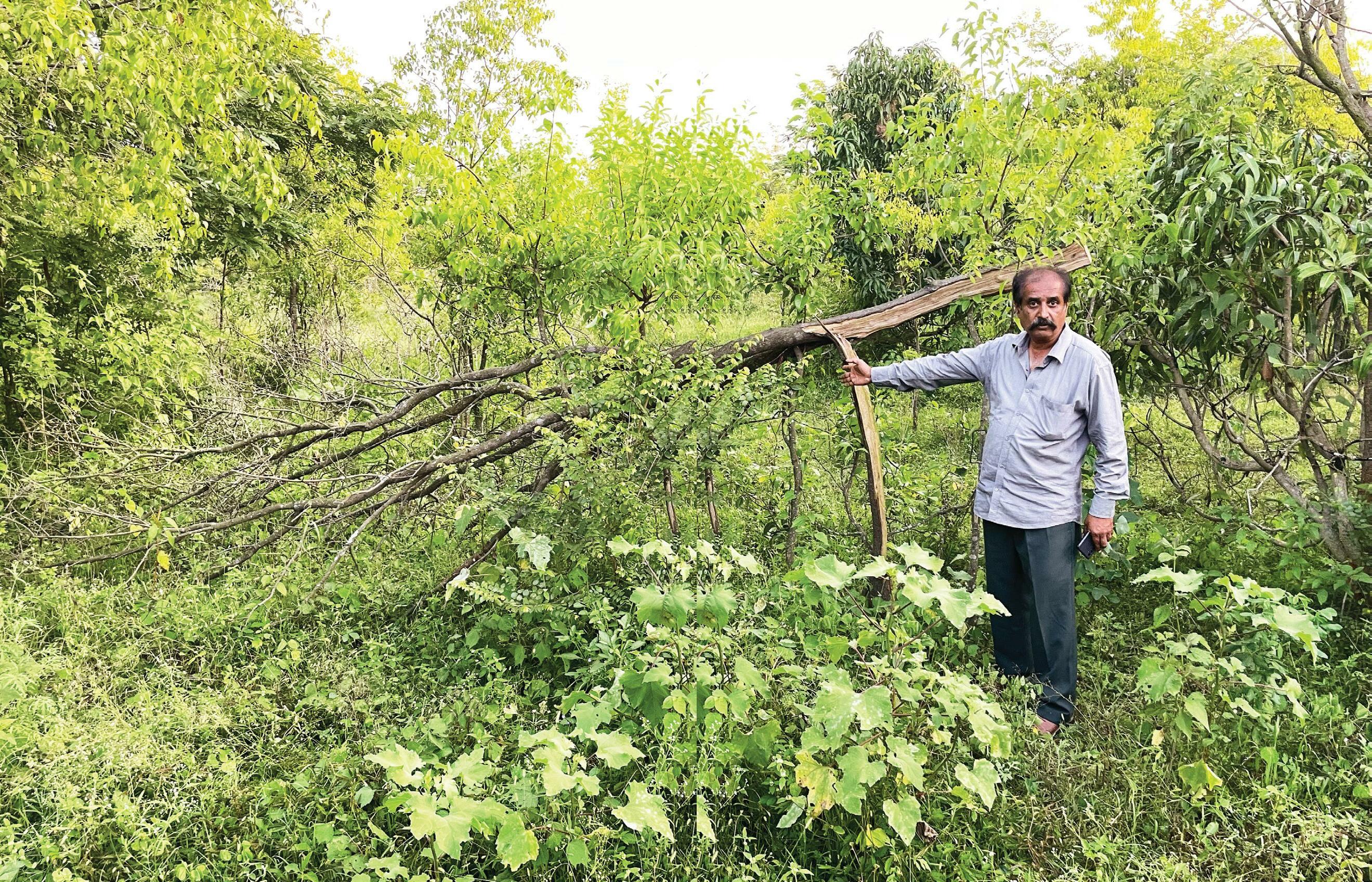
IN 2009, when K Sharanappa planted 1,000 sandalwood saplings across his 2.8-hectare (ha) farm, he was not just growing trees-he was staking his future on a once-forbidden trade. Indian sandalwood (Santalum album), one of the country's most commercially valuable tree species, is worth its weight in gold.
High-quality Indian sandalwood fetches up to ₹78 lakh per tonne (1,000 kg), earning it the nickname "dollar-earning parasite" in international markets. For Sharanappa, a resident of Karnataka's Adapura village in Koppal district, the plan was simple: in 15 years, the trees would mature, earning him a projected ₹4 crore-an amount several hundred times his modest salary as a police officer with the state government. "I timed it with my retirement in 2023. I would be financially secure and my sons would inherit a thriving business," he says.
"But it has now become a burden," he adds.
His voice, once filled with hope, now carries the weight of disillusionment.
Sharanappa is among the first group of sandalwood growers in Karnataka, home to almost 60 per cent of India's natural extent of sandalwood, according to a study published in Discover Applied Sciences in November 2024. He took up cultivation after Karnataka loosened its iron grip on the timber's trade two decades ago. In 1792, the erstwhile Mysore state declared it as the "Royal Tree". Since then, the harvesting and sale of sandalwood remained a government monopoly. Even if a tree grew naturally on private land, the owner had no rights over it-yet was responsible for its protection.

Dit verhaal komt uit de March 16, 2025-editie van Down To Earth.
Abonneer u op Magzter GOLD voor toegang tot duizenden zorgvuldig samengestelde premiumverhalen en meer dan 9000 tijdschriften en kranten.
Bent u al abonnee? Aanmelden
MEER VERHALEN VAN Down To Earth
Down To Earth
1,500 days, and an alarm for new climate
SEASONS ARE the compass that guide humans to survive and thrive as a society. What happens if seasons lose their distinct character and predictable rhythm? This is no longer a theoretical question. The Earth is entering a new climate regime, its atmosphere now saturated with greenhouse gases at levels without precedent in human history. And the earliest sign of this shift is the near-dissolution of familiar seasons; all merging and dissipating like the pupa inside the chrysalis, but, not to give birth to that mesmerising butterfly. This metamorphosis is manifest in the blizzard of weather events, extreme in severity and unseasonal by nature and geography.

2 mins
December 01, 2025
Down To Earth
Rights in transit
A recent dispute over transport and trade of kendu leaves in Odisha highlights differing interpretations of forest rights laws in the state
6 mins
December 01, 2025
Down To Earth
Roots of peace
Kerala's forest department plants fruit and fodder trees to ease human-wildlife tensions
2 mins
December 01, 2025

Down To Earth
Flattened frontiers
Efforts to reclaim degraded land from Chambal ravines expose both people and biodiversity to ecological risks from erosion and flooding
5 mins
December 01, 2025

Down To Earth
INDIA'S DRY RUN
India is poised to be a global hub of data centres—back-end facilities that house servers and hardware needed to run online activities.
21 mins
December 01, 2025

Down To Earth
Bangla generic drugs to the rescue
A buyer's club for generic cystic fibrosis drugs sourced from Bangladesh highlights the country's laudable pharma development
4 mins
December 01, 2025

Down To Earth
COP OF TALK
The UN's 30th climate summit, COP30 in Belém, was billed as the COP of truth and implementation.It was an opportunity for the world to move beyond diagnosis to delivery. Instead it revealed a system struggling to prove its relevance.
14 mins
December 01, 2025

Down To Earth
Direct approach
A new direct cash transfer scheme as well as decades of women-centric programmes yield an electoral windfall for the ruling alliance in Bihar
5 mins
December 01, 2025
Down To Earth
HIDDEN RESOURCE
Punjab's 1.4 million abandoned borewells offer a chance to mitigate flood damage and replenish depleting groundwater
4 mins
December 01, 2025
Down To Earth
Corporate bias
INDIA'S DRAFT Seeds Bill, 2025, introduced by the Centre in mid-November, proposes a few key changes.
1 min
December 01, 2025
Listen
Translate
Change font size