Poging GOUD - Vrij
Flattened frontiers
Down To Earth
|December 01, 2025
Efforts to reclaim degraded land from Chambal ravines expose both people and biodiversity to ecological risks from erosion and flooding
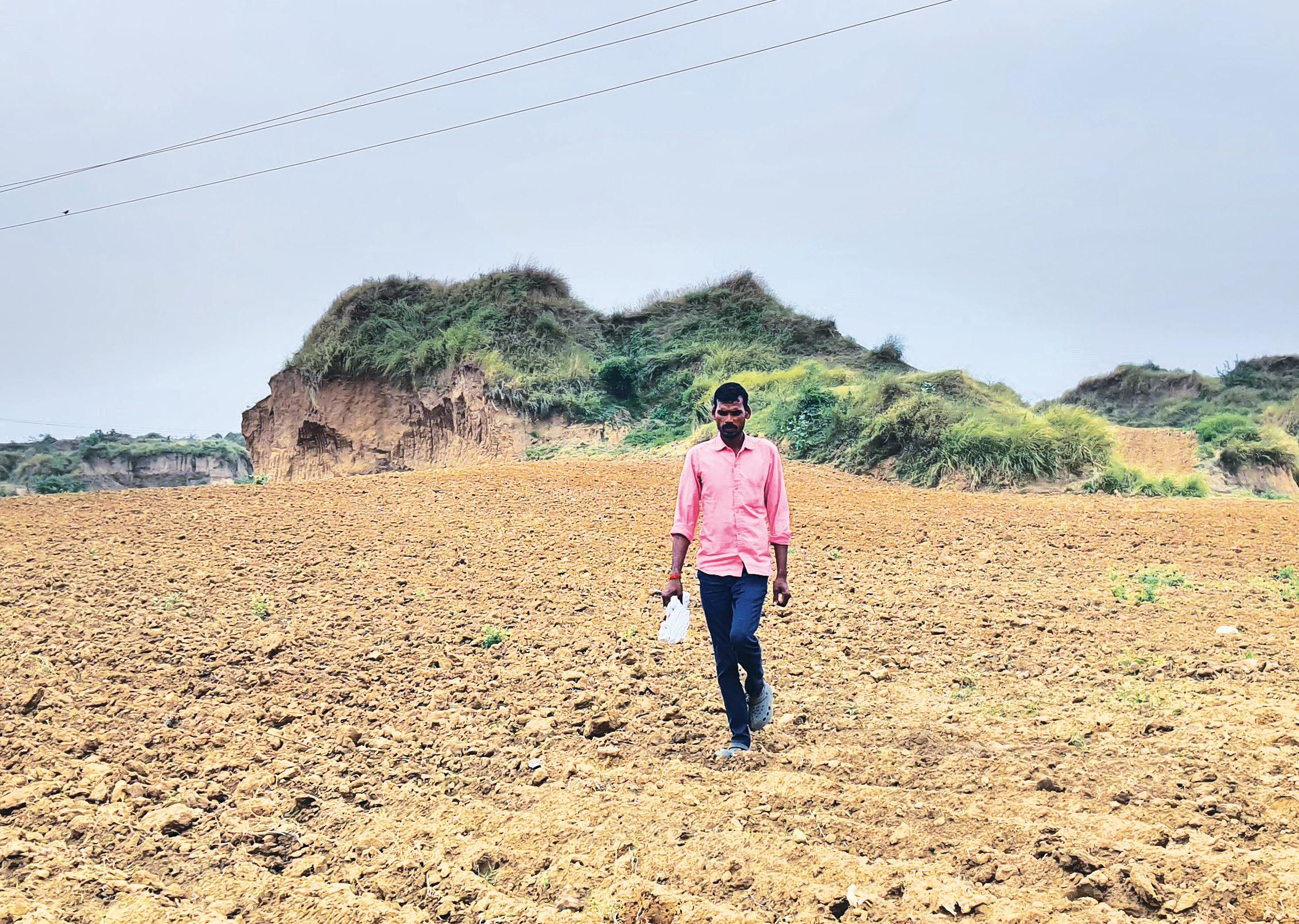
RAVINES OF Chambal evoke images of deep gullies along the Chambal river, long infamous as hideouts of dacoits. Today, however, these gorges face a different threat—encroachment by those seeking to “reclaim” the land.
Formed by erosion due to river flow or rainfall, ravines are steep, degraded landforms. The Chambal ravines, spanning Rajasthan, Uttar Pradesh and Madhya Pradesh, are often regarded as badlands or wastelands: severely degraded, unproductive and largely left unused.
Efforts have been on to utilise these lands through levelling, or flattening the terrains to make the slope gentler and more productive.
For instance, in Morena district of Madhya Pradesh, farmers have been levelling ravines in hopes of gaining cultivable land. Consider Rajghat, a popular spot for a Chambal river safari, located in Morena tehsil. “At least 10 km of ravines in Rajghat have been levelled,” says Bhagwan Singh Solanki, who has been working as a boatman for the safari for the past 32 years. Much of it is done by farmers of Bhanpur village, adjacent to Rajghat. According to resident Siyaram Meena, the village has 100 families; many of them have land holdings of only 2-5 bighas (0.4-1 hectare or ha; 5 bighas equal 1 ha). Lack of space, along with population growth and poor employment, force farmers to convert ravines.
The river safari also passes through Morena's Masoodpur village. Some 15 years ago, the village's farms were at least 5 km away from the Chambal, recalls Bhura Singh Gurjar, a resident. “Now, fields have reached the riverbank,” he says.
Farmers speaking with Down To Earth (DTE) say for several years, levelling was done manually and on a smaller scale. However, the practice has accelerated since 2000 with the availability of machines. In many cases, it is the only affordable option. Farmers' estimates suggest preparing a field in a ravine costs ₹50,000 to ₹1 lakh, while buying 1 bigha can cost ₹14-15 lakh.


Dit verhaal komt uit de December 01, 2025-editie van Down To Earth.
Abonneer u op Magzter GOLD voor toegang tot duizenden zorgvuldig samengestelde premiumverhalen en meer dan 9000 tijdschriften en kranten.
Bent u al abonnee? Aanmelden
MEER VERHALEN VAN Down To Earth
Down To Earth
1,500 days, and an alarm for new climate
SEASONS ARE the compass that guide humans to survive and thrive as a society. What happens if seasons lose their distinct character and predictable rhythm? This is no longer a theoretical question. The Earth is entering a new climate regime, its atmosphere now saturated with greenhouse gases at levels without precedent in human history. And the earliest sign of this shift is the near-dissolution of familiar seasons; all merging and dissipating like the pupa inside the chrysalis, but, not to give birth to that mesmerising butterfly. This metamorphosis is manifest in the blizzard of weather events, extreme in severity and unseasonal by nature and geography.

2 mins
December 01, 2025
Down To Earth
Rights in transit
A recent dispute over transport and trade of kendu leaves in Odisha highlights differing interpretations of forest rights laws in the state
6 mins
December 01, 2025
Down To Earth
Roots of peace
Kerala's forest department plants fruit and fodder trees to ease human-wildlife tensions
2 mins
December 01, 2025

Down To Earth
Flattened frontiers
Efforts to reclaim degraded land from Chambal ravines expose both people and biodiversity to ecological risks from erosion and flooding
5 mins
December 01, 2025

Down To Earth
INDIA'S DRY RUN
India is poised to be a global hub of data centres—back-end facilities that house servers and hardware needed to run online activities.
21 mins
December 01, 2025

Down To Earth
Bangla generic drugs to the rescue
A buyer's club for generic cystic fibrosis drugs sourced from Bangladesh highlights the country's laudable pharma development
4 mins
December 01, 2025

Down To Earth
COP OF TALK
The UN's 30th climate summit, COP30 in Belém, was billed as the COP of truth and implementation.It was an opportunity for the world to move beyond diagnosis to delivery. Instead it revealed a system struggling to prove its relevance.
14 mins
December 01, 2025

Down To Earth
Direct approach
A new direct cash transfer scheme as well as decades of women-centric programmes yield an electoral windfall for the ruling alliance in Bihar
5 mins
December 01, 2025
Down To Earth
HIDDEN RESOURCE
Punjab's 1.4 million abandoned borewells offer a chance to mitigate flood damage and replenish depleting groundwater
4 mins
December 01, 2025
Down To Earth
Corporate bias
INDIA'S DRAFT Seeds Bill, 2025, introduced by the Centre in mid-November, proposes a few key changes.
1 min
December 01, 2025
Listen
Translate
Change font size