Poging GOUD - Vrij
Pharmaco-Metaphysics?
Philosophy Now
|August/September 2025
Raymond Tallis argues against acidic assertions, and doubts DMT discoveries.
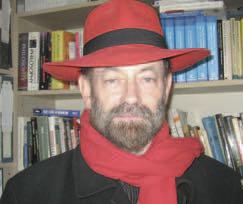
I ought to begin with a confession. I have had no firsthand- or first-head - experience of psychedelic drugs. Admittedly, I occasionally (actually, frequently) 'do' a bit of (actually, quite a lot of) my favourite white wine. Courtesy of Pinot Grigio, I am sometimes translated to a parallel universe in which my jokes are funny and the laughter they trigger is directed at the tale rather than the teller. But this is hardly comparable to the experiences of 'psychonauts' who take hallucinogenic drugs such as psilocybin in pursuit of revelations about the true nature of the world, of our place in it, and of our eventual destination.
In The Doors of Perception (1954), Aldous Huxley reported on his experiences with the psychedelic drug mescaline. They ranged from the enchantment of an unpeeled awareness of the beauty of flowers, to a sense of a Divine Presence. The title of the book echoed William Blake's claim in The Marriage of Heaven and Hell (1790) that "If the doors of perception were cleansed, then everything would appear to man as it is, Infinite."
The philosopher and psychologist William James (1842-1910) was ahead of Huxley. His experiences with nitrous oxide (laughing gas) had an enduring influence on his thought and, in particular, on his attitude towards religion. Reflecting on his experiences, he felt that all religions "converge towards a kind of insight to which I cannot help ascribing some metaphysical significance." James was haunted by the suspicion that his everyday awareness was flanked by utterly different modes of consciousness, and separated from them by 'the flimsiest of screens'.
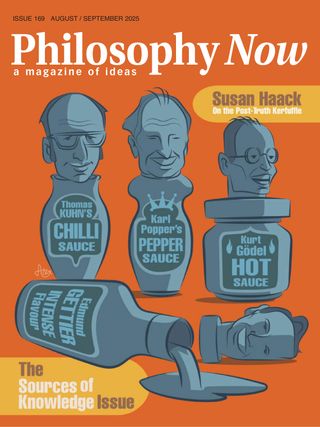

Dit verhaal komt uit de August/September 2025-editie van Philosophy Now.
Abonneer u op Magzter GOLD voor toegang tot duizenden zorgvuldig samengestelde premiumverhalen en meer dan 9000 tijdschriften en kranten.
Bent u al abonnee? Aanmelden
MEER VERHALEN VAN Philosophy Now

Philosophy Now
Star Trek: Enterprise
Sofia Villaweaver asks, what kind of future do we want — Gene Roddenberry's, or Friedrich Nietzsche's?

7 mins
June/July 2026

Philosophy Now
The Delphic Injunctions
Massimo Pigliucci philosophises about prophetic principles.
4 mins
June/July 2026

Philosophy Now
What’s the Value of Mountaineering?
Suleyman Moollan wonders why people climb mountains.
8 mins
June/July 2026

Philosophy Now
Death as Life’s Picture Frame
Joshua Clements puts us in the picture.
10 mins
June/July 2026
Philosophy Now
Philosophers on Butterflies
Summer is upon those of us in the northern hemisphere. That invites reflection.
2 mins
June/July 2026
Philosophy Now
Margalit & Limits to Political Compromise
Laure Gillot-Assayag reflects on the political philosophy of Avishai Margalit.
12 mins
June/July 2026

Philosophy Now
Making Omelettes & A Future Like Ours
Jimmy Alfonso Licon wonders what's wrong with killing — first chickens, then humans.
5 mins
June/July 2026

Philosophy Now
Breakfast with Habermas
Matt Qvortrup recalls chat over coffee and scrambled eggs with a champion of reasoned debate.
5 mins
June/July 2026

Philosophy Now
Who Wants to Live Forever?
Dan Pollen weighs up the pros and cons of indefinitely extended life.
10 mins
June/July 2026

Philosophy Now
Carl Schmitt (1888-1985)
Marco Pandolfini on the ideas of a highly contentious legal theorist.
9 mins
June/July 2026
Listen
Translate
Change font size