
Mit Magzter GOLD unbegrenztes Potenzial nutzen
Erhalten Sie unbegrenzten Zugriff auf über 9.000 Zeitschriften, Zeitungen und Premium-Artikel für nur
Versuchen GOLD - Frei
Pharmaco-Metaphysics?
Philosophy Now
|August/September 2025
Raymond Tallis argues against acidic assertions, and doubts DMT discoveries.

I ought to begin with a confession. I have had no firsthand- or first-head - experience of psychedelic drugs. Admittedly, I occasionally (actually, frequently) 'do' a bit of (actually, quite a lot of) my favourite white wine. Courtesy of Pinot Grigio, I am sometimes translated to a parallel universe in which my jokes are funny and the laughter they trigger is directed at the tale rather than the teller. But this is hardly comparable to the experiences of 'psychonauts' who take hallucinogenic drugs such as psilocybin in pursuit of revelations about the true nature of the world, of our place in it, and of our eventual destination.
In The Doors of Perception (1954), Aldous Huxley reported on his experiences with the psychedelic drug mescaline. They ranged from the enchantment of an unpeeled awareness of the beauty of flowers, to a sense of a Divine Presence. The title of the book echoed William Blake's claim in The Marriage of Heaven and Hell (1790) that "If the doors of perception were cleansed, then everything would appear to man as it is, Infinite."
The philosopher and psychologist William James (1842-1910) was ahead of Huxley. His experiences with nitrous oxide (laughing gas) had an enduring influence on his thought and, in particular, on his attitude towards religion. Reflecting on his experiences, he felt that all religions "converge towards a kind of insight to which I cannot help ascribing some metaphysical significance." James was haunted by the suspicion that his everyday awareness was flanked by utterly different modes of consciousness, and separated from them by 'the flimsiest of screens'.
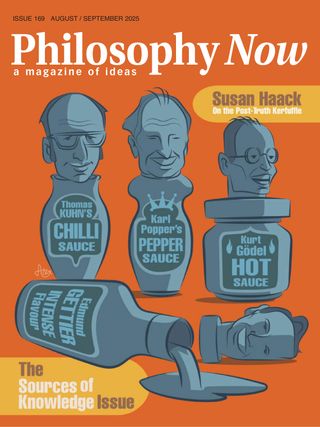

Diese Geschichte stammt aus der August/September 2025-Ausgabe von Philosophy Now.
Abonnieren Sie Magzter GOLD, um auf Tausende kuratierter Premium-Geschichten und über 9.000 Zeitschriften und Zeitungen zuzugreifen.
Sie sind bereits Abonnent? Anmelden
WEITERE GESCHICHTEN VON Philosophy Now

Philosophy Now
The Possibility- Bearing Animal
Raymond Tallis explores a twilight zone.

7 mins
February/March 2026

Philosophy Now
Amazing Times at the Pub Agora
John Douglas Mullen is a philosophical bar fly on the wall.
8 mins
February/March 2026

Philosophy Now
Friedrich Nietzsche (1844-1900)
Hilarius Bogbinder considers the all too human life of the notorious iconoclast.
11 mins
February/March 2026

Philosophy Now
Heisenberg's Philosophy of Quantum Mechanics
Kanan Purkayastha explains how Werner Heisenberg's 1925 paper turned the quantum theory of the early 1900s into the quantum mechanics of today.
10 mins
February/March 2026

Philosophy Now
Cicero & the Ideal of Virtue
Abdullah Shaikh explores Cicero's ideas about the core Roman principle of virtus.
13 mins
February/March 2026

Philosophy Now
ROPE
Les Jones has a Nietzschean take on a Hitchcock thriller.
6 mins
February/March 2026
Philosophy Now
What Have the Romans Ever Done For Us?
Salve! This issue's theme is Roman Philosophy. But as the rebels in Monty Python's Life of Brian asked, what have the Romans ever done for us? The question seems relevant here; we are philosophers, not archaeologists.
2 mins
February/March 2026

Philosophy Now
Paul Guyer
Paul Guyer is an American philosopher and a leading scholar of both Immanuel Kant and aesthetics. AmirAli Maleki interviews him about Kant's political and moral vision.
9 mins
February/March 2026
Philosophy Now
Identity in the Age of Connectivity
Sara Asran explores the dynamics of identity online.
6 mins
February/March 2026
Philosophy Now
A Very Short History of Critical Thinking
Luc de Brabandere summarises a long history through key figures of thought.
7 mins
February/March 2026
Listen
Translate
Change font size