Poging GOUD - Vrij
Brucellosis Can Bankrupt You. Don't Let It!
Farmer's Weekly
|Farmer's Weekly 28 September 2018
A widespread problem in sub-Saharan Africa, bovine brucellosis can cripple a cattle or dairy farming operation. As no cure is available, all infected animals are required by law to be slaughtered. This makes prevention and control of the disease a crucial aspect of a cattle operation.

Bovine brucellosis, also known as contagious abortion, is reported across all nine provinces of South Africa, particularly in the central and Highveld regions. The disease causes abortion in cattle, resulting in severe reproduction and production losses and drastically reducing financial turnover. It can infect most other mammals, including humans.
Symptoms are often vague and may resemble other diseases. Frequent testing of the herd is imperative to ensure that an outbreak is detected as early as possible.
Dr Peter Oberem, CEO of Afrivet, says that because the state veterinary services’ rigorous tuberculosis and brucellosis control programmes were halted, the true extent of the disease is unknown.
“It can, however, be clearly stated that the situation is bad and a threat to food security, food safety and human health. Fortunately […], probably all the milk sold via the major dairies and chain stores is pasteurised and/or UHT, and hence safe for human consumption.”
CAUSE AND SPREAD
Bovine brucellosis is caused by the Brucella abortus bacterium, and is highly contagious. Cattle usually get the disease from contaminated feed or water, or after licking an infected afterbirth, calf or cow. Infected animals remain carriers of the disease for the rest of their lives. Brucellosis is a state controlled disease, and positive animals must be reported to the state vet immediately.
Dr Faffa Malan, manager of the Ruminant Veterinary Association of South Africa, stresses that a single infected animal can rapidly infect the rest of the herd if not identified and slaughtered before calving.
He warns that if an animal has recently been bought into the herd from an auction or another herd without the CA3 declaration as proof that the herd of origin was recently tested for bovine brucellosis, the animal could be positive or latently positive.
IDENTIFYING BRUCELLOSIS
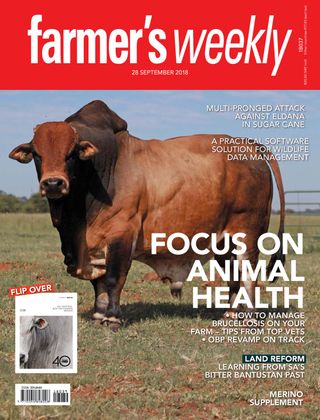

Dit verhaal komt uit de Farmer's Weekly 28 September 2018-editie van Farmer's Weekly.
Abonneer u op Magzter GOLD voor toegang tot duizenden zorgvuldig samengestelde premiumverhalen en meer dan 9000 tijdschriften en kranten.
Bent u al abonnee? Aanmelden
MEER VERHALEN VAN Farmer's Weekly

Farmer's Weekly
How AFGRI uses technology to unlock farm finance from asset to market
As modern farming becomes more capital-intensive and digitally driven, AFGRI is reinventing agricultural finance by linking technology directly to lending decisions.

5 mins
January 16-23, 2026

Farmer's Weekly
Adele's Mohair: a living tapestry of craft, colour and rural heritage
Octavia Avesca Spandiel spoke to Adele Cutten, founder of Adele's Mohair, to explore how a small spinning experiment grew into a thriving rural craft enterprise rooted in South Africa's rich mohair heritage.
6 mins
January 16-23, 2026
Farmer's Weekly
Cannabis and marketing in South Africa
The path from cultivation to commercial success remains complicated by regulatory ambiguity. Cultivators who master compliant marketing while delivering verifiable quality will build sustainable businesses, says Thomas Walker.
2 mins
January 16-23, 2026
Farmer's Weekly
Foot-and-mouth disease project targets waste reduction and regulatory reform
A groundbreaking research collaboration between Red Meat Industry Services, the University of Pretoria, and global animal health leader Zoetis is aiming to transform South Africa's approach to foot-and-mouth disease.
3 mins
January 16-23, 2026
Farmer's Weekly
What to expect in 2026
The world faces a complex interplay of economic, geopolitical, environmental, technological, and social pressures.
3 mins
January 16-23, 2026

Farmer's Weekly
How drones are revolutionising pest and disease detection in agriculture
Drones are reshaping modern crop protection by giving farmers a powerful new vantage point: the sky. With advanced sensors, high-resolution imaging, and artificial intelligence-driven analytics, these unmanned aerial vehicles can detect early signs of disease, water stress, and pest damage long before the human eye can. Jedrie Harmse spoke to agricultural drone specialist Monique Heydenrych.
7 mins
January 16-23, 2026
Farmer's Weekly
Generic advertising in perspective
Dr Koos Coetzee explains how industry organisations and the agriculture sector actually have the ability to prudently manage the negative perceptions surrounding generic advertising campaigns.
2 mins
January 16-23, 2026
Farmer's Weekly
The modern Merino: the benchmark breed
The Merino breed has transformed dramatically over the past seven decades-from the skin-folded wool specialists of the 1950s to today's plain-bodied, fertile, well-balanced sheep prized for their dual-purpose productivity. Yet, despite its versatility, myths persist. Willie van Heerden, manager at Merino South Africa, dispels some of these myths.
2 mins
January 16-23, 2026

Farmer's Weekly
Elsenburg Agricultural Training Institute celebrates excellence
The Elsenburg Agricultural Training Institute marked a major milestone in December 2025, conferring over 200 agricultural qualifications, including bachelor's degrees and various national certificates.
2 mins
January 16-23, 2026
Farmer's Weekly
Grain SA issues guidelines as poor-quality agri inputs threaten farmers livelihoods
Grain SA has urged South African grain and oilseed farmers to act fast when seeds, fertilisers, or agrochemicals underperform, providing clear guidelines to protect crops.
2 mins
January 16-23, 2026
Translate
Change font size