Essayer OR - Gratuit
Brucellosis Can Bankrupt You. Don't Let It!
Farmer's Weekly
|Farmer's Weekly 28 September 2018
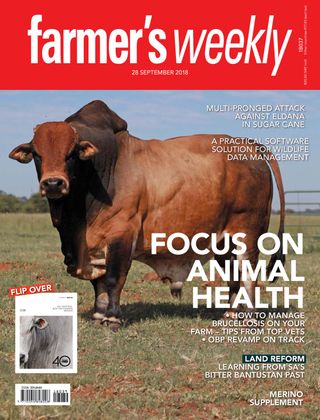
A widespread problem in sub-Saharan Africa, bovine brucellosis can cripple a cattle or dairy farming operation. As no cure is available, all infected animals are required by law to be slaughtered. This makes prevention and control of the disease a crucial aspect of a cattle operation.

Bovine brucellosis, also known as contagious abortion, is reported across all nine provinces of South Africa, particularly in the central and Highveld regions. The disease causes abortion in cattle, resulting in severe reproduction and production losses and drastically reducing financial turnover. It can infect most other mammals, including humans.
Symptoms are often vague and may resemble other diseases. Frequent testing of the herd is imperative to ensure that an outbreak is detected as early as possible.
Dr Peter Oberem, CEO of Afrivet, says that because the state veterinary services’ rigorous tuberculosis and brucellosis control programmes were halted, the true extent of the disease is unknown.
“It can, however, be clearly stated that the situation is bad and a threat to food security, food safety and human health. Fortunately […], probably all the milk sold via the major dairies and chain stores is pasteurised and/or UHT, and hence safe for human consumption.”
CAUSE AND SPREAD
Bovine brucellosis is caused by the Brucella abortus bacterium, and is highly contagious. Cattle usually get the disease from contaminated feed or water, or after licking an infected afterbirth, calf or cow. Infected animals remain carriers of the disease for the rest of their lives. Brucellosis is a state controlled disease, and positive animals must be reported to the state vet immediately.
Dr Faffa Malan, manager of the Ruminant Veterinary Association of South Africa, stresses that a single infected animal can rapidly infect the rest of the herd if not identified and slaughtered before calving.
He warns that if an animal has recently been bought into the herd from an auction or another herd without the CA3 declaration as proof that the herd of origin was recently tested for bovine brucellosis, the animal could be positive or latently positive.
IDENTIFYING BRUCELLOSIS

Cette histoire est tirée de l'édition Farmer's Weekly 28 September 2018 de Farmer's Weekly.
Abonnez-vous à Magzter GOLD pour accéder à des milliers d'histoires premium sélectionnées et à plus de 9 000 magazines et journaux.
Déjà abonné ? Se connecter
PLUS D'HISTOIRES DE Farmer's Weekly
Farmer's Weekly
What to expect in 2026
The world faces a complex interplay of economic, geopolitical, environmental, technological, and social pressures.

3 mins
January 16-23, 2026

Farmer's Weekly
Elsenburg Agricultural Training Institute celebrates excellence
The Elsenburg Agricultural Training Institute marked a major milestone in December 2025, conferring over 200 agricultural qualifications, including bachelor's degrees and various national certificates.
2 mins
January 16-23, 2026
Farmer's Weekly
Grain SA issues guidelines as poor-quality agri inputs threaten farmers livelihoods
Grain SA has urged South African grain and oilseed farmers to act fast when seeds, fertilisers, or agrochemicals underperform, providing clear guidelines to protect crops.
2 mins
January 16-23, 2026
Farmer's Weekly
Vegetable price trends as we enter the new year
This analysis by Zama Sangweni explores how five key vegetable commodities, cabbages, carrots, onions, potatoes, and tomatoes, performed, considering recent supply volumes and consumer demand patterns.
2 mins
January 16-23, 2026

Farmer's Weekly
Joburg Fresh Produce Market needs a 'refresh'
South Africa's fresh produce markets are vital to food security, supplying up to half of the nation's fruit and vegetables. Protecting and modernising these markets is essential for a resilient, equitable food system writes Marc Wegerif, senior lecturer in Development Studies at the University of Pretoria.
4 mins
January 16-23, 2026
Farmer's Weekly
Infrastructure, policy, and finance will be the African continent's growth drivers
Africa's agricultural potential is vast, but inefficiencies in infrastructure, trade policy, and finance limit growth. Investments in transport, cold storage, irrigation, and digital trade systems, among others, are key to unlocking faster, cheaper, and more efficient agricultural trade.
3 mins
January 2-9, 2026

Farmer's Weekly
SAPPO Academy showcases skills development and small business success
The South African Pork Producers' Organisation (SAPPO) Academy, a training organisation that promotes animal, environmental, and public health in the pig industry through knowledge transfer, recently hosted a mini development symposium in Pretoria. The event included an afternoon of meaningful dialogue, strategic learning, and leadership exchange, effectively bridging academic insight with real-world industry innovation.
3 mins
January 2-9, 2026

Farmer's Weekly
Backing for SA Canegrowers as sugar imports soar
Coenie Snyman, winemaker and founder of Rock of Eye Wines, was named the 2025 Diners Club Winemaker of the Year for his Rock of Eye Cabernet Sauvignon 2022, while Marnich Aucamp, assistant winemaker at Stellenbosch Vineyards, won the Young Winemaker of the Year award for his Stellenbosch Vineyards Credo Chenin Blanc 2024 at a gala dinner near Kleinmond in the Western Cape.
1 mins
January 2-9, 2026

Farmer's Weekly
New or used? A practical guide to second-hand farm equipment
Second-hand farm machinery can deliver excellent value, if you know what to look for. Western Cape equipment broker Debbie Smit gave Lindi Botha practical advice to help farmers decide when to buy new, when pre-owned is the smarter choice, and how to avoid the costly pitfalls that often catch buyers off-guard.
4 mins
January 2-9, 2026
Farmer's Weekly
The story of the Drakensberger beef cattle breed's evolution in Africa
The Drakensberger cattle breed has been part of the South African landscape for ages. So-called black indigenous cattle existed in South Africa as early as the 15th and 16th centuries and formed the foundation of the current Drakensberger beef cattle breed.
4 mins
January 2-9, 2026
Translate
Change font size