
Gå ubegrenset med Magzter GOLD
Få ubegrenset tilgang til over 9000 magasiner, aviser og premiumhistorier for bare
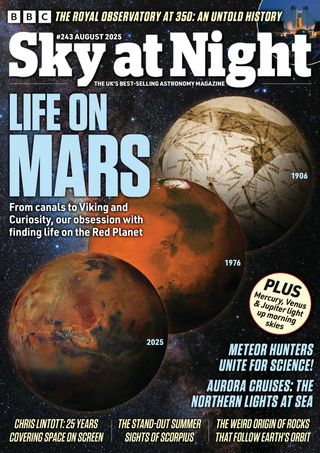
From canals to Curiosity The search for life on Mars
BBC Sky at Night Magazine
|August 2025
Mars has long ignited our imagination. Ben Evans traces the history of our quest for life on the fourth rock from the Sun
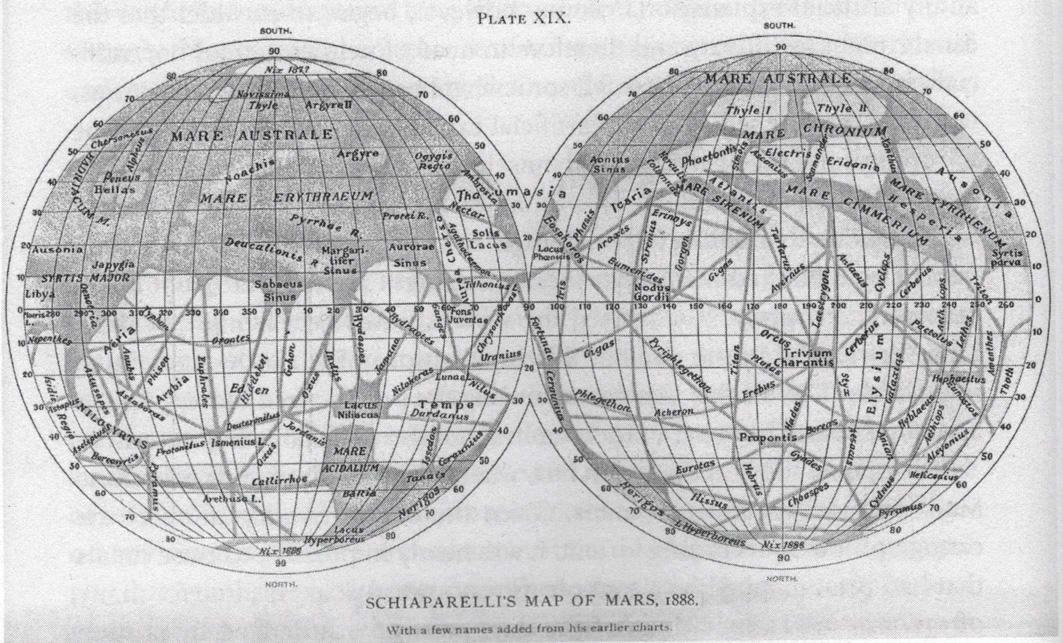
The prospect of life on Mars - Earth's planetary next-door neighbour, an alien world that betrays tantalising hints of a watery past - has bewitched humanity for centuries. From the 'canals' seen by astronomer Percival Lowell, and HG Wells's fire-spewing tripods, to David Bowie's glam-rock croons about a girl with mousy hair, life on Mars has captured our imagination as a literal and metaphorical trope.
At first glance, the contrast between the iridescent blues, greens and tans of Earth - awash with water, teeming with life - and the barren, subfreezing, radiation-drenched Mars could hardly be more stark. Half the size of Earth and 11 per cent as massive, Mars's orbit around the Sun takes it as near to us as 56 million km (35 million miles) and as far as 400 million km (250 million miles).
Yet the pair do share similarities. Mars's 24-hour, 36-minute day mirrors our 23 hours, 56 minutes. Its axial tilt of 25.19° is close to our 23.44°, producing similar seasons. But Martian seasons last nearly twice as long, the planet's more distant orbit taking 687 days to circle the Sun compared to Earth's 365 days.
Life on Mars has long sat at the forefront of human imagination. Early ideas regarded the Red Planet as little more than a volcanic wasteland. But in the 19th century, it adopted a new persona: a utopia, with 'Martians' exhibiting character traits of decadence and enlightened intelligence. One story even imagined them aging backwards, like otherworldly Benjamin Buttons.
Canals and dead ends

Denne historien er fra August 2025-utgaven av BBC Sky at Night Magazine.
Abonner på Magzter GOLD for å få tilgang til tusenvis av kuraterte premiumhistorier og over 9000 magasiner og aviser.
Allerede abonnent? Logg på
FLERE HISTORIER FRA BBC Sky at Night Magazine
BBC Sky at Night Magazine
MOONWATCH
January's top lunar feature to observe

2 mins
January 2026
BBC Sky at Night Magazine
Speed up your processing workflow
How to use Photoshop's Actions tool to drastically cut your processing time
3 mins
January 2026
BBC Sky at Night Magazine
Chasing Canada's polar lights
With solar maximum peaking and a new Moon promising dark skies, Jamie Carter travels to Churchill, Manitoba to hunt the Northern Lights - and dodge polar bears – in Canada's far north
7 mins
January 2026
BBC Sky at Night Magazine
Beyond Pluto: The search for the hidden planets
Could one – or even two - undiscovered planets lurk at the edges of our Solar System? Nicky Jenner explores how close we are to finding the elusive 'Planet 9'
6 mins
January 2026
BBC Sky at Night Magazine
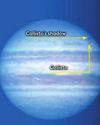
Jupiter moon events
Jupiter is a magnificent planet to observe.
2 mins
January 2026
BBC Sky at Night Magazine
What samples from space have taught us
Alastair Gunn explains what scientists have learnt in the 20 years since the first unmanned mission brought materials back from alien worlds
3 mins
January 2026
BBC Sky at Night Magazine
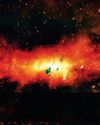
The Milky Way as you've never seen it before
This is the largest low-frequency radio colour image of our Galaxy ever assembled
1 min
January 2026
BBC Sky at Night Magazine
Merger of ‘impossibly' massive black holes explained
Scientists discover how enormous, fast-spinning black holes can exist after all
1 mins
January 2026
BBC Sky at Night Magazine
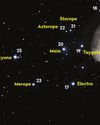
Lunar occultation of the Pleiades
BEST TIME TO SEE: 27 January from 20:30 UT
1 min
January 2026
BBC Sky at Night Magazine
The Universe's expansion may be slowing down
New study suggests current theories of dark energy could be wrong
1 mins
January 2026
Listen
Translate
Change font size