
Gå ubegrenset med Magzter GOLD
Få ubegrenset tilgang til over 9000 magasiner, aviser og premiumhistorier for bare
Charting the heavens
BBC Sky at Night Magazine
|September 2025
For centuries, astronomical catalogues have helped bring order to the boundless cosmos. Pete Lawrence takes a deep dive into the essential databases every astronomer should know
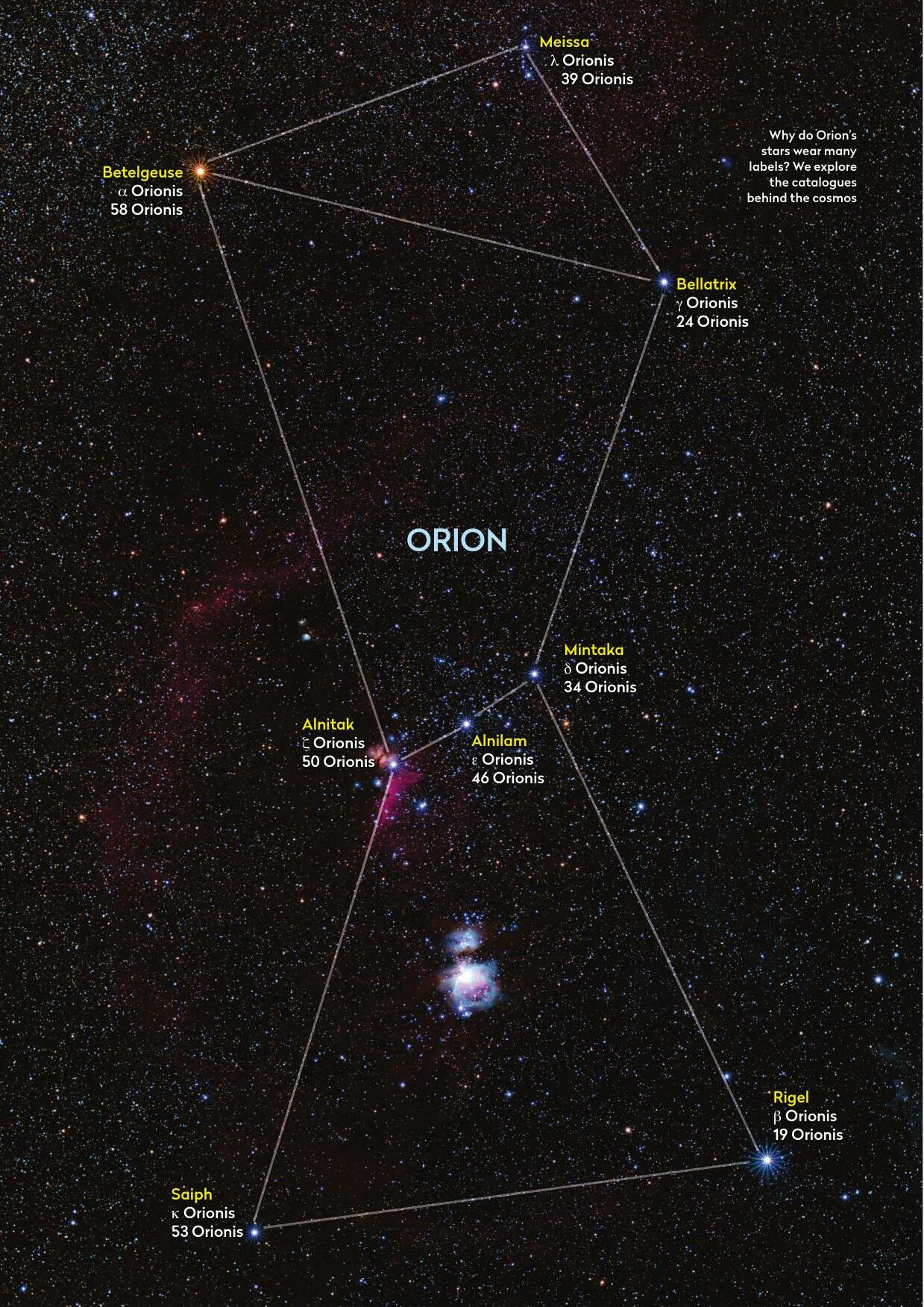
Star and deep-sky catalogues are crucial resources for making sense of the night sky. There are a lot of them, though – so many, in fact, that you almost need a catalogue of catalogues to keep track of them all!
There's a rich history wrapped up in the creation of these databases, and many astronomical objects appear in multiple catalogues, each with its own naming conventions and quirks. In this guide, we'll explore some of the widely used catalogues and the types of celestial objects they cover, from nearby stars to distant galaxies.
With massive amounts of high-precision data now streaming into mainstream planetarium apps, what role do older catalogues play? Stars and deep-sky objects may not change rapidly, but when it comes to pinpoint accuracy, even small shifts can matter. We'll look at which catalogues are being actively maintained and refined.
If you've ever wondered what those odd suffixed numbers on star maps mean, read on and be impressed by how human beings have brought structure to the cosmos.
Star catalogues we all start with
We'll begin with the star catalogues that any new or experienced astronomer is likely to encounter.
The Bayer star labelling system was compiled by German astronomer Johann Bayer and published in 1603 as part of his Uranometria star atlas. Bright constellation stars were given a Greek letter in order of descending brightness. When all 24 Greek alphabet characters were exhausted, Roman letters a-z were used, then A-Q. Beyond Q, we find the beginnings of the variable star labelling system, variables identified with R-Z then RR, RS, RT, and so on, to ZZ. Similar brightness levels and long-term variability mean that some Bayer labels appear out of sequence. For example, Betelgeuse (Alpha (α) Orionis) is currently dimmer than Rigel (Beta (β) Orionis).

Denne historien er fra September 2025-utgaven av BBC Sky at Night Magazine.
Abonner på Magzter GOLD for å få tilgang til tusenvis av kuraterte premiumhistorier og over 9000 magasiner og aviser.
Allerede abonnent? Logg på
FLERE HISTORIER FRA BBC Sky at Night Magazine

BBC Sky at Night Magazine
MOONWATCH
January's top lunar feature to observe

2 mins
January 2026
BBC Sky at Night Magazine
Speed up your processing workflow
How to use Photoshop's Actions tool to drastically cut your processing time
3 mins
January 2026

BBC Sky at Night Magazine
Chasing Canada's polar lights
With solar maximum peaking and a new Moon promising dark skies, Jamie Carter travels to Churchill, Manitoba to hunt the Northern Lights - and dodge polar bears – in Canada's far north
7 mins
January 2026

BBC Sky at Night Magazine
Beyond Pluto: The search for the hidden planets
Could one – or even two - undiscovered planets lurk at the edges of our Solar System? Nicky Jenner explores how close we are to finding the elusive 'Planet 9'
6 mins
January 2026
BBC Sky at Night Magazine
Jupiter moon events
Jupiter is a magnificent planet to observe.
2 mins
January 2026

BBC Sky at Night Magazine
What samples from space have taught us
Alastair Gunn explains what scientists have learnt in the 20 years since the first unmanned mission brought materials back from alien worlds
3 mins
January 2026
BBC Sky at Night Magazine
The Milky Way as you've never seen it before
This is the largest low-frequency radio colour image of our Galaxy ever assembled
1 min
January 2026

BBC Sky at Night Magazine
Merger of ‘impossibly' massive black holes explained
Scientists discover how enormous, fast-spinning black holes can exist after all
1 mins
January 2026
BBC Sky at Night Magazine
Lunar occultation of the Pleiades
BEST TIME TO SEE: 27 January from 20:30 UT
1 min
January 2026
BBC Sky at Night Magazine
The Universe's expansion may be slowing down
New study suggests current theories of dark energy could be wrong
1 mins
January 2026
Listen
Translate
Change font size