Prøve GULL - Gratis
CIVIL RIGHTS UNDONE
The Atlantic
|January - February 2024
In late 2020, even as the instigators of insurrection were marshaling their followers to travel to Washington, D.C., another kind of coup-a quieter onewas in the works. On December 21, in one of his departing acts as attorney general, Bill Barr submitted a proposed rule change to the White House. The change would eliminate the venerable standard used by the Justice Department to handle discrimination cases, known as "disparate impact."

The memo was quickly overshadowed by the events of January 6, and, in the chaotic final days of Donald Trump's presidency, it was never implemented. But Barr's proposal represented perhaps the most aggressive step the administration took in its effort to dismantle existing civil-rights law.
Should Trump return to power, he would surely attempt to see the effort through.
Since the legislative victories of the civilrights movement in the 1960s, legal and civil rights for people on the margins have tended to expand. The Civil Rights Act of 1964, the Voting Rights Act of 1965, and the Fair Housing Act of 1968 were followed by voting provisions for Indigenous people and non-English speakers, a Supreme Court guarantee of the right to abortion, increased protections for people with disabilities, and formal recognition of same-sex marriage. The trend mostly continued under presidents of both partiesuntil Trump. Though his administration could be bumbling, the president's actions matched his rhetoric when it came to eroding civil-rights enforcement.
Under Trump, the Justice Department abandoned its active protection of voting rights. The Environmental Protection Agency ignored civil-rights complaints.
The Department of Housing and Urban Development scaled back investigations into housing discrimination. Trump's appointees to the Supreme Court, for their part, have whittled away at landmark civilrights legislation and presided over the end of affirmative action.
In a second term, the most effective way for Trump to continue rolling back protections would be to dismantle disparate-impact theory. Under the theory, the federal government can prohibit discriminatory practices not just in instances of malicious and provable bigotry, but also in cases where a party's actions unintentionally affect a class of marginalized people disproportionately.
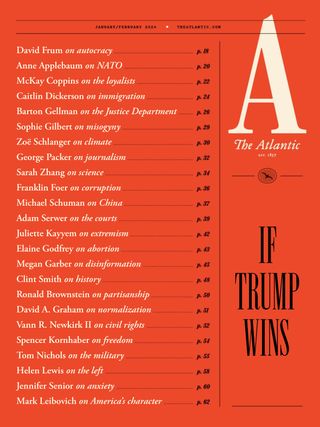

Denne historien er fra January - February 2024-utgaven av The Atlantic.
Abonner på Magzter GOLD for å få tilgang til tusenvis av kuraterte premiumhistorier og over 9000 magasiner og aviser.
Allerede abonnent? Logg på
FLERE HISTORIER FRA The Atlantic

The Atlantic
Deadlier Than Gettysburg
How the cruelty of the Confederacy's prison camps gave rise to the rules of war

10 mins
March 2026

The Atlantic
THE MAN WHO BROKE PHYSICS
One of the pleasures of watching Ilia Malinin, apart from his indifference to gravity, is to witness him becoming.
16 mins
March 2026

The Atlantic
How Toni Morrison Saw History
In her novels, she located the missing story of Black America.
12 mins
March 2026

The Atlantic
The Madness of Lord Tennyson
The Victorian poet was startlingly modern.
5 mins
March 2026

The Atlantic
THE PLOT AGAINST THE HUMANITIES
What is the Andrew W. Mellon Foundation doing to higher education?
22 mins
March 2026

The Atlantic
Why Do Democrats Hate Winning?
Ken Martin has one of those resting dread faces, as if he's bracing for someone to dump a bucket of rocks on his head.
37 mins
March 2026

The Atlantic
ROD DREHER'S DEMONS
HE DERIDES THE ENLIGHTENMENT, SECULARISM, AND THE MODERN WORLD. CONSERVATIVES-INCLUDING THE VICE PRESIDENT-ARE JOINING HIM ON A MARCH BACK TO THE MIDDLE AGES.
20 mins
March 2026

The Atlantic
Every Nation for Itself
President Trump wants to return to the 19th century's international order. He will leave America less prosperous—and the whole world less secure.
19 mins
March 2026

The Atlantic
The Secrets of Indigenous Art
Major exhibits are upending the way people understand Native American and Aboriginal artists.
14 mins
March 2026

The Atlantic
The Novel as Extended Op-Ed
If anyone could write good fiction about immigration, it would probably be Lionel Shriver. Instead, her latest book goes off the rails.
10 mins
March 2026
Listen
Translate
Change font size