Prøve GULL - Gratis
IGNITING A NEW ORBIT FOR SPACE RESEARCH
Voice and Data
|November 2025
From mission design to Earth observation, HPC is now the hidden engine accelerating simulations, autonomy, and discovery across global space science.
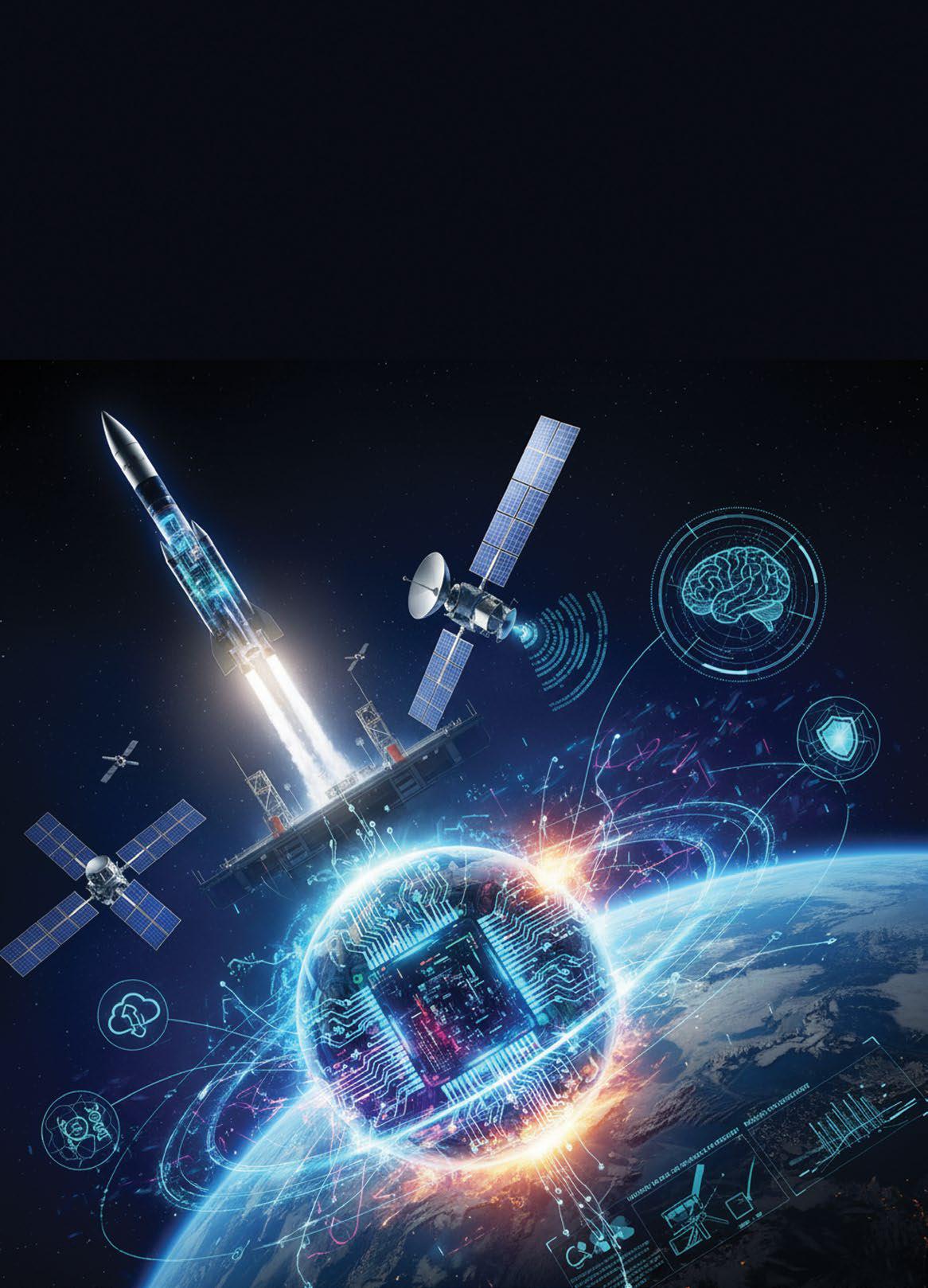
There is Hopper. There is an Octopus. There is IceCore. There is Marvin. There is Satyameba. There is Param Rudra. These are not star students strolling across a university campus, but star machines powering those students, their professors, and entire ecosystems of research. The world of exascale simulations, GPU clusters, and high-performance computing is blossoming in new colours and scales across universities, laboratories, and space-tech projects everywhere.
Recently, the European Space Agency unveiled the ESA Space High-Performance Computing (HPC) environment, now available to support scientific research and technological development across all ESA programmes. The ESA Space HPC supercomputer, inaugurated at ESRIN in Italy in March, has been designed to meet the rising computational demands of the European space industry—particularly for weather modelling, rapid warnings, and advanced simulations.
Earlier this year, the National University of Singapore expanded its computing might with Hopper, a supercomputer capable of 25 quadrillion calculations per second, or 25 PetaFLOPS, dramatically empowering NUS researchers with unprecedented HPC access.
In the United States, the University of Alabama is developing an HPC project aimed at mitigating the rising financial and energy costs associated with AI and machine-learning research. The Executive Director of the University’s High Performance Computing and Data Centre described the push simply: “Having access to the GPUs at the HPC will enable our faculty and students to do scientific-level research and AI.”
Across the Pacific, the Osaka University D3 Centre is progressing swiftly with trial operations of the “Osaka University Compute and sTOrage Platform Urging open Science” (Octopus), built by NEC Corporation. With a theoretical performance of 2.293 PetaFLOPS and 140 computing nodes, Octopus is a computational and data platform designed to drive open science.

Denne historien er fra November 2025-utgaven av Voice and Data.
Abonner på Magzter GOLD for å få tilgang til tusenvis av kuraterte premiumhistorier og over 9000 magasiner og aviser.
Allerede abonnent? Logg på
FLERE HISTORIER FRA Voice and Data

Voice and Data
Shaping India's near-future digital playbook
As India enters 2026, these ten technologies will advance network design, strengthen digital infrastructure, and unlock new layers of enterprise value.

11 mins
December 2025

Voice and Data
Securing the nation in an age of silent cyber conflict
India's expanding digital ecosystem now sits at the centre of global cyber conflict, demanding resilience, sovereign control, and Al-driven defence at scale.
4 mins
December 2025

Voice and Data
INDIA'S NEXT NETWORK FRONTIER
Ten deep-tech shifts will redefine how India connects, secures, and scales its digital future in 2026 and beyond—reshaping networks, infrastructure, and innovation.
8 mins
December 2025

Voice and Data
DPDP Act sets new guardrails for India's Al ecosystem
India's data law reshapes the foundations of Al by enforcing trust, clarity, and responsible innovation across every layer of its evolving digital ecosystem.
3 mins
December 2025

Voice and Data
"We are building a Rapido, not a bus, for space"
Immanuel Louis, Co-founder and COO of Astrophel Aerospace, is attempting to rewire how India thinks about satellite launches-from large-ride dependency to faster, indigenous access to orbit. Alongside his co-founder, Louis is building a vertically integrated space-tech startup focused on Made-in-India rocket components, reusable engines, and sub-systems optimised for small and CubeSat missions.
6 mins
December 2025

Voice and Data
Driving speed, stability, and next-gen wireless efficiency
Built on multi-link architecture, expanded spectrum, and higher-order modulation, Wi-Fi 7 lays the foundation for the next phase of immersive and connected living.
4 mins
December 2025

Voice and Data
UNSHACKLING SATCOM: THE POLICY RESET INDIA NEEDS FOR VIKSIT BHARAT
India's connectivity gap demands a regulatory shift that can enable satellite networks to reach regions where terrestrial infrastructure cannot viably operate.
6 mins
December 2025

Voice and Data
Telcos to Techcos: The long climb to a new success story
As operators climb out of the commodity-connectivity trap, they are rebuilding networks, services, and platforms to script a sustainable growth story.
3 mins
December 2025

Voice and Data
When automation turned against the world wide web
A routine Cloudflare update triggered a global outage, exposing the security and stability risks of centralised cloud and why resilience must be re-engineered.
7 mins
December 2025

Voice and Data
6G to need 2-3 GHz more mid-band spectrum by 2040
GSMA forecasts 2-3 GHz more mid-band spectrum needed by 2040 to avoid urban congestion and enable global 6G readiness.
1 min
December 2025
Listen
Translate
Change font size