Prøve GULL - Gratis
UNSHACKLING SATCOM: THE POLICY RESET INDIA NEEDS FOR VIKSIT BHARAT
Voice and Data
|December 2025
India's connectivity gap demands a regulatory shift that can enable satellite networks to reach regions where terrestrial infrastructure cannot viably operate.
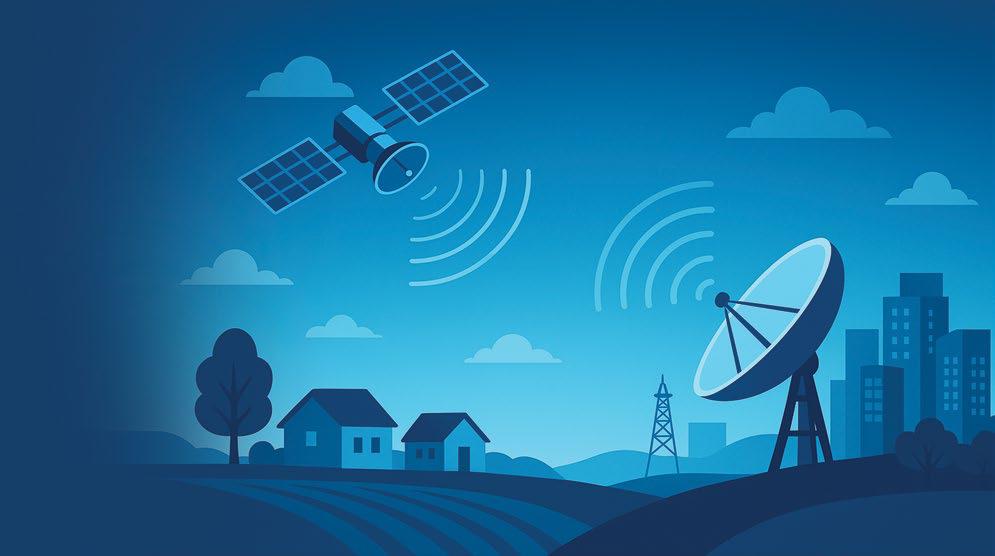
India's digital revolution has transformed the lives of hundreds of millions, reshaping how people communicate, learn, work, trade, and access public services. Over the past two decades, mobile networks and broadband have driven extraordinary gains across governance, fintech, health, education, and commerce. Yet, despite this remarkable progress, a significant proportion of India remains outside the digital mainstream. Nearly 55% of the population still does not have internet access, let alone broadband connectivity.
Border villages, tribal belts, high-altitude areas, forest regions, deserts, river islands, and disaster-prone zones continue to suffer from unreliable or nonexistent broadband coverage. These landscapes are unforgiving, population densities are low, and the cost of laying fibre or building towers is often prohibitive. As a result, the country's digital divide has remained stubbornly high, ranging from 65% to 67% between 2020 and 2025, according to TRAI's Quarterly Performance Indicator Reports.
As India advances toward universal digital access, bridging this divide is not merely desirable; it is essential. Satellite communication, by virtue of its architecture and coverage capability, is uniquely positioned to play a central role in this next phase of digital expansion. The question is no longer whether satellite-based connectivity is required, but whether regulatory and policy frameworks will allow it to perform the role for which it is technologically suited and so urgently needed.
UNDERSTANDING THE CORE DISTINCTION
To understand why satellite communication, though indispensable, should not be treated like terrestrial networks, it is important to recognise how satellite systems function. At the heart of the policy debate lies a simple yet often overlooked reality: satellite and terrestrial networks are designed for fundamentally different operational contexts.


Denne historien er fra December 2025-utgaven av Voice and Data.
Abonner på Magzter GOLD for å få tilgang til tusenvis av kuraterte premiumhistorier og over 9000 magasiner og aviser.
Allerede abonnent? Logg på
FLERE HISTORIER FRA Voice and Data

Voice and Data
DPDP Act sets new guardrails for India's Al ecosystem
India's data law reshapes the foundations of Al by enforcing trust, clarity, and responsible innovation across every layer of its evolving digital ecosystem.

3 mins
December 2025

Voice and Data
Securing the nation in an age of silent cyber conflict
India's expanding digital ecosystem now sits at the centre of global cyber conflict, demanding resilience, sovereign control, and Al-driven defence at scale.
3 mins
December 2025

Voice and Data
"We are building a Rapido, not a bus, for space"
Immanuel Louis, Co-founder and COO of Astrophel Aerospace, is attempting to rewire how India thinks about satellite launches-from large-ride dependency to faster, indigenous access to orbit. Alongside his co-founder, Louis is building a vertically integrated space-tech startup focused on Made-in-India rocket components, reusable engines, and sub-systems optimised for small and CubeSat missions.
6 mins
December 2025

Voice and Data
Driving speed, stability, and next-gen wireless efficiency
Built on multi-link architecture, expanded spectrum, and higher-order modulation, Wi-Fi 7 lays the foundation for the next phase of immersive and connected living.
4 mins
December 2025

Voice and Data
UNSHACKLING SATCOM: THE POLICY RESET INDIA NEEDS FOR VIKSIT BHARAT
India's connectivity gap demands a regulatory shift that can enable satellite networks to reach regions where terrestrial infrastructure cannot viably operate.
6 mins
December 2025

Voice and Data
Telcos to Techcos: The long climb to a new success story
As operators climb out of the commodity-connectivity trap, they are rebuilding networks, services, and platforms to script a sustainable growth story.
3 mins
December 2025

Voice and Data
When automation turned against the world wide web
A routine Cloudflare update triggered a global outage, exposing the security and stability risks of centralised cloud and why resilience must be re-engineered.
7 mins
December 2025

Voice and Data
6G to need 2-3 GHz more mid-band spectrum by 2040
GSMA forecasts 2-3 GHz more mid-band spectrum needed by 2040 to avoid urban congestion and enable global 6G readiness.
1 min
December 2025

Voice and Data
"Neutral networks will anchor 5G, satcom and 6G growth"
Salil Ahuja, Chief Strategy Officer at Shaurrya Teleservices, oversees strategy at one of India's emerging neutral digital infrastructure providers and among the early TRAI-empanelled Digital Connectivity Rating Agencies (DCRAs). With connectivity quality, fragmented in-building networks, private 5G readiness, satcom convergence, and AI-driven infrastructure becoming central to India's digital ecosystem, he is shaping how buildings, enterprises, and operators prepare for the next wave of digital services.
4 mins
December 2025

Voice and Data
Shaping India's near-future digital playbook
As India enters 2026, these ten technologies will advance network design, strengthen digital infrastructure, and unlock new layers of enterprise value.
11 mins
December 2025
Listen
Translate
Change font size