कोशिश गोल्ड - मुक्त
IGNITING A NEW ORBIT FOR SPACE RESEARCH
Voice and Data
|November 2025
From mission design to Earth observation, HPC is now the hidden engine accelerating simulations, autonomy, and discovery across global space science.
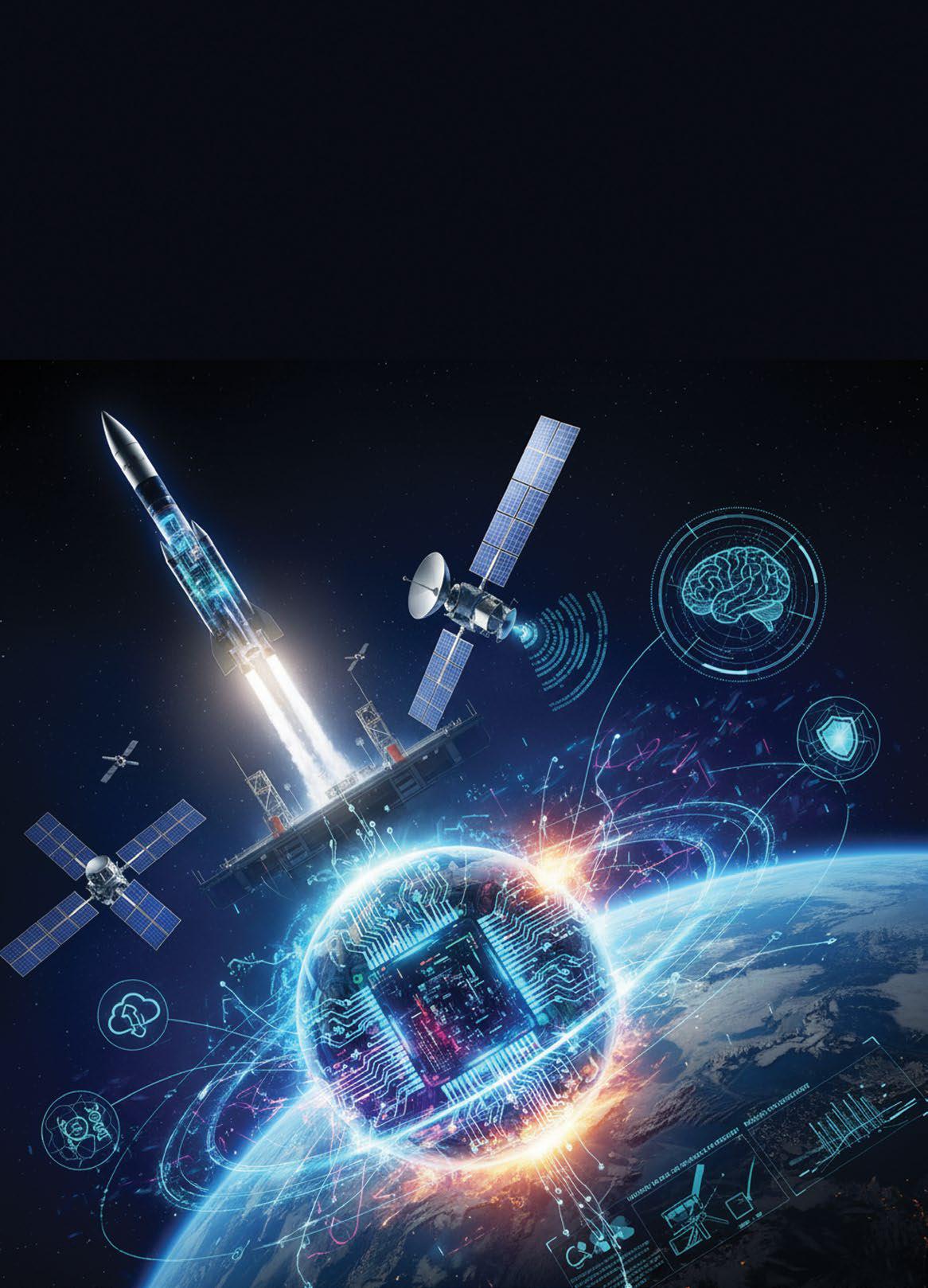
There is Hopper. There is an Octopus. There is IceCore. There is Marvin. There is Satyameba. There is Param Rudra. These are not star students strolling across a university campus, but star machines powering those students, their professors, and entire ecosystems of research. The world of exascale simulations, GPU clusters, and high-performance computing is blossoming in new colours and scales across universities, laboratories, and space-tech projects everywhere.
Recently, the European Space Agency unveiled the ESA Space High-Performance Computing (HPC) environment, now available to support scientific research and technological development across all ESA programmes. The ESA Space HPC supercomputer, inaugurated at ESRIN in Italy in March, has been designed to meet the rising computational demands of the European space industry—particularly for weather modelling, rapid warnings, and advanced simulations.
Earlier this year, the National University of Singapore expanded its computing might with Hopper, a supercomputer capable of 25 quadrillion calculations per second, or 25 PetaFLOPS, dramatically empowering NUS researchers with unprecedented HPC access.
In the United States, the University of Alabama is developing an HPC project aimed at mitigating the rising financial and energy costs associated with AI and machine-learning research. The Executive Director of the University’s High Performance Computing and Data Centre described the push simply: “Having access to the GPUs at the HPC will enable our faculty and students to do scientific-level research and AI.”
Across the Pacific, the Osaka University D3 Centre is progressing swiftly with trial operations of the “Osaka University Compute and sTOrage Platform Urging open Science” (Octopus), built by NEC Corporation. With a theoretical performance of 2.293 PetaFLOPS and 140 computing nodes, Octopus is a computational and data platform designed to drive open science.


यह कहानी Voice and Data के November 2025 संस्करण से ली गई है।
हजारों चुनिंदा प्रीमियम कहानियों और 10,000 से अधिक पत्रिकाओं और समाचार पत्रों तक पहुंचने के लिए मैगज़्टर गोल्ड की सदस्यता लें।
क्या आप पहले से ही ग्राहक हैं? साइन इन करें
Voice and Data से और कहानियाँ

Voice and Data
Cyber insurance: The new backbone of India's digital resilience
As India's digital infrastructure expands across payments, commerce and services, cyber insurance is emerging as a financial layer that protects continuity.

7 mins
March 2026

Voice and Data
FROM PILOTS TO PLATFORMS: INDUSTRIAL IOT GROWS UP
Factory systems are evolving into a layered digital infrastructure where sensors, connectivity, edge computing and AI are driving real-time operational decisions.
11 mins
March 2026

Voice and Data
"Customers today are buying outcomes, not products"
Enterprise technology conversations have changed dramatically over the past decade.
6 mins
March 2026

Voice and Data
"Geopolitics may encourage domestic technology development"
The US and Israel launched a large-scale military campaign against Iran on 28 February, targeting the regime’s leadership as well as military and security infrastructure.
4 mins
March 2026

Voice and Data
Telco capex walks a tightrope of returns
As capex surges to fund 5G and Al-era networks, telecom operators face the harder challenge of turning massive infrastructure investments into real returns.
6 mins
March 2026
Voice and Data
Free-space optics open a new path for networks
Taara Beam promises fibre-like speeds without trenching cables, enabling operators to bridge urban connectivity gaps and extend network capacity.
3 mins
March 2026

Voice and Data
BFSI security moves to AI-driven infrastructure video
AI-enabled video platforms are emerging as critical digital infrastructure for banks, strengthening security, compliance, analytics and operational oversight.
4 mins
March 2026
Voice and Data
The invisible security moat in a connected world
As cyber risks grow in hyperconnected systems, air-gapping resurfaces as a protective barrier for critical assets, even as modern networks demand secure connectivity.
6 mins
March 2026

Voice and Data
Telecom becomes responsible AI's toughest governance test
As AI embeds deeper into telecom networks, operators must build explainability, sovereignty and auditability into systems where failure carries systemic risk.
4 mins
March 2026

Voice and Data
Meity's deepfake clampdown: short, sharp and suddenly real
India's new rules require platforms to label AI-generated content and comply with accelerated takedown orders, signalling tighter oversight of synthetic content.
5 mins
March 2026
Listen
Translate
Change font size