Prøve GULL - Gratis
Star power
Down To Earth
|April 16, 2022
The world is close to cracking nuclear fusion energy code, a source of virtually endless clean energy

CALL IT a bold vision or the desperation for carbon-free energy, nuclear fusion research is finally gathering momentum and the world's dream of virtual limitless energy is closer to reality than ever before.
On December 21 last year, the world moved a step closer to mastering this energy process that powers our sun and stars. A laboratory in the UK generated 12 MW over five seconds through fusion, more than doubling its own record of 1997. The energy is enough to power 35 homes for five seconds.
But the reason this source of energy, despite being known for some 70 years, has never become viable is that nuclear fusion happens at extremely high temperatures, when nuclei of atoms fuse to form new elements and release huge amounts of energy in the process. In the sun, massive gravitational pressure enables nuclear fusion at around 10 million degrees Celsius. On Earth, where the pressure is much lower, the temperature required is above 100 million degrees Celsius. No material can survive such heat.
To enable fusion in a laboratory, scientists at the Culham Centre for Fusion Energy in Oxfordshire heated a 0.17 mg mixture of deuterium and tritium—two variants of hydrogen—to temperatures 10 times hotter than the sun, converting the gases into plasma, the fourth state of matter. They then held it in place using superconductor electromagnets as it spun around in the doughnut-shaped Joint European Torus (JET) reactor, fusing and releasing vast amounts of energy as heat. If done for more than five seconds, the copper wire electromagnets would have become overheated.

In comparison [to fusion), fossil fuels would have required 10 million times more fuel to generate the same amount of energy
ATHINA KAPPATOU, physicist, Max Planck Institute of Plasma Physics, Germany
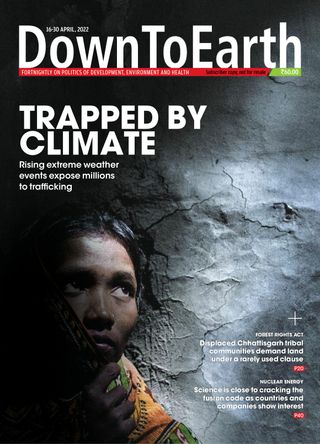

Denne historien er fra April 16, 2022-utgaven av Down To Earth.
Abonner på Magzter GOLD for å få tilgang til tusenvis av kuraterte premiumhistorier og over 9000 magasiner og aviser.
Allerede abonnent? Logg på
FLERE HISTORIER FRA Down To Earth

Down To Earth
THINK TWICE BEFORE FELLING SAL TREES
Many trees considered to be affected by sal borer in the 1990s are still alive today

1 mins
February 16, 2026

Down To Earth
EDGE OF SURVIVAL
Caste divides deny marginalised communities land, resources and essential aid, leaving them more vulnerable to climate disasters
6 mins
February 16, 2026

Down To Earth
A WISH LIST?
Union Budget for 2026-27 conveys the impression of a roll-call of intentions and ambitious proposals, with little detail on their formulation
6 mins
February 16, 2026
Down To Earth
Break down the gender wall
THE RULING National Democratic Alliance (NDA) government has been heavily invested in the goal to make India a developed economy by 2047.
2 mins
February 16, 2026

Down To Earth
MENSTRUAL HEALTH, NOW A FUNDAMENTAL RIGHT
In a landmark judgement, the Supreme Court has recognised menstrual health and hygiene as a fundamental right under Article 21 of the Constitution of India, which guarantees the right to life and dignity.
8 mins
February 16, 2026

Down To Earth
Of devolution and new disasters
The 16th Finance Commission pushes for changes in view of new fiscal and climatic conditions
11 mins
February 16, 2026
Down To Earth
Rising risks of plastics
NEGATIVE IMPACTS on human health due to emissions linked to the plastic lifecycle could double by 2040, according to a study published in The Lancet Planetary Health in January.
1 min
February 16, 2026

Down To Earth
GAP BETWEEN EPIDEMICS NARROWING
A watershed-based and landscape-level approach is needed to address forest degradation
2 mins
February 16, 2026
Down To Earth
WAITING TO STRIKE
Sal heartwood borer is considered the biggest threat to forestry in India, especially to the sal tree, where it lives and breeds.
11 mins
February 16, 2026
Down To Earth
A SPRING DELIGHT
Mustard flowers are not meant only for the eyes. Invite them to your plate once in a while
3 mins
February 16, 2026
Translate
Change font size